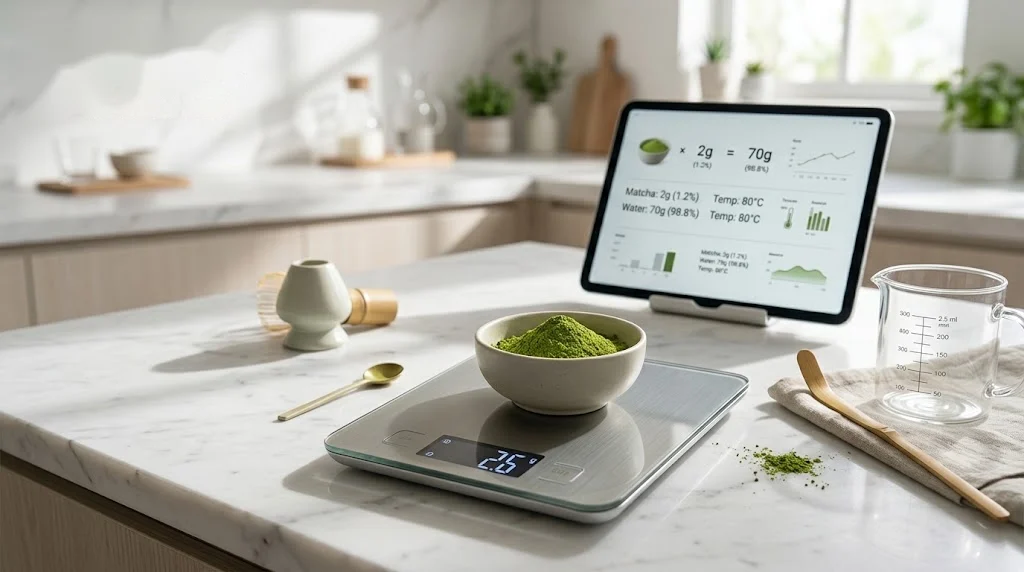
How much matcha per cup? Use 1–2 g of matcha (about ½–1 level teaspoon) per cup. For matcha tea, whisk it with 60–80 ml of water at 75–80 °C. For a matcha latte, whisk it into a paste with 30 ml of hot water, then add 150–200 ml of milk. Pick your drink, strength and number of cups below to get exact grams.

1. What are you making?
2. How strong?
Matcha you need
Sift the matcha first and never use boiling water. Step-by-step method
How much matcha per cup: quick guide
| Drink | Matcha | Water | Milk |
|---|---|---|---|
| Matcha tea, light | 1 g (½ tsp) | 60–80 ml at 75–80 °C | — |
| Matcha tea, standard | 1.5 g | 60–80 ml at 75–80 °C | — |
| Matcha tea, strong | 2 g (1 tsp) | 60–80 ml at 75–80 °C | — |
| Hot matcha latte | 1–2 g | 30 ml at 75–80 °C | 150–200 ml |
| Iced matcha latte | 1–2 g | 30 ml at 75–80 °C | 150–200 ml cold, plus ice |
A level teaspoon of matcha weighs about 2 g, so half a teaspoon is about 1 g. Matcha is light and fluffy, so a heaped spoon can hold much more: weigh it with a small kitchen scale the first time, then you will know how your spoon measures.
How to use the matcha calculator
- Choose your drink: matcha tea, hot matcha latte or iced matcha latte.
- Choose a strength. Standard (1.5 g) suits most people; start light if matcha is new to you.
- Enter the number of cups. The calculator scales the matcha, water and milk.
- Pick your pack size to see how many cups it will make.
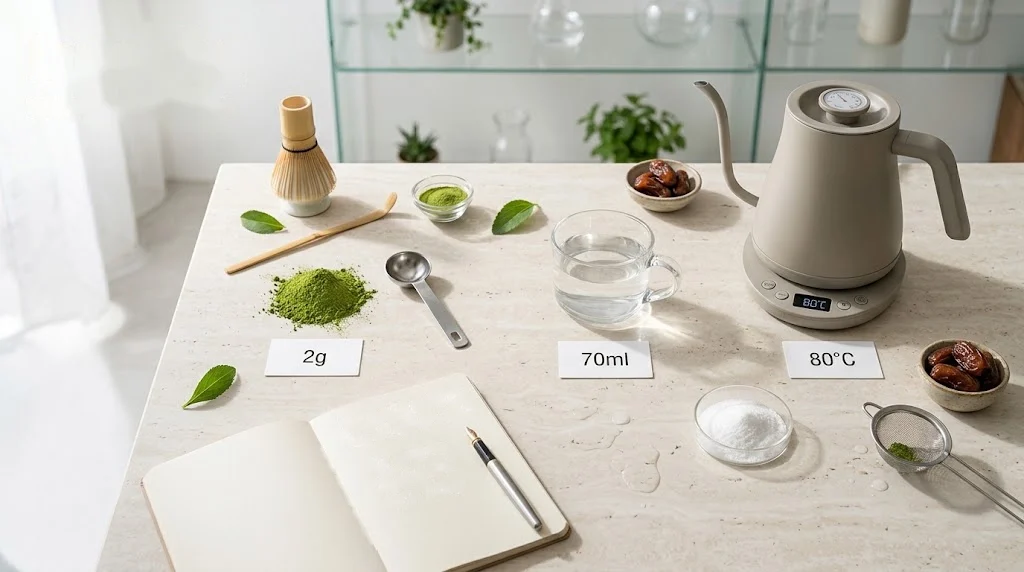
How much caffeine? A review of matcha studies reports about 19–44 mg of caffeine per gram of powder[1], so a 2 g serving has roughly 38–88 mg. For healthy adults, EFSA considers up to 400 mg of caffeine a day safe[2].
Tips for the right amount of matcha
- Sift first. Matcha clumps easily; sifting gives a smooth cup without lumps.
- Not too hot. Boiling water makes matcha bitter. Use 75–80 °C.
- Make a paste for lattes. Whisk the matcha with 30 ml of hot water before adding milk, so it mixes evenly.
- Adjust slowly. If your cup is too bitter, use less matcha or more milk rather than adding sugar.
- Store it well. Keep matcha sealed, cool and away from light. See how to store matcha.
New to matcha? Read the complete matcha guide, learn how to prepare matcha tea, or see 10 ways to use matcha powder. For the tools, see matcha tools. Lucarise pure matcha powder comes in 1 g sachets (one sachet is one light cup) and 50 g and 200 g tins. More free tools are on our calculators page.
Embed this calculator on your website
Run a blog, café website or gym page? You can add this free calculator to your own site. Copy the code below and paste it into an HTML block. It works on WordPress, Wix and most website builders that allow custom HTML and JavaScript. Please keep the credit link under the calculator.
New to matcha? Start with our complete matcha guide: what matcha is, its grades, and how to prepare it.
Serve matcha in your café?
Pure ceremonial matcha in 200 g tins and 5 kg bags, and unsweetened matcha latte mixes. See recipes, cups per pack and cost per cup, and ask for a sample for your baristas.
Frequently asked questions
How many grams of matcha per cup?
Use 1–2 g of matcha per cup: about 1 g for a light cup, 1.5 g for standard and 2 g for strong.
How much matcha is a teaspoon?
A level teaspoon of matcha weighs about 2 g. Half a level teaspoon is about 1 g.
How much matcha for a matcha latte?
Use 1–2 g of matcha whisked with 30 ml of hot water at 75–80 °C, then add 150–200 ml of milk.
How much water for matcha tea?
Use 60–80 ml of water at 75–80 °C for 1–2 g of matcha, and whisk until frothy.
How many cups are in 30 g of matcha?
About 30 light cups at 1 g, 20 standard cups at 1.5 g, or 15 strong cups at 2 g.
Why does my matcha taste bitter?
Usually the water is too hot, or there is too much matcha for the water or milk. Use 75–80 °C water and try 1 g first.
Sources
- Kochman J. et al. (2021). Health benefits and chemical composition of matcha green tea: a review. Molecules 26(1):85.
- EFSA Panel on Dietetic Products (2015). Scientific opinion on the safety of caffeine. doi:10.2903/j.efsa.2015.4102


