
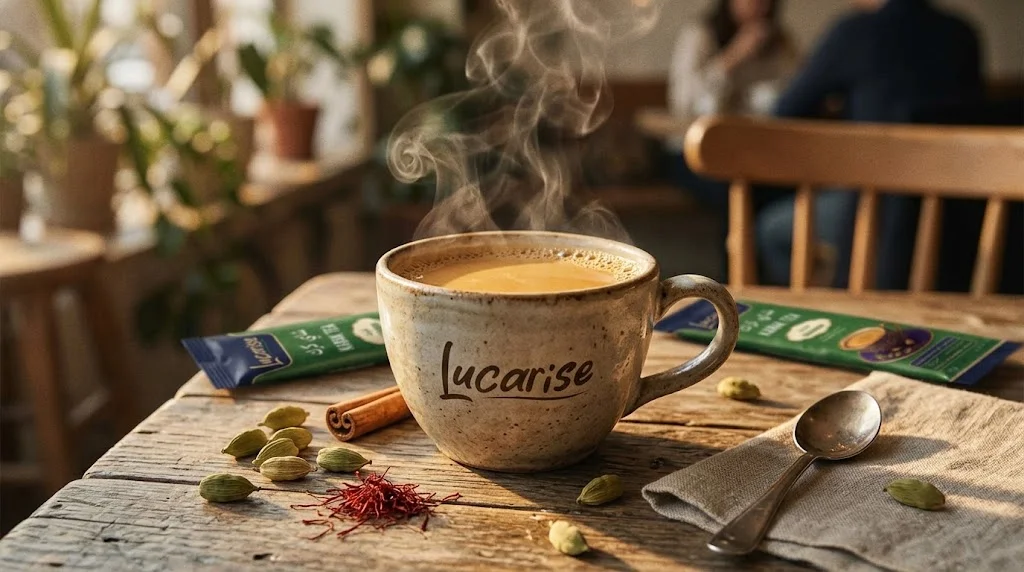
Quick answer: Karak tea (karak chai) is strong black tea boiled with milk, sugar and cardamom until it turns thick and creamy, sometimes with saffron or ginger. The name comes from the Hindi and Urdu word for “strong”. It came to the Gulf with families and workers from India and Pakistan and is now one of the most popular drinks in Saudi Arabia, the UAE, Qatar and Oman.
The Lucarise karak guide: everything about karak in short reads
Walk into any café, petrol station or roadside tea stall in Muscat, Dubai, Doha or Riyadh and you will see the same thing: small paper cups of hot, milky, spiced tea passed through car windows. That drink is karak tea (also called karak chai), and for millions of people across the Gulf it is not just a drink but a daily ritual.
In this guide you will learn what karak tea is, where it comes from, how it differs from masala chai, how to make it at home, how much sugar a typical cup contains, and how to enjoy the same rich, creamy flavour without added sugar.
Karak tea, from the Gulf to your cup
Its origin, a home recipe, and a no-added-sugar way to enjoy it.
What Is Karak Tea?
Karak tea, often written as karak chai, is a strong black tea simmered with milk, sugar and cardamom until it turns thick, creamy and deep golden-brown. The name comes from the Hindi and Urdu word kadak, which means “strong”. That is the whole idea: the tea is brewed longer and harder than a normal cup, so the flavour is bold enough to stand up to milk and spice.
A classic cup has four building blocks: strong black tea (usually Assam or a CTC blend), milk (often evaporated milk for extra creaminess), sugar, and crushed green cardamom. Many cafés add a pinch of saffron for colour and aroma (see our full guide to saffron karak tea), and some recipes include ginger or a little clove.
Karak Tea Meaning and Other Names
Karak comes from the Hindi and Urdu word kadak, which means strong. In the Gulf the drink is also called karak chai, chai karak and Gulf chai, and in everyday English it is often described as Arabic milk tea. Whatever the name, it means the same thing: strong black tea, milk and cardamom, simmered together until thick and creamy.
Karak Tea Origin: Where Does Karak Come From?
Karak is the Gulf’s own version of the spiced milk tea of South Asia. It travelled to the region with workers and families from India and Pakistan, and over the decades it became part of local life in Oman, the UAE, Qatar, Bahrain, Kuwait and Saudi Arabia. Gulf karak is usually simpler than Indian masala chai, with cardamom as the hero spice, and it is typically richer and sweeter, served in small cups throughout the day.
Karak vs Masala Chai vs Regular Milk Tea
| Feature | Karak tea | Masala chai | Regular milk tea |
|---|---|---|---|
| Tea strength | Very strong, simmered | Strong | Light to medium |
| Main spice | Cardamom (sometimes saffron) | Mix of cardamom, ginger, cinnamon, clove, pepper | Usually none |
| Milk | Rich, often evaporated milk | Fresh milk | A splash of milk |
| Sweetness | Usually very sweet | Sweet | To taste |
| Where it is popular | Gulf countries | India and Pakistan | Worldwide |
Karak Tea Ingredients
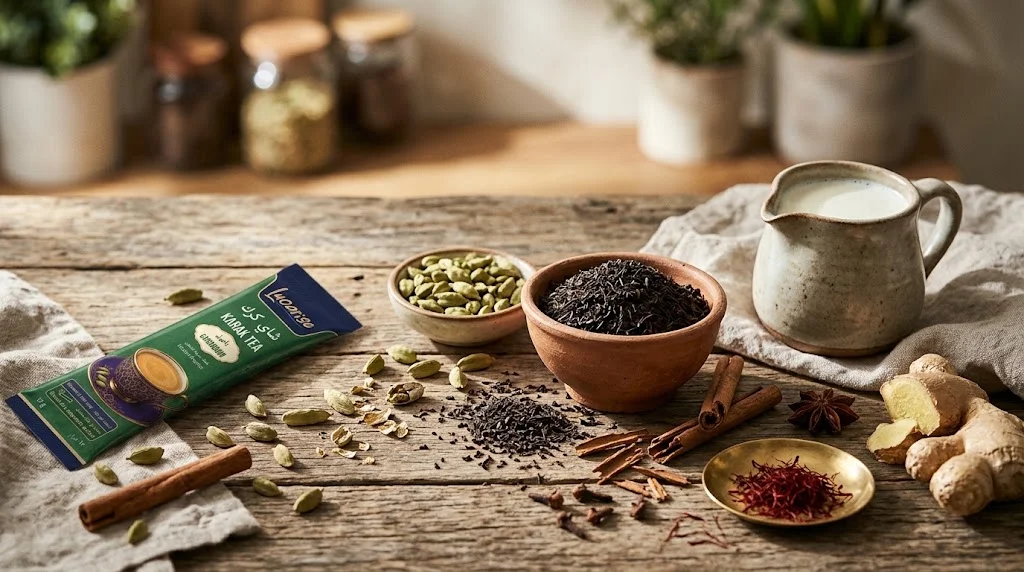
Karak needs only a handful of ingredients, most of which you can find in any supermarket:
- Strong black tea: loose Assam or CTC tea, or tea bags.
- Milk: evaporated milk is the classic choice for creaminess; full-fat milk also works.
- Green cardamom pods: lightly crushed, the signature spice of karak.
- Sugar or a sweetener: traditional karak is sweet; for a no-added-sugar cup, a zero-calorie sweetener such as stevia Reb-M works well (see our stevia sugar guide).
- Optional extras: saffron, ginger or a little clove.
What Does Karak Tea Taste Like?
Karak tastes bold, creamy and warm. The long simmer gives the tea a deep, malty strength, the evaporated milk makes it thick and rich, and the cardamom adds a fragrant, gently citrusy spice. Traditional café karak is also quite sweet, which is why many people now choose a no-added-sugar version.
How to Make Traditional Karak Tea at Home
This classic stovetop method makes two small cups. For amounts for 4 or 8 cups and more tips, see our full karak tea recipe with cardamom.
- Bring 250 ml of water to the boil in a small pan.
- Add 2 teaspoons of strong black tea leaves (or 2 tea bags) and 3–4 lightly crushed cardamom pods. Simmer for 3–4 minutes until the colour is very dark.
- Add a few saffron threads if you like.
- Pour in 150 ml of evaporated milk (or full-fat milk) and sweeten to taste.
- Bring it back to a gentle boil, then lower the heat and let it bubble for 2–3 minutes. Pouring it back and forth between the pan and a cup helps it become frothy and creamy.
- Strain into cups and serve hot.
How Much Sugar Is in a Cup of Karak?
This is the part most people do not think about. Café karak is traditionally made very sweet. A small cup often contains around 2–4 teaspoons of sugar (roughly 8–16 g), and recipes that use sweetened condensed milk can contain even more. If you drink two or three cups a day, the sugar adds up quickly.
For reference, the World Health Organization recommends keeping free sugars below 10% of daily energy, and ideally below 5%, which is about 25 g (6 teaspoons) a day for an adult. Two sweet cups of karak can use up most of that allowance before you have eaten anything else.
How Many Calories Are in Karak Tea?
Almost all the calories in karak tea come from the milk and the sugar. The tea and cardamom add only a calorie or two. The table below is an estimate for one small café cup (about 150 ml), calculated from standard USDA nutrient values: evaporated milk about 134 kcal per 100 g, sweetened condensed milk about 321 kcal per 100 g and sugar about 16 kcal per teaspoon.
| Cup of karak (about 150 ml) | What goes in | Approx. calories |
|---|---|---|
| Classic café karak | Strong tea, about 50 ml evaporated milk, 2–4 tsp sugar | 100–135 kcal |
| Condensed-milk karak | Strong tea, about 2 tbsp (40 g) sweetened condensed milk | About 130 kcal |
| Karak with no added sugar | Strong tea, about 50 ml evaporated milk, a zero-calorie sweetener such as stevia Reb-M | About 70 kcal |
So two sweet cups a day can add roughly 200–270 kcal. Cutting the sugar is the simplest way to lower the calories without losing the creamy, cardamom taste. Real numbers vary with cup size and with how much milk and sugar each café uses; for a ready-made mix, check the nutrition label on the pack.
Can You Enjoy Karak Without Sugar?
Yes. The flavour of karak comes from strong tea, creamy milk and cardamom, not from sugar alone. You can simply reduce the sugar step by step, or replace it with a zero-calorie sweetener. Stevia Reb-M is a good option: it is the cleanest-tasting part of the stevia leaf, gives a sugar-like sweetness with very little bitter aftertaste, and adds no calories. For a plain-language overview, see our stevia sugar guide.
If you want karak without measuring, boiling or adding sweetener yourself, instant no-added-sugar karak is the easiest route.
Popular Karak Flavours
- Cardamom karak: the classic. Warm, fragrant and comforting.
- Saffron karak: a more luxurious cup with a golden colour and a delicate floral aroma.
- Pistachio karak: a modern café favourite with a rich, nutty finish.
- Ginger karak: a spicier version that many people enjoy in winter.
Lucarise No-Added-Sugar Karak Tea
At Lucarise we make instant karak tea in our own facility in the Sohar Free Zone, Oman. Every blend is made with tea, milk, creamer and cardamom, and is sweetened only with Stevia Reb-M, so there is no added sugar. Each single-serve sachet makes one cup in seconds with hot water or hot milk.
- Cardamom Karak Tea: the classic cardamom karak, creamy and aromatic.
- Saffron Karak Tea with Topping: made with pure Sargol saffron and cardamom, with a separate saffron topping sachet.
- Pistachio Karak Tea with Topping: cardamom karak with a separate pistachio topping sachet for a rich, nutty finish.
How to prepare: empty one sachet into a cup, add about 150 ml of hot water or hot milk, and stir well. For the topping editions, sprinkle the topping on top just before drinking. For an iced karak, dissolve the sachet in a little hot water, then pour over ice and top up with cold milk.

Karak in seconds, no stove needed
Lucarise instant karak comes in single sachets: add hot water or hot milk and stir. Sweetened with Stevia Reb-M, no added sugar.
Where to Buy Karak Tea in Oman and the GCC
Karak is the everyday tea of the Gulf, from Muscat and Sohar to Dubai, Doha, Riyadh, Kuwait City and Manama. Lucarise instant karak tea is made in the Sohar Free Zone, Oman, and we deliver within Oman and to the UAE, Saudi Arabia, Qatar, Kuwait and Bahrain. You can order the full Lucarise karak tea range online, starting with the classic Cardamom Karak Tea.
For cafés, hotels, offices and distributors, wholesale prices and bulk packs are available through Lucarise for Business. Want to know what sweetens our karak? Read what stevia Reb-M is.
How do café drinks compare? See our data on how much sugar is in karak, Spanish latte and 8 other popular café drinks.
Keep reading
Frequently Asked Questions About Karak Tea
What is the karak drink made of?
A classic karak is made from strong black tea, milk, sugar and cardamom, simmered together until thick and creamy. Saffron or ginger are popular variations. Lucarise instant karak keeps the strong tea and cardamom, and is sweetened with Stevia Reb-M instead of sugar.
How many calories are in karak tea?
A small café cup of sweet karak (about 150 ml) usually has around 100–135 calories, mostly from evaporated milk and 2–4 teaspoons of sugar. Made with no added sugar, the same cup is closer to 70 calories.
Where does karak tea come from?
Karak is the Gulf’s own version of the spiced milk tea of South Asia. It travelled to the region with workers and families from India and Pakistan, and over the decades it became part of everyday life in Oman, the UAE, Qatar, Bahrain, Kuwait and Saudi Arabia.
Is there a sugar-free karak tea?
Karak is usually made with sugar, but you can make it without adding any. Milk still contains its own natural milk sugar (lactose), so karak made with milk is never completely sugar-free. That is why we describe Lucarise instant karak as “no added sugar”: it is sweetened with Stevia Reb-M instead of sugar. See our karak tea range.
How much caffeine is in karak tea?
Karak is made with black tea, so a typical cup contains roughly 40–80 mg of caffeine, depending on how strong it is brewed. That is usually less than a cup of brewed coffee, which has around 95 mg. For the full breakdown, see does karak tea have caffeine.
Is karak tea the same as chai?
They are close relatives. Karak is the Gulf style of spiced milk tea: stronger, richer and focused on cardamom. Masala chai from India usually uses a wider mix of spices.
Is no-added-sugar karak suitable for people with diabetes?
Karak sweetened with Stevia Reb-M contains no added sugar, which makes it a better fit for a sugar-controlled diet than traditional café karak. Milk still contains natural carbohydrates, so check the nutrition label and follow your doctor’s or dietitian’s advice.
Can I drink karak at night?
Because it contains caffeine, karak may affect sleep if you drink it late in the evening. If you are sensitive to caffeine, enjoy it in the morning or afternoon.
Can I make iced karak?
Yes. Prepare karak as usual but slightly stronger, let it cool, then pour it over ice. With instant karak, dissolve one sachet in a little hot water and top up with cold milk over ice. Here is our full iced karak recipe.
What does karak mean?
Karak comes from the Hindi and Urdu word kadak, which means strong. It describes tea that is brewed long and hard so that the flavour stands up to milk and spice.
What does karak tea taste like?
Karak tastes bold, creamy and warm: deep malty tea, rich evaporated milk and fragrant cardamom. Traditional café karak is also quite sweet.
What are the ingredients of karak tea?
Strong black tea, milk (often evaporated milk), sugar and crushed green cardamom. Saffron, ginger and clove are popular extras. Lucarise instant karak is made with tea, milk, creamer and cardamom, and is sweetened with Stevia Reb-M.
Is karak tea the same as Arabic milk tea?
In everyday English, the Gulf’s karak is often described as Arabic milk tea or Gulf chai: strong black tea simmered with milk and cardamom until thick and creamy.
The Bottom Line
Karak tea is the Gulf’s favourite daily drink: strong black tea, creamy milk and fragrant cardamom, often finished with saffron. Its only real downside is the amount of sugar in most café versions. Choosing a no-added-sugar karak sweetened with Stevia Reb-M lets you keep the ritual and the flavour while cutting out the added sugar.
Written by the Lucarise team in the Sohar Free Zone, Oman. Last updated: October 3, 2026.
Try Lucarise before you buy
Free samples are available for cafés, hotels, offices and distributors in Oman and the GCC.


