

Quick answer: Real stevia sweetener gets its sweetness from steviol glycosides (E 960), such as Reb A or Reb M. Read the ingredients: if most of the product is sugar, dextrose or maltodextrin, or its sweetness comes from sucralose or aspartame, it is not genuine stevia, even if the box says stevia.
Many shoppers want to know how to spot real stevia, because shelves are full of products called stevia that differ widely in ingredients, taste and price. So this guide shows you how to read the label and know exactly what you are buying.
How to spot real stevia
Simple steps to read the label and tell genuine stevia from blends.
What Is Real Stevia Sweetener?
The sweetness in the stevia plant comes from compounds called steviol glycosides. What regulators approve as a food sweetener is the purified extract, at 95% purity or more, not ground leaves or crude extract.[1][2] Because this extract is hundreds of times sweeter than sugar, it is usually blended with a bulking ingredient such as erythritol, so you can use it by the spoon or sachet.
Read the Label: What Each Ingredient Means
| Ingredient on the label | What it means |
|---|---|
| Steviol glycosides / E 960 / Reb A / Reb M | This is real stevia, the source of the sweetness |
| Erythritol (E 968) | A bulking agent with almost no calories; large amounts can upset the stomach[3] |
| Dextrose / maltodextrin / sugar | Carbohydrates that add calories and, as a result, can raise blood sugar |
| Sucralose / aspartame / acesulfame | Other sweeteners, not stevia |
| Inulin | A dietary fibre used as a filler |
5 Signs of Real Stevia
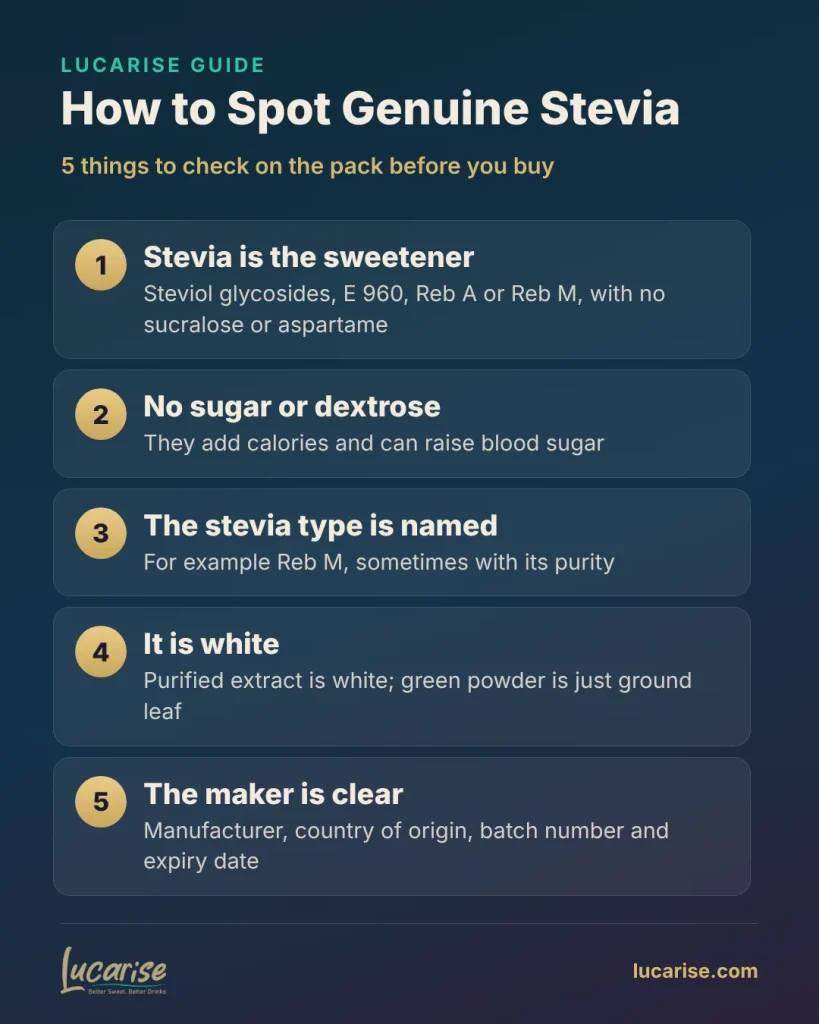
- The sweet ingredient is stevia: look for steviol glycosides, Reb A or Reb M, and check there is no other sweetener such as sucralose.
- No sugar or dextrose: if your goal is to avoid raising blood sugar, these defeat the purpose.[4]
- The type of stevia is named: good products state the type, such as Reb M, and sometimes the purity.
- It is white: purified extract is white, whereas green powder is ground leaf, not the sweetener approved as a food additive.[1]
- The maker is clear: finally, the manufacturer, country of origin, batch number and expiry date are on the pack.
Stevia Powder, Drops or Tablets: Which Should You Choose?
Pure stevia extract is roughly 200 to 300 times sweeter than sugar, so it is almost never sold on its own. It is mixed with something that makes it easy to measure. The form you choose decides what is added, so read the ingredients either way.
| Form | What it usually contains | Best for | Watch out for |
|---|---|---|---|
| Powder sachets | Stevia extract with a bulking agent such as erythritol or inulin | Coffee and tea, especially on the go | Dextrose or sugar as the bulking agent |
| Liquid drops | Stevia extract dissolved in water or glycerin | Hot and cold drinks | Very strong; start with one or two drops |
| Small tablets | Stevia extract with binders | Carrying in a pocket or travelling | Some contain other ingredients, so check the label |
| Green powder | Ground stevia leaves | Not ideal as a daily sweetener | Grassy taste, and not the extract approved as a food additive |
Is Genuine Stevia Safe?
Purified steviol glycosides (E 960) are approved food additives in the GCC under the Gulf standard GSO 2500, and they have been assessed by JECFA and the European Food Safety Authority (EFSA). EFSA set an acceptable daily intake of 4 mg per kg of body weight (as steviol equivalents), which is hard to reach from sweetening everyday drinks. Green powder and raw stevia leaves are not the same substance covered by that assessment. For possible side effects and who should take care, read stevia side effects.
Is Organic Stevia Better?
Organic refers to how the plant is grown, not to the purity or taste of the extract. In other words, organic stevia can be good, and non-organic stevia can also be very well purified. In the end, what matters most is the type of steviol glycoside and the other ingredients.
Why Do Taste and Price Vary?
For example, the older, cheaper Reb A can leave a bitter aftertaste. In contrast, the newer Reb M tastes closer to sugar, but it costs more because the leaf contains very little of it. So a price difference between two products may come from the type of stevia, not from one of them being fake. Read more in what is stevia Reb-M.
What Does Lucarise Use?
At Lucarise, we use stevia Reb-M at 95% purity or higher. In addition, our tabletop sachets (Classic and Cardamom) combine Reb-M with erythritol, with no sugar or dextrose, at 1 g per sachet, and this is clearly stated on the pack.
Sweetness without sugar in your cup
Classic and Cardamom stevia Reb-M sachets, 50 sachets per box.
Quick questions
How do I know if stevia is real?
Read the ingredients: the sweetness should come from steviol glycosides (E 960) such as Reb A or Reb M, with no sugar, dextrose or other sweeteners.
Is green stevia better?
No. Green powder is ground leaf, not the purified extract approved as a food additive, and it also tastes more bitter.
Why does stevia sweetener contain erythritol?
The extract is so sweet that it is blended with erythritol to give it bulk, so it is easy to use, while adding almost no calories.
Is organic stevia better?
Organic refers to farming; quality and taste depend on the type of stevia, its purity and the other ingredients.
Why does some stevia taste bitter?
Bitterness usually depends on the type and amount. Common Reb A can leave a bitter aftertaste at higher doses, while Reb M tastes cleaner and closer to sugar.
Is liquid stevia more genuine than powder?
Not necessarily. Both can be real stevia; what matters is that steviol glycosides are the only sweetener and that you know what else is added.
Is there stevia with no additives at all?
Pure extract is extremely sweet, so it is usually sold mixed with a bulking agent or dissolved as drops. Drops are the closest to extract alone.
References
- Center for Science in the Public Interest. Stevia / steviol glycosides: Chemical Cuisine rating (updated 2026). cspi.org
- EFSA Panel on Food Additives (2010). Scientific Opinion on the safety of steviol glycosides for the proposed uses as a food additive. EFSA Journal 8(4):1537. doi.org
- EFSA Panel on Food Additives and Flavourings (2023). Re-evaluation of erythritol (E 968) as a food additive. EFSA Journal 21(12):8430. www.efsa.europa.eu
- Anton SD, Martin CK, Han H, et al. (2010). Effects of stevia, aspartame, and sucrose on food intake, satiety, and postprandial glucose and insulin levels. Appetite 55(1):37–43. pmc.ncbi.nlm.nih.gov
Swapping sugar for stevia in a recipe or drink? Use our stevia to sugar conversion calculator to work out how much you need.


