
Exclusive Distributor or Agent? Partnering With a Beverage Manufacturer in the GCC
Quick answer: An exclusive distributor buys a brand’s products and resells them, and is the only one allowed to do so in an agreed territory. A commercial agent usually sells on the brand’s behalf, often for a commission, and in the GCC agency relationships are regulated and registered with the government. For instant drinks, most partnerships start as a distribution agreement, with exclusivity agreed once the distributor shows it can build the market.
If you run a food distribution company in Saudi Arabia, the UAE, Qatar, Kuwait, Bahrain, Oman or further afield, adding a new beverage brand is a big decision. You need to know what kind of agreement you are signing, what the law in your country requires, and whether the manufacturer can supply you reliably. This guide explains the difference between an exclusive agent and a distributor, the basics of commercial agency rules in the GCC, and the questions to ask before you sign. It is general information, not legal advice.
Exclusive distributor or agent?
How partnerships with a beverage manufacturer work in the GCC, and what to check before you sign.
Exclusive Distributor vs Commercial Agent: What Is the Difference?
| Distributor | Commercial agent | |
|---|---|---|
| Who owns the stock | The distributor buys and owns the goods | Usually the brand, until the customer buys |
| How they earn | Margin between buying and selling price | Commission on sales, or a margin, depending on the agreement |
| Exclusivity | Exclusive or non-exclusive, as agreed | Often exclusive for a territory |
| Registration | Depends on local law and the agreement | In the UAE and Saudi Arabia, agencies are registered with the government |
In practice, the words are used loosely in the Gulf, and a “distributor” can also be treated as a commercial agent under local law. What matters is what the contract says and whether it is registered.
Commercial Agency Rules in the GCC, in Brief
United Arab Emirates
Federal Law No. 3 of 2022 on commercial agencies came into force on 16 June 2023[1]. In general, a commercial agent must be a UAE national or a company wholly owned by UAE nationals, with limited exceptions approved by the Cabinet. The agency agreement must be in writing, notarised and registered with the Ministry of Economy, and the law’s protections apply to registered agencies[2].
Saudi Arabia
Under the Saudi Law of Commercial Agencies, registration of commercial agencies is limited to Saudis, and agencies are recorded in a special register kept by the ministry[3]. The Ministry of Commerce has been working on a new commercial agencies law, so check the current rules before you sign[4].
Other GCC countries and beyond
Kuwait, Qatar, Bahrain and Oman each have their own agency rules, and so do markets outside the Gulf. A short consultation with a local commercial lawyer before signing is always worth it.
What Distributors Should Check Before Choosing a Supplier
- Food registration: in Saudi Arabia, the importer needs a commercial register that includes food trade and an SFDA account, foreign producers must be registered with SFDA, and shipments need documents such as a certified invoice, certificate of origin and an original halal certificate[5]. Ask the manufacturer which documents they can provide.
- Labels: Arabic and English labels that meet the technical regulations of your market. Read our guide to SFDA food labelling.
- Shelf life and storage: how long the products last, and how they should be stored in your warehouse and in shops.
- Reliable supply: production capacity, lead times and how stock is kept consistent from batch to batch.
- Samples: test the products with your customers before you commit.
- Order size and cartons: minimum order quantities, carton sizes and pallet configuration.
- Marketing support: product photos, descriptions in Arabic and English, and support for listings in supermarkets, pharmacies and online.
Key Terms in a Distribution or Agency Agreement
- Territory: which country or cities the agreement covers.
- Exclusivity: whether you are the only distributor in that territory, and for which products.
- Duration and renewal: how long the agreement lasts and how it is renewed.
- Targets: any minimum purchase or sales targets linked to exclusivity.
- Prices and payment: price list, currency, payment terms and who pays for shipping and duties.
- Registration: who handles product and agency registration in your country.
- Termination: how either side can end the agreement and what happens to remaining stock.
Why the No-Added-Sugar Category
Familiar Gulf drinks such as karak and matcha latte, made with no added sugar, are easy for shops to stock and easy to explain to customers. Pharmacies, health stores and online shops are natural channels for them, alongside supermarkets. Stevia sweeteners complete the shelf and add one more item to the basket.
How to Start a Partnership With Lucarise
- Fill in the distributor application form with your country, channels and the products you are interested in.
- We review your request and approve your business account.
- Request free samples and test them with your customers.
- Agree order sizes, cartons and delivery. We deliver across Oman and the GCC and can arrange export to other countries.
- If you are interested in exclusive distribution for your market, tell us about your sales channels and plans so we can discuss the options.
Want to sell under your own brand instead? Read about private label instant drinks.
Distribute Lucarise in your market
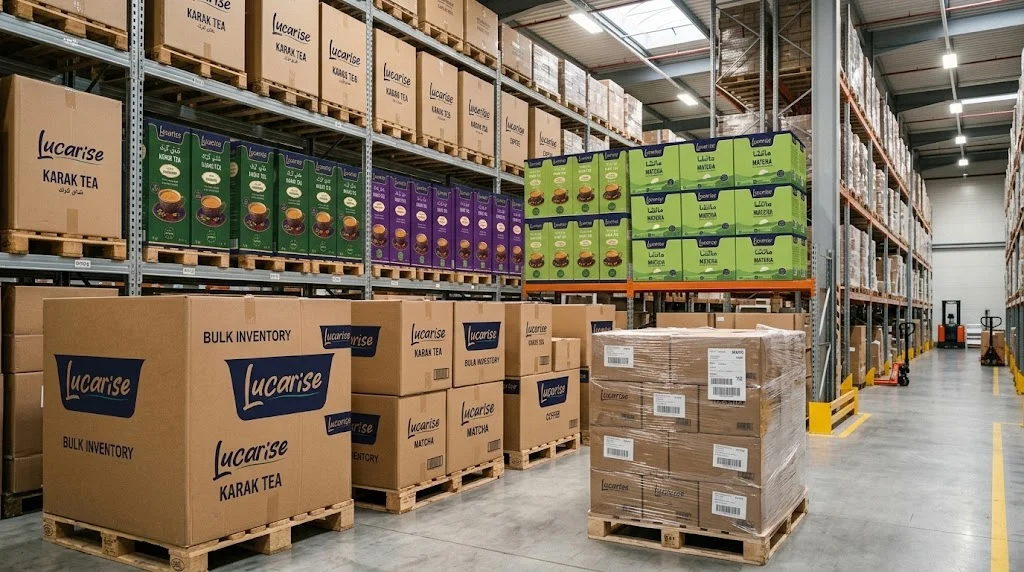
Lucarise makes karak, matcha lattes, cappuccino, coffee and stevia sweeteners at its own facility in Sohar Free Zone, Oman, in retail boxes with bilingual English and Arabic packaging. We deliver across Oman and the GCC and can arrange export to other countries. Tell us about your market and request free samples.
Distributor Partnerships: Quick Questions
What is the difference between an agent and a distributor?
A distributor buys the products and resells them for a margin. A commercial agent usually sells on behalf of the brand, often for a commission. In the GCC, the terms overlap and local law decides how a relationship is treated.
Does an exclusive agency need to be registered?
In the UAE and Saudi Arabia, commercial agencies are registered with the government, and in the UAE the law’s protections apply to registered agencies. Check the current rules in your country with a local lawyer.
Do you work with distributors outside the GCC?
Yes. We deliver across Oman and the GCC and can arrange export to other countries. Tell us about your market in the application form.
Can distributors get samples first?
Yes. We offer free samples to business customers.
Is the packaging in Arabic and English?
Yes. Lucarise retail packaging is bilingual, in English and Arabic.
Sources
- UAE Federal Law No. 3 of 2022 Regulating Commercial Agencies (official text). uaelegislation.gov.ae
- HAS Law Firm via Mondaq. Key features of the new UAE commercial agencies law. www.mondaq.com
- Ministry of Investment, Saudi Arabia. Law of Commercial Agencies. misa.gov.sa
- Bremer Law Firm. Overview of pending amendments to the Saudi commercial agency and distributor regime. www.bremerlf.com
- Saudi Food and Drug Authority. Conditions and Requirements for Food Clearance. sfda.gov.sa
Keep reading
- What we will read in this article
- Submit Comment


