
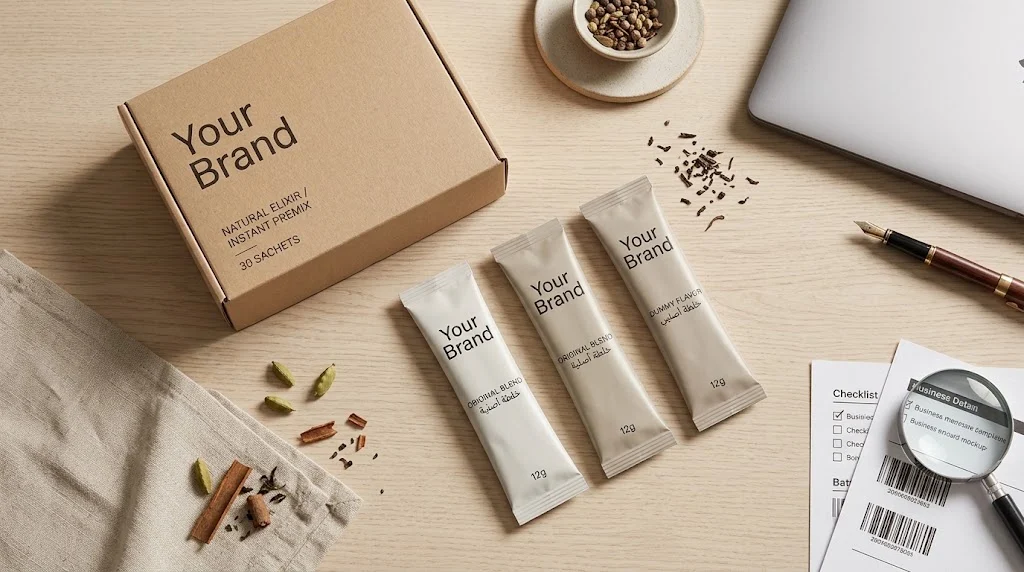
Quick answer: Private label instant coffee, tea and latte drinks are sachets made by a manufacturer and sold under your brand. In short, a typical project has seven steps: define your market, choose the drink and formula, test samples, choose the pack format, check the rules of the country you will sell in, produce with quality checks, then ship. The more you decide before you contact a manufacturer, the faster it goes.
Today, cafés, distributors, hotel groups and new brands across the GCC want their own karak tea, cappuccino or matcha latte in sachets, without building a factory. That is what private label (also called white label) manufacturing is for. This guide explains how a private label instant drink project works from first idea to delivered cartons, what you need to prepare, and which questions to ask any manufacturer before you sign.
Your brand on the sachet. Our line behind it.
Lucarise makes instant drink sachets in Sohar Free Zone, Oman, for brands and distributors in the GCC.
What Is Private Label Instant Coffee and Tea?
With private label, the manufacturer develops and produces the drink, and you sell it under your own name and packaging. As a result, you own the brand and the customer relationship, while the manufacturer owns the recipe work, the production line and the day-to-day quality control.
This is also different from simply reselling a branded product: the box, the sachet design and often the flavour are yours. In addition, it is different from building your own plant, which needs mixers, filling machines, packing lines, a licensed facility and trained staff before you sell a single box.
| Private label | Own factory | Reselling a brand | |
|---|---|---|---|
| Your brand on pack | Yes | Yes | No |
| Upfront investment | Low (stock and artwork) | High (building, machines, licences) | Low |
| Control over recipe | Shared with the manufacturer | Full | None |
| Time to market | Weeks to a few months | Often a year or more | Fast |
Which Instant Drinks Work Well as Private Label?
In general, drinks that people already buy in sachets and drink every day are the easiest to sell under a new brand. For example, in the Gulf the strongest categories are:
- Karak tea: black tea, milk and cardamom, often with saffron. See what karak tea is.
- Cappuccino and coffee lattes: foamy, creamy instant coffee drinks. See what is cappuccino.
- Coffee mix: coffee and creamer in one sachet. See 2 in 1 vs 3 in 1 coffee.
- Matcha latte: a growing category with younger buyers. See what is matcha.
- Caffeine-free drinks, such as a date seed latte. See date seed coffee.
Sweetness is also a key decision, because many buyers in Saudi Arabia and the wider GCC look for drinks with no added sugar. For instance, one option is to sweeten with stevia Reb-M instead of sugar; another is to leave the mix unsweetened and attach a separate sweetener sachet so the drinker chooses. Read more in what is stevia Reb-M.
Private Label Step by Step
1. Define your market and buyer
First, decide who will buy and where: supermarket shelves in Riyadh, office pantries in Muscat, hotel rooms in Dubai, or your own café chain. This choice then decides the pack size, price point, language on the label and which country rules apply.
2. Choose the drink and formula
Pick the base drink (for example saffron karak or classic cappuccino), the sweetness (sugar, stevia Reb-M or unsweetened) and any extras, such as a separate topping sachet with freeze-dried fruit or pistachio. Next, you can start from a manufacturer’s existing recipe, which is faster, or ask for a custom flavour, which takes more rounds of testing.
3. Test samples
Before you approve anything, ask for samples and prepare them exactly as your customers will: same water temperature, same cup size, same milk or no milk. Also, taste with people from your target market, not only your own team. Note what to change (sweeter, stronger, more cardamom) and request a second round if needed.
4. Choose the pack format and artwork
After the taste is approved, decide the sachet type, the weight per sachet, the number of sachets per box and the boxes per carton. In practice, stick sachets are the most common format for instant drinks. Our guide to stick pack sachets explains the options. Finally, brief your designer with the exact sachet and box dimensions from the manufacturer.
5. Check the rules for your target country
Every GCC country requires an Arabic label; however, each has its own registration process. If you plan to sell in Saudi Arabia, read selling food in Saudi Arabia: SFDA labelling basics and the official Saudi Food and Drug Authority website before your artwork is final, so you do not have to reprint packaging.
6. Production and quality checks
Once artwork and formula are approved, the order then goes into production: mixing, filling, sealing, packing, coding and final checks. Our article on how instant drink powders are made walks through each stage.
7. Delivery
Finally, agree on the delivery terms, pallet and carton labelling, and the documents your importer needs. Plan your first order around realistic sales, so that stock stays fresh on the shelf.
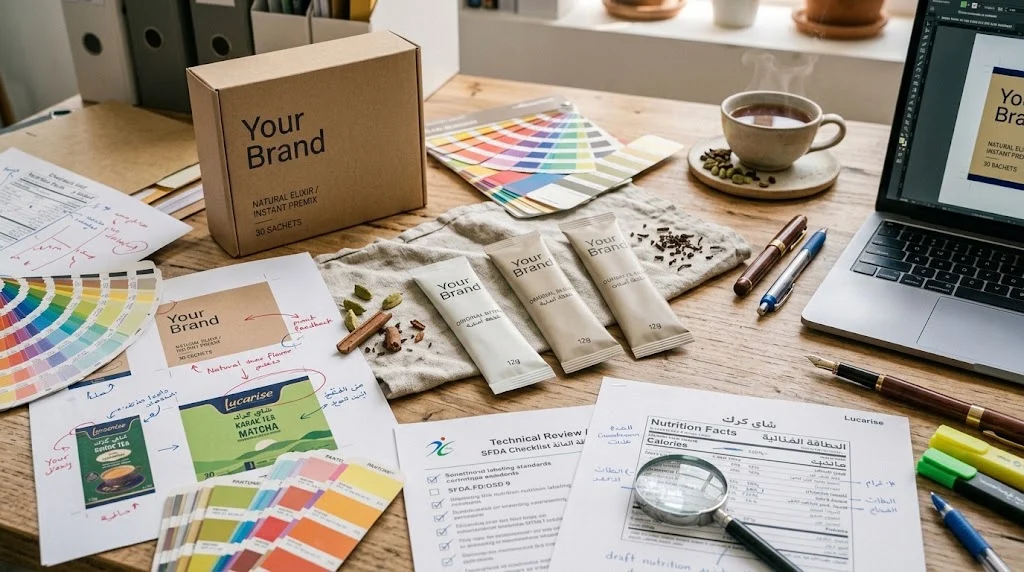
What to Prepare Before You Contact a Private Label Instant Coffee Manufacturer
- The drinks you want and a rough target taste (or a product you like as a reference).
- Your target country and sales channel (retail, HoReCa, offices, online).
- Sweetness preference: sugar, stevia or unsweetened.
- An estimate of the quantity for your first order and per year.
- Your brand name, logo and whether you already have a designer.
- Who will be the importer and register the product in each country.
Questions to Ask Any Private Label Manufacturer
- What is the minimum order quantity per flavour and per pack design?
- How long do samples, artwork approval and production take?
- Which food safety and halal certificates does the facility hold?
- What shelf life do you guarantee, and how should we store the product?
- Can you support the label and documents needed for my target country?
- Who owns the recipe if you develop it specially for my brand?
- Which checks do you run on every batch (weight, sealing, metal detection, coding)?
In our experience, good manufacturers answer these clearly and in writing. If the answers are vague, ask again before you commit. The same questions apply whether you need private label instant coffee, karak or matcha latte.
Start your own drink brand
Tell us what you want to make, and then we can share samples and the details for your project.
Quick questions
What is the difference between private label and white label?
In practice, people often use the terms for the same thing: a product made by a manufacturer and sold under your brand. Some people use white label for a standard product with only your logo, and private label when the recipe or pack is customised for you.
Can I choose my own flavour?
Usually yes. Starting from an existing recipe is faster; however, a custom flavour needs extra sample rounds before production.
Can private label drinks be made without sugar?
Yes. Drinks can be sweetened with stevia Reb-M instead of sugar, or left unsweetened with a separate sweetener sachet.
Who registers the product in Saudi Arabia?
In Saudi Arabia, the importer registers the food product with the SFDA before import. Still, check the current rules with the SFDA or your importer.
Where does Lucarise make its drinks?
All Lucarise drinks are produced at our own facility in Sohar Free Zone, Oman.


