
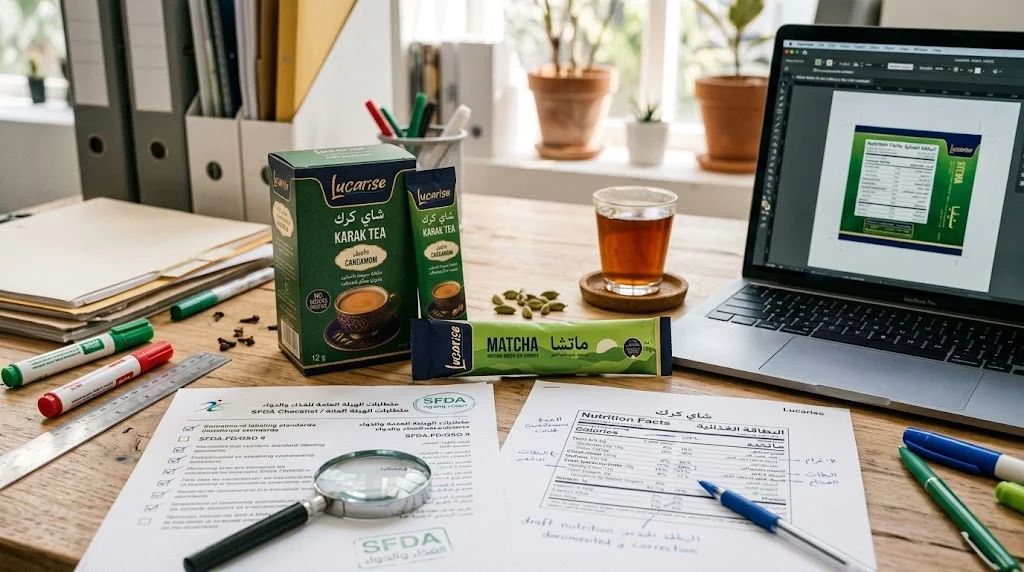
Selling Instant Drinks in Saudi Arabia: SFDA Labelling Basics
Quick answer: To sell packaged instant drinks in Saudi Arabia, the product must be registered with the Saudi Food and Drug Authority (SFDA) before import, usually by the importer, and the label must be in Arabic and follow the SFDA/GSO standards. Key standards cover general labelling (SFDA.FD/GSO 9), expiry dates (SFDA.FD/GSO 150-1), nutrition labelling (SFDA.FD 2233) and additives such as sweeteners. Rules change, so always confirm the current requirements with the SFDA before you print packaging.
Saudi Arabia is the largest food market in the GCC, and many new coffee, tea and latte brands plan to sell there first. Getting the label right early saves reprinting costs and delays at the border. This guide summarises the main SFDA labelling and registration rules that apply to packaged instant drinks such as karak tea, cappuccino and matcha latte sachets, based on public guidance. It is a starting point, not legal advice.
Get the label right before you print
Arabic labelling, registration, expiry dates and nutrition panels: what instant drink brands should check first.
Who Regulates Food in Saudi Arabia?
The Saudi Food and Drug Authority (SFDA) is the main body that sets and enforces food safety and labelling rules for both local and imported products. Other bodies, such as the Saudi Standards, Metrology and Quality Organization (SASO), also play a role in standards.[1] Many SFDA food standards are adopted from Gulf (GSO) standards, which is why their names often include both, such as SFDA.FD/GSO 9.
Step 1: Product Registration
Every food product must be registered with the SFDA before it is imported, and the importer is responsible for this.[1][2] Importers need an SFDA account and a commercial registration that covers food trade, and the product registration number is checked when shipment documents are reviewed.[2] According to one regulatory summary, general food products are processed in about 5 working days, while special categories, such as energy drinks or foods for special dietary use, take longer.[1]
Depending on the product type and the exporting country, the foreign manufacturer may also need to be registered with the SFDA as a foreign establishment. Check this with your importer early.[1][2]
Step 2: Arabic Labelling (SFDA.FD/GSO 9)
The label must be in Arabic. Other languages can be added, but the information must match the Arabic text.[1][2] Labels must not be false or misleading, and must stay attached and readable during normal handling.[4]
The main mandatory items on a pre-packaged food label include:[1][3]
- Product name
- List of ingredients in descending order of weight
- Nutrition information
- Net content
- Name and address of the manufacturer or packer, and of the importer
- Country of origin
- Production and expiry dates
- Storage conditions and instructions for use
- Batch number
- Allergen information, for example milk in creamy drinks
For instant drinks, two items often need extra care: the preparation instructions (how much water, hot or cold) and the allergens, because many lattes and cappuccinos contain milk powder.
Step 3: Expiry Dates (SFDA.FD/GSO 150-1)
Expiry dating follows SFDA.FD/GSO 150-1, and the dates and storage conditions must appear on the label.[1][2] Dates must not be covered, changed or added later with a sticker.[4] Products must also have enough shelf life left when they arrive, so plan production and shipping times together.[2]
Step 4: Nutrition Labelling and Claims
Nutrition labelling is mandatory for pre-packaged food and follows SFDA.FD 2233.[1][2] If you use claims such as “no added sugar” or “low fat”, they fall under the rules for nutrition and health claims (SFDA.FD/GSO 2333), so check that your product meets the conditions before you print the claim.[1]
Step 5: Additives and Sweeteners
Food additives must be permitted for that food category and used within the maximum levels set in SFDA.FD/GSO 2500, and they must be named on the label by function plus name or code.[1] Sweeteners follow their own standard (SFDA.FD GSO 995) and flavourings follow SFDA.FD GSO 707.[1] If your drink uses a sweetener such as stevia, confirm the permitted use and the labelling wording with your importer or a regulatory adviser. Learn more about stevia Reb-M.
Step 6: Halal
Halal certificates are required for food products that contain ingredients of animal origin such as animal fats, gelatin, collagen or animal-derived enzymes, and any product carrying a halal logo also needs a valid certificate. Certificates must come from bodies approved by the SFDA Halal Center.[1]
If You Sell to Cafés and Restaurants
Since July 1, 2025, the SFDA requires food establishments to show nutrition information on menus, including the caffeine content of drinks, on physical and online menus.[5] If your instant drinks are used in cafés, hotels or offices with menus, be ready to share the caffeine and nutrition details per serving. Our caffeine chart gives typical values for common drinks.
A Simple Checklist Before You Print
- Is your importer ready to register the product with the SFDA?
- Is every mandatory item on the label, in Arabic?
- Do the English and Arabic texts say the same thing?
- Are allergens such as milk clearly declared?
- Is the nutrition panel in the required format?
- Do claims like “no added sugar” meet the claims rules?
- Are all additives and sweeteners permitted for this product?
- Is there a clear space for the batch number and dates?
- Will the product arrive with enough shelf life left?
For the full private label process, read private label instant drinks step by step.
Planning a drink brand for Saudi Arabia?
We produce instant drink sachets in Oman for brands and distributors across the GCC. Talk to us about your project.
This article is general information, not legal or regulatory advice. Regulations change; confirm the current requirements with the SFDA (unified number 19999) or a qualified adviser before you register or print packaging.
Quick questions
Does food sold in Saudi Arabia need an Arabic label?
Yes. The label must be in Arabic. Other languages may be added if they carry the same information.
Who registers an imported food product with the SFDA?
The importer is responsible for registering each food product with the SFDA before import.
Which standard covers food labels in Saudi Arabia?
General labelling of pre-packaged food follows SFDA.FD/GSO 9. Expiry dates follow SFDA.FD/GSO 150-1 and nutrition labelling follows SFDA.FD 2233.
Can I write “no added sugar” on the pack?
Claims like this fall under the nutrition and health claims rules, so check that the product meets the conditions before printing the claim.
Do cafés in Saudi Arabia have to show caffeine on menus?
Yes. Since July 1, 2025, food establishments must show nutrition information on menus, including the caffeine content of drinks.
References
- ChemLinked. Saudi Arabia food regulation (Foodpedia). food.chemlinked.com
- Intertek. SFDA exporter guidelines (2024). w3prep.intertek-france.com
- U.S. International Trade Administration. Saudi Arabia country commercial guide: labeling and marking requirements. www.trade.gov
- Al Madani Law. Regulations concerning import of pre-packaged food products in KSA. almadanilaw.com
- Saudi Food and Drug Authority. News: new technical regulations for food establishments (June 2025). sfda.gov.sa
Keep reading
- What we will read in this article
- Submit Comment


