
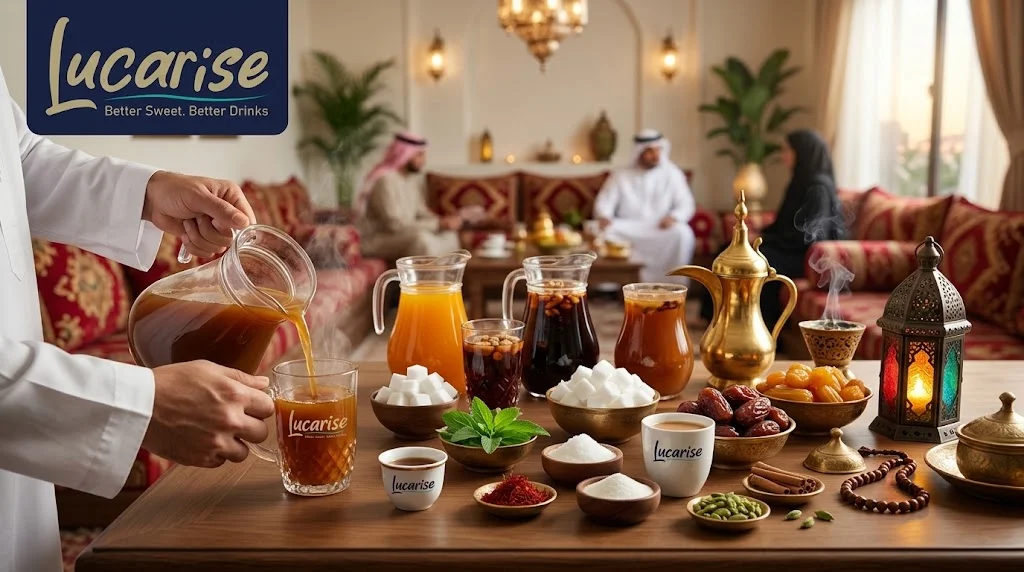
Key finding: a single 240 ml glass of jallab, Vimto, tamarind, qamar al-din or Rooh Afza carries about 30 to 34 g of free sugar, or 7 to 8 teaspoons. That is more than the 25 g the WHO suggests as an ideal limit for the whole day. A typical iftar evening with two sweet drinks and a cup of karak reaches about 83 g, or 20 teaspoons.
Ramadan tables across the Gulf are full of sweet drinks: Vimto at iftar, jallab and qamar al-din with the meal, tamarind in the evening and karak after taraweeh. They are part of the season, but most of them are made from syrups, nectars or sugar. We estimated the free sugar in one glass of ten popular Ramadan drinks, using product labels and published nutrition data, and turned it into teaspoons so it is easy to picture.
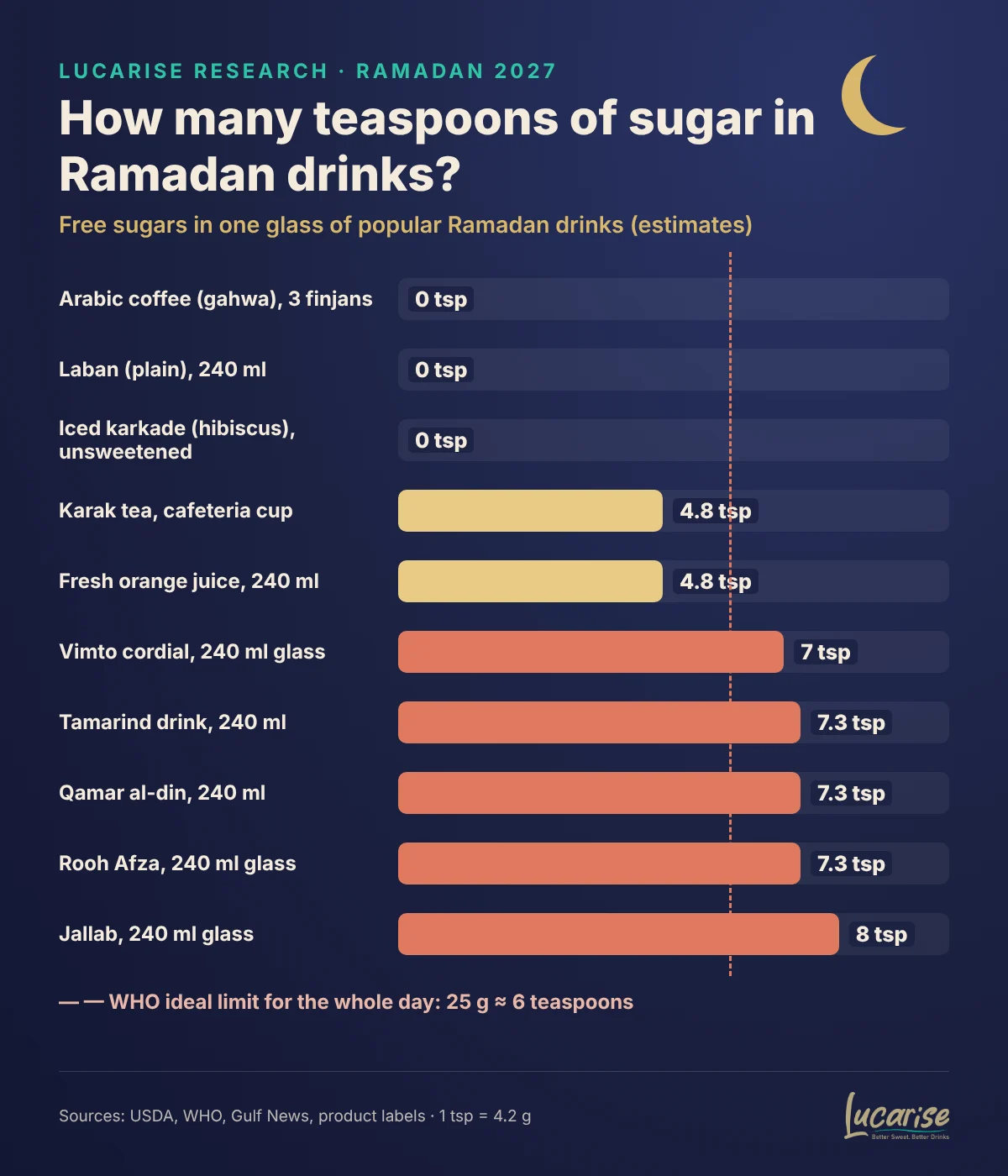
The Numbers: Sugar in 10 Ramadan Drinks
| Drink | Serving and recipe assumed | Free sugar | Teaspoons | Share of 25 g ideal limit |
|---|---|---|---|---|
| Arabic coffee (gahwa), 3 finjans | Plain, served with dates | 0 g | 0 | 0% |
| Laban (plain), 240 ml | Unsweetened | 0 g | 0 | 0% |
| Iced karkade (hibiscus), unsweetened | Made at home, no sugar | 0 g | 0 | 0% |
| Karak tea, cafeteria cup | About 100 g sugar per litre of tea | 20 g | 4.8 | 80% |
| Fresh orange juice, 240 ml | No sugar added | 20.2 g | 4.8 | 81% |
| Vimto cordial, 240 ml glass | Prepared drink, Gulf cordial | 29.5 g | 7 | 118% |
| Tamarind drink, 240 ml | Tamarind nectar | 30.5 g | 7.3 | 122% |
| Qamar al-din, 240 ml | Apricot nectar | 30.7 g | 7.3 | 123% |
| Rooh Afza, 240 ml glass | 40 ml syrup + water | 30.8 g | 7.3 | 123% |
| Jallab, 240 ml glass | 40 ml syrup + water | 33.6 g | 8 | 134% |
Free sugars are sugars added to food and drink plus the sugars in syrups, fruit juices and nectars. They do not include the natural lactose in laban and milk, or the sugar inside whole fruit. So a glass of fresh orange juice counts, but an orange does not.1
What a Typical Iftar Evening Adds Up To
Picture a common evening: a glass of Vimto when you break your fast (about 30 g), a glass of jallab with the meal (about 34 g) and a cup of karak after taraweeh (about 20 g). That is about 83 g of free sugar, or 20 teaspoons, from drinks alone. It is more than three times the WHO’s ideal 25 g and well over its 50 g upper limit, before any dessert.
Add up your own evening with our free sugar in drinks calculator. For café drinks such as Spanish latte and caramel latte, see how much sugar is in popular Gulf café drinks.
Do the Dates Count?
Iftar usually starts with water and dates. A Medjool date (about 24 g) has roughly 16 g of natural sugar, according to USDA data, so three dates have close to 48 g. The WHO does not count this as free sugar, because it comes inside the whole fruit with fibre. Dates are still rich in energy, which is one more reason to keep the sweet drinks around them small.2
How to Enjoy Ramadan Drinks With Less Sugar
- Use half the syrup. 20 ml of jallab or Rooh Afza in a glass instead of 40 ml halves the sugar, to about 15 to 17 g.
- Pour smaller glasses. A 150 ml glass of Vimto or qamar al-din has about 18 to 19 g instead of 30 g.
- Alternate with water and laban. Plain laban and water add fluid without free sugar.
- Make iced karkade without sugar. See how to make hibiscus tea, and sweeten lightly with stevia Reb-M if you like.
- Keep karak and Arabic coffee less sweet. Gahwa is traditionally served without sugar, and the dates beside it are sweet enough.
For when to drink water, coffee and karak between iftar and suhoor, read our Ramadan drinks guide and caffeine in Ramadan.
Methodology
- These are estimates for typical servings, not lab tests. Brands, recipes and how strongly people mix syrups all vary.
- Serving: one 240 ml glass. For syrups (jallab, Rooh Afza) we assumed 40 ml of syrup topped up with water, about one part syrup to five parts water.
- Tamarind and qamar al-din use USDA values for canned tamarind nectar (12.7 g sugars per 100 g) and apricot nectar (12.8 g per 100 g). Homemade versions vary with the amount of sugar used.
- Jallab: the Caprice d’Orient label lists 84 g carbohydrate per 100 ml with sugar as the first ingredient, so we treated the carbohydrate as sugar. Rooh Afza: 77 g sugars per 100 ml (Open Food Facts).
- Vimto: 12.3 g sugars per 100 ml of the prepared Gulf cordial, from the Open Food Facts entry for Vimto Fruit Cordial (Aujan). Check your own bottle, because labels change.
- Karak: Gulf News reported cafeterias using about 100 g of sugar per litre of tea, which a dietitian estimated at about 20 g per cup. Orange juice: USDA, 8.4 g per 100 g.
- One level teaspoon of sugar is taken as 4.2 g. The WHO recommends keeping free sugars below 10% of daily energy (about 50 g) and ideally below 5% (about 25 g).
Use This Chart
Journalists, bloggers and teachers are welcome to use the chart and figures on this page. Please credit Lucarise and link to this page. For the chart in Arabic, a high-resolution file or a question about the data, email info@lucarise.com.
Quick Questions
How much sugar is in a glass of Vimto?
About 30 g in a 240 ml glass of the Gulf Vimto cordial made up as a drink, or roughly 7 teaspoons, based on the prepared values listed for the product. A stronger mix has more.
Is jallab high in sugar?
Yes. Jallab syrup lists about 84 g of carbohydrate per 100 ml and sugar is its first ingredient, so 40 ml of syrup in a glass adds about 34 g, or 8 teaspoons.
Does fruit juice count as sugar?
Yes. The WHO counts the sugar in fruit juices and nectars as free sugar, just like added sugar. The sugar inside whole fruit, such as dates, is not counted.
How can I make Ramadan drinks with less sugar?
Use half the syrup, serve smaller glasses, and alternate with water, laban or unsweetened iced karkade. Drink karak and Arabic coffee without sugar or with less.
References
- WHO: guideline on sugars intake for adults and children (2015)
- USDA FoodData Central: tamarind nectar, canned (167786), 12.7 g sugars per 100 g; apricot nectar, canned (171704), 12.8 g; orange juice, raw (169098), 8.4 g; Medjool dates (168191)
- Caprice d’Orient: Jallab syrup, 84 g carbohydrate per 100 ml, sugar listed first
- Open Food Facts: Hamdard Rooh Afza, 77 g sugars per 100 ml
- Open Food Facts: Vimto Fruit Cordial (Aujan), 12.3 g sugars per 100 ml prepared
- Gulf News: The bitter truth about your sweet karak tea in UAE


