

Can you drink coffee in Ramadan? Yes. What matters is when you have it and how much. If you drink coffee every day, the headache many people get in the first days of Ramadan is often caffeine withdrawal: it usually starts 12 to 24 hours after your last cup, peaks after one to two days and can last two to nine days. To avoid it, cut back gradually over the two weeks before Ramadan, have your coffee or karak after iftar rather than at suhoor, and drink plenty of water between iftar and suhoor.
Try it: add up your own cups with our free caffeine calculator.
For many people in the Gulf, the day does not really start without Arabic coffee, karak or a latte. In Ramadan that cup suddenly moves from the morning to the evening, and the body notices. This guide explains why the first days of fasting often bring a headache, how to cut caffeine before Ramadan, the best time for coffee and tea during the month, and which caffeine-free drinks suit suhoor.
Why do you get a headache in the first days of Ramadan?
There are usually several causes at once: less water, lower blood sugar, less sleep and, for regular coffee and tea drinkers, caffeine withdrawal. A review of 66 studies by researchers at Johns Hopkins found that headache is the most common withdrawal symptom, affecting about half of people in experimental studies. Symptoms typically begin 12 to 24 hours after stopping, peak after one to two days and last two to nine days, and they can appear even in people who drank as little as 100 mg a day, about one small cup of coffee.2
Other symptoms include tiredness, low mood or irritability and difficulty concentrating.2 People who get migraines may notice more attacks: in a small study of patients with migraine, migraine days roughly tripled during Ramadan, and the authors linked fasting headaches to dehydration and caffeine withdrawal.3
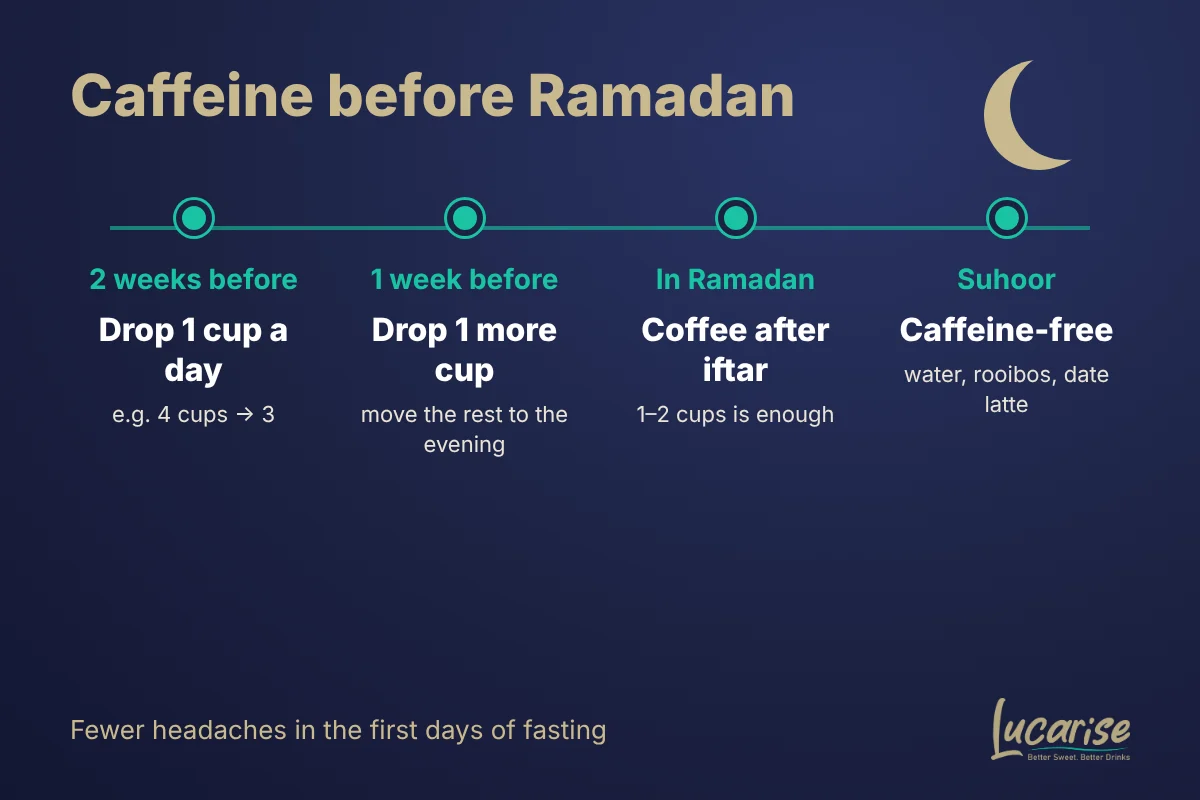
How to cut caffeine before Ramadan: a two-week plan
Stopping suddenly on the first day of Ramadan is what causes the strongest symptoms. The US FDA advises that daily caffeine drinkers who want to cut back do it gradually.4 A simple plan:
| When | What to do |
|---|---|
| Two weeks before | Drop one cup a day. If you have four cups, go down to three. |
| One week before | Drop another cup, swap one coffee for a lighter tea, and move the rest of your caffeine to the afternoon or evening. |
| In Ramadan | Have coffee, karak or tea only after iftar, and keep it to one or two cups. |
| At suhoor | Water and caffeine-free drinks only. |
Moving your cups to the evening before Ramadan starts helps your body get used to the new timing, so the first fasting day feels much less of a shock.
When is the best time for coffee and tea in Ramadan?
- After iftar: the best time. Break your fast with water and dates first, then enjoy Arabic coffee, karak or a latte after the meal.
- Late at night: go lighter. A strong coffee close to bedtime can cut into the few hours of sleep you get before suhoor.
- At suhoor: best avoided. Coffee and tea increase urine output, so nutrition guidance recommends cutting back on caffeine at suhoor and drinking water instead.1
For a full plan of what to drink at each time of the night, read our guide to Ramadan drinks.
How much caffeine is in your Ramadan drinks?
| Drink | Serving | Caffeine |
|---|---|---|
| Brewed coffee | 237 ml cup | about 96 mg5 |
| Instant coffee | 237 ml cup | about 62 mg5 |
| Karak tea | 150 ml cup | about 40–80 mg (estimate) |
| Black tea | 237 ml cup | about 48 mg5 |
| Green tea | 237 ml cup | about 29 mg5 |
| Rooibos, hibiscus, date seed latte | 1 cup | 0 mg |
The US FDA says up to 400 mg a day is an amount not generally linked to negative effects in healthy adults, though sensitivity varies from person to person.4 In Ramadan, though, all of that caffeine is squeezed into a few evening hours, so it is wiser to stay well below that. For more drinks, see our caffeine chart and how much caffeine is in karak.
Caffeine-free drinks for suhoor and late evenings

- A date seed latte: warm, creamy and coffee-like, with no caffeine. Read about date seed coffee.
- Rooibos: naturally caffeine-free and never bitter. Read what is rooibos tea.
- Hibiscus (karkade): caffeine-free, hot or iced. Read what is hibiscus tea.
This article is general information. If you have a health condition, are pregnant or take regular medication, talk to your doctor about fasting and how much caffeine suits you.
Caffeine-free drinks for Ramadan nights
Classic Date Latte is made with date seed extract, with no coffee or tea and no added sugar in the mix. Rooibos and Hibiscus Tea are pure and caffeine-free, so you can enjoy a warm cup at suhoor without the caffeine.
Worried about sleep? See how much caffeine is left at bedtime with our caffeine half-life calculator.
Caffeine in Ramadan: frequently asked questions
Why do I get a headache in the first days of Ramadan?
Usually because of caffeine withdrawal together with less water and sleep. Withdrawal symptoms typically start 12 to 24 hours after your last cup and peak after one to two days.
Should I drink coffee at suhoor?
It is best not to. Coffee and tea increase urine output, so enjoy them after iftar and keep suhoor to water and caffeine-free drinks.
When should I start cutting coffee before Ramadan?
About two weeks before: drop one cup each week and move your remaining cups to the evening so your body gets used to the new timing.
How many cups of coffee can I drink in Ramadan?
One or two cups after iftar are enough for most people. The general limit for healthy adults is 400 mg of caffeine a day, but in Ramadan it is wiser to stay well below that.
What is a warm caffeine-free drink for suhoor?
A date seed latte, rooibos or hibiscus tea, all of which are caffeine-free.
Sources
- Johns Hopkins Aramco Healthcare. Ramadan Nutrition and Hydration Guide: How to Nourish Your Body While Fasting. jhah.com
- Juliano LM, Griffiths RR. A critical review of caffeine withdrawal: empirical validation of symptoms and signs, incidence, severity, and associated features. Psychopharmacology, 2004. Johns Hopkins University
- Abu-Salameh I, Plakht Y, Ifergane G. Migraine exacerbation during Ramadan fasting. The Journal of Headache and Pain, 2010. Springer
- U.S. Food and Drug Administration. Spilling the Beans: How Much Caffeine Is Too Much? fda.gov
- Mayo Clinic. Caffeine content for coffee, tea, soda and more. mayoclinic.org


