

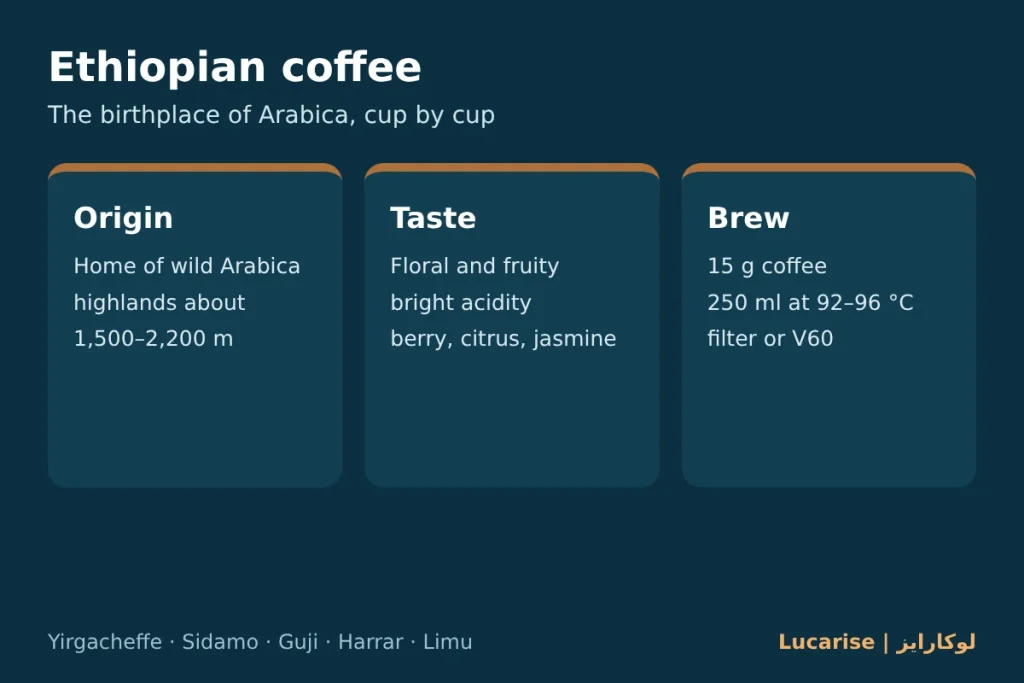
Quick answer: Ethiopian coffee is coffee grown in Ethiopia, the original home of the Arabica coffee plant. It is known for a light, floral and fruity cup with lively acidity, often with notes of berries, citrus or jasmine. Famous growing regions include Yirgacheffe, Sidamo (Sidama), Guji, Harrar and Limu. It tastes best as filter or pour-over coffee, but a medium roast also works well as espresso.
Not sure Ethiopian coffee is for you? Take our 30-second coffee quiz.
Ethiopia is where Arabica coffee began: the wild Coffea arabica plant still grows in the montane rainforests of south-western Ethiopia, the main centre of its genetic diversity[1]. Today Ethiopia is Africa’s largest coffee producer, and Saudi Arabia is one of the biggest buyers of Ethiopian coffee[2]. This guide covers what makes Ethiopian coffee different, its best-known regions, how it tastes, how to brew it at home, and how it compares with Yemeni and Colombian coffee.
What is Ethiopian coffee?
Ethiopian coffee is 100% Arabica coffee grown in the highlands of Ethiopia, mostly between about 1,500 and 2,200 metres. Much of it comes from small farms and garden plots, and some still grows half-wild under forest shade. Because Ethiopia is the birthplace of Arabica, it has thousands of local coffee varieties, often called “heirloom” varieties, which is one reason Ethiopian coffee tastes so varied.
A popular legend says a goat herder called Kaldi noticed his goats became lively after eating red coffee cherries. It is a story, not history, but it shows how closely coffee is linked to Ethiopia.
Ethiopian coffee regions and their flavours
| Region | Often described as |
|---|---|
| Yirgacheffe | Light and floral, with jasmine, lemon and tea-like notes |
| Sidamo (Sidama) | Bright and sweet, with berry and citrus notes |
| Guji | Fruity and juicy, with stone fruit and floral notes |
| Harrar | Bold and winey, with blueberry and dried fruit notes, often natural processed |
| Limu | Balanced and mild, with gentle spice and wine notes |
These are typical descriptions, not rules: the taste also depends on the farm, the processing and the roast.
Washed vs natural Ethiopian coffee
| Washed | Natural (dry processed) | |
|---|---|---|
| How it is made | The fruit is removed before the beans are dried | The whole coffee cherry is dried in the sun with the bean inside |
| Taste | Clean, bright, floral, tea-like | Sweeter and fruitier, with berry and wine notes |
| Body | Lighter | Fuller |
What does Ethiopian coffee taste like?
Compared with coffee from Brazil or Colombia, Ethiopian coffee usually has more acidity and a lighter body, with fruity and floral aromas instead of nutty or chocolate notes. A lighter roast keeps these fruity notes; a medium roast gives more sweetness and body while keeping some of the brightness. See how other origins compare in our specialty coffee guide.
How to make Ethiopian coffee
Filter or pour-over (V60, Chemex, drip machine)
| For one large cup | |
|---|---|
| Coffee | 15 g, ground medium-fine |
| Water | 250 ml at about 92–96 °C |
| Ratio | about 1:16 |
| Brew time | about 2½–3½ minutes |
Pour a little water first to wet the grounds and wait about 30 seconds, then pour the rest slowly in circles. For a step-by-step method, read our drip coffee guide.
Espresso
A medium-roasted Ethiopian coffee makes a bright, fruity espresso. Start with about 18 g of coffee for about 36 g of espresso in 25–30 seconds, then adjust the grind to taste. More in our espresso guide.
The Ethiopian coffee ceremony
In Ethiopia, coffee is part of daily hospitality. In the traditional coffee ceremony, green beans are washed and roasted in a pan in front of the guests, ground by hand, and brewed in a clay pot called a jebena. The coffee is served in small cups, often in three rounds, with incense and snacks such as popcorn. It is a slow, social ritual, much like serving gahwa in the Gulf.
Ethiopian coffee vs Yemeni and Colombian coffee
| Ethiopian | Yemeni | Colombian | |
|---|---|---|---|
| Typical taste | Floral, fruity, bright acidity | Rich and complex, dried fruit, spice | Balanced, sweet, caramel |
| Body | Light to medium | Medium to full | Medium |
| Best for | Filter and pour-over, fruity espresso | Filter and traditional brewing | Everyday espresso and filter |
Does Ethiopian coffee have a lot of caffeine?
Ethiopian coffee is Arabica, which has less caffeine than Robusta. A 237 ml cup of brewed coffee has about 96 mg of caffeine[3], and the exact amount depends on how much coffee you use. EFSA considers up to 400 mg of caffeine a day safe for healthy adults, and up to 200 mg a day during pregnancy[4]. Check your daily total with our caffeine calculator.
How to choose Ethiopian coffee beans
- Whole beans: grind just before brewing to keep the floral aroma.
- Roast date: coffee tastes best within a few weeks of roasting.
- Roast level: light for the most fruit and acidity, medium for more sweetness and body.
- Processing: washed for a clean, tea-like cup; natural for a sweeter, fruitier one.
- Storage: keep the bag closed, away from heat, light and moisture.
Lucarise Ethiopia Coffee Beans are 100% Arabica whole beans from Ethiopia, medium roasted at our own roastery in Sohar, Oman. They come in a 250 g pouch for home or a 1 kg pouch for offices and cafés.
Run a café, restaurant or shop?
Lucarise makes café drinks in business packs in our own factory in Oman: 1 kg café bags, 100-sachet hotel boxes and distributor cartons. Prices on request.
Ethiopian coffee: frequently asked questions
Why is Ethiopian coffee famous?
Ethiopia is the original home of the Arabica coffee plant, and its many local varieties give a floral, fruity cup that is different from other origins.
What does Ethiopian coffee taste like?
Usually light and bright, with floral, citrus and berry notes. Natural processed coffee tastes sweeter and fruitier; washed coffee tastes cleaner and more tea-like.
Which Ethiopian coffee is best?
It depends on your taste. Yirgacheffe is known for a floral, tea-like cup, Sidamo and Guji for fruity sweetness, and Harrar for a bold, winey cup.
Is Ethiopian coffee Arabica?
Yes. Ethiopian coffee is Arabica, and Ethiopia is where the Arabica plant comes from.
How do you make Ethiopian coffee at home?
Filter or pour-over brings out its fruity notes best: about 15 g of medium-fine coffee for 250 ml of water at 92–96 °C. A medium roast also makes a good espresso.
What is the difference between Ethiopian and Yemeni coffee?
Both are Arabica from neighbouring regions, but Ethiopian coffee is usually lighter and more floral, while Yemeni coffee is richer, with dried fruit and spice notes.
Sources
- Aerts R. et al. (2012). Genetic variation and risks of introgression in the wild Coffea arabica gene pool in south-western Ethiopian montane rainforests. Evolutionary Applications 6(2): 243–252.
- Daily Coffee News (12 June 2026). Ethiopia coffee report: production up, reporting USDA Foreign Agricultural Service data.
- Mayo Clinic. Caffeine: how much is too much?
- EFSA Panel on Dietetic Products (2015). Scientific opinion on the safety of caffeine. doi:10.2903/j.efsa.2015.4102


