
Quick answer: espresso is a small, strong coffee made by pushing hot water through finely ground coffee under high pressure. A single shot uses about 7–9 g of coffee and gives about 25–30 ml in 25–30 seconds; a double uses about 18 g. The only ingredients are coffee and water. Without a machine, a moka pot makes the closest strong coffee, though it is not true espresso. One 30 ml shot has about 63 mg of caffeine.
Espresso is the base of almost every café drink in the Gulf, from cappuccino and latte to Spanish latte and iced latte. This guide explains what espresso is, what goes into it, how to make it at home with or without a machine, why a shot can taste bitter or sour, how much caffeine it has, and which coffee to choose.
What is espresso?
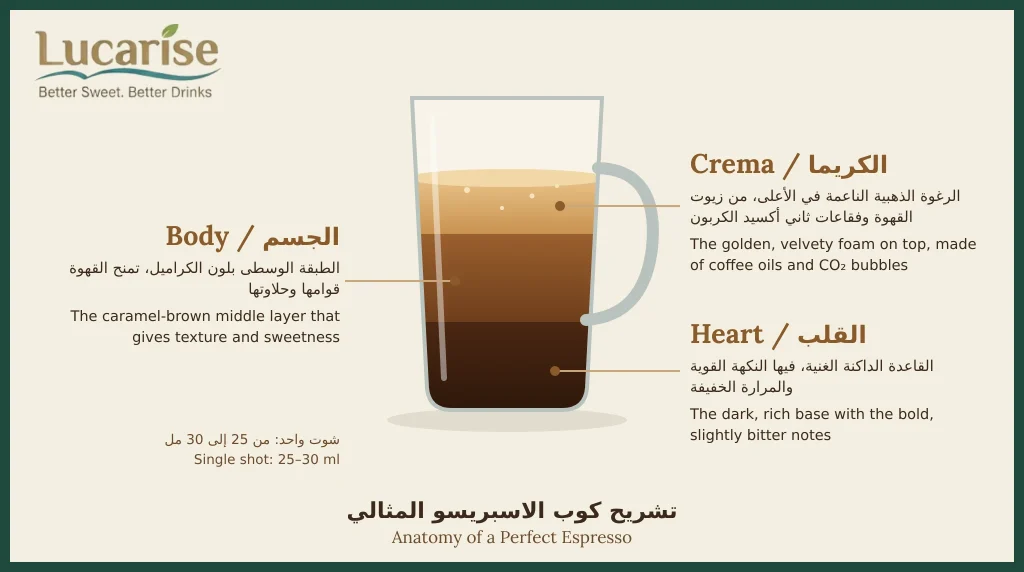
Espresso is a brewing method, not a type of bean. Hot water, at around 9 bar of pressure, is forced through a compact puck of finely ground coffee for about half a minute[1]. The result is a short, thick coffee with a layer of golden-brown foam on top called crema. Any coffee can be brewed as espresso, but medium-dark roasts are the most common because they give a full body and less acidity.
Espresso ingredients and ratios
Espresso has only two ingredients: ground coffee and water. What makes it espresso is the ratio, the grind and the pressure.
| Single shot | Double shot | |
|---|---|---|
| Ground coffee | about 7–9 g | about 16–18 g |
| Espresso in the cup | about 25–30 ml | about 50–60 ml (about 36–40 g) |
| Extraction time | about 25–30 seconds | about 25–30 seconds |
| Water temperature | about 88–94 °C | about 88–94 °C |
| Pressure | about 9 bar | about 9 bar |
| Grind | fine | fine |
The Italian espresso standard is 7 g of coffee, 25 ml in the cup, 9 bar and about 25 seconds[1]. Many cafés today use a little more coffee, often 18 g for a double. For other brewing methods, use our coffee to water ratio calculator.
How to make espresso with a machine
- Heat the machine fully, usually 15–20 minutes, and run a little water through the group head.
- Dose about 9 g of finely ground coffee for a single or 18 g for a double into a dry portafilter basket.
- Level the coffee and tamp it evenly and firmly, so the surface is flat.
- Lock the portafilter in and start the shot straight away.
- Stop at about 25–30 ml for a single (50–60 ml for a double), after about 25–30 seconds.
- Drink it straight, or use it as the base for a cappuccino or latte.
Why is my espresso bitter or sour?
| What you see | Likely cause | What to change |
|---|---|---|
| Shot runs in under 20 seconds, pale and sour | Grind too coarse or too little coffee | Grind finer or add a little coffee |
| Shot takes over 35 seconds, dark and bitter | Grind too fine or too much coffee | Grind coarser or use a little less coffee |
| Uneven, spurting shot | Uneven tamping | Level the coffee and tamp straight |
| Thin crema, flat taste | Old or stale coffee | Use freshly roasted coffee and close the pack tightly |
How to make espresso without a machine
True espresso needs about 9 bar of pressure, which only a machine can give. These methods make a strong, concentrated coffee that works well in milk drinks:
- Moka pot (stovetop espresso maker): fill the bottom with hot water up to the valve, fill the basket with finely ground coffee without pressing it, and heat on medium-low. Take it off the heat as soon as the coffee starts to gurgle. It brews at about 1–2 bar, so the coffee is strong but has little or no crema.
- AeroPress: use about 15–18 g of fine coffee and a short amount of hot water, then press firmly. It gives a strong, espresso-style shot.
- French press, strong: use double the usual coffee and steep for about 4 minutes. It is not espresso, but it is a usable base for a latte.
- Instant coffee: 1 teaspoon dissolved in 30 ml of hot water is the quickest shortcut for an iced latte or a Spanish latte.
How much caffeine is in espresso?
A 30 ml shot of espresso has about 63 mg of caffeine, and a double about 126 mg[2]. A 237 ml cup of brewed coffee has about 96 mg, so a single espresso has less caffeine per cup, even though it is stronger per sip. For healthy adults, EFSA considers up to 400 mg of caffeine a day safe, and up to 200 mg a day during pregnancy and breastfeeding[3]. Check your daily total with our caffeine calculator.
Popular espresso drinks
| Drink | What is in it |
|---|---|
| Americano | Espresso topped up with hot water |
| Macchiato | Espresso with a spoon of milk foam |
| Cortado | Espresso with about the same amount of steamed milk |
| Cappuccino | Espresso, steamed milk and a thick layer of foam |
| Latte | Espresso with more steamed milk and a thin layer of foam |
| Spanish latte | Espresso, milk and sweetened condensed milk |
| Iced latte | Espresso poured over cold milk and ice |
Which coffee is best for espresso?
- Roast: medium-dark roasts give a full body, low acidity and good crema. Light roasts taste brighter but are harder to get right.
- Grind: fine, a little finer than table salt. Pre-ground coffee should say it is for espresso machines or moka pots.
- Freshness: close the pack tightly and keep it in a cool, dry place away from sunlight. Ground coffee loses aroma quickly once opened.
- Bean: 100% Arabica gives a smoother, sweeter taste; Robusta adds more bitterness, crema and caffeine. Read more in Arabica vs Robusta.
Lucarise Espresso Ground Coffee is 100% Arabica with a medium-dark roast, ground fine for espresso machines and moka pots, roasted and packed in our own factory in Oman. It comes in a 250 g pouch.
☕ Prefer a lighter, larger cup? See how to make drip coffee with a V60 or drip bags.
Making Turkish coffee? Read our step-by-step guide: how to make Turkish coffee with thick foam.
More ways to brew: see our specialty coffee guide, with grind, ratio, origins and every brewing method in one place.
Run a café, restaurant or shop?
Lucarise makes café drinks in business packs in our own factory in Oman: 1 kg café bags, 100-sachet hotel boxes and distributor cartons. Prices on request.
Espresso: frequently asked questions
What is espresso made of?
Only finely ground coffee and hot water. It is the brewing method, with high pressure and a short time, that makes it espresso.
How many grams of coffee for one espresso?
About 7–9 g for a single shot of 25–30 ml, and about 16–18 g for a double.
Can I make espresso without a machine?
Not true espresso, which needs about 9 bar of pressure. A moka pot or AeroPress makes a strong, espresso-style coffee that works well in milk drinks.
How much caffeine is in one shot of espresso?
About 63 mg in a 30 ml shot, and about 126 mg in a double.
Why is my espresso sour?
It usually ran too fast. Grind finer or use a little more coffee so the shot takes about 25–30 seconds.
What is the difference between espresso and regular coffee?
Espresso is brewed with high pressure, fine grind and a short time, so it is small and strong. Filter coffee uses gravity, a coarser grind and more water, so it is lighter and larger.
Sources
- Istituto Nazionale Espresso Italiano. Certified Italian Espresso standard: 7 ± 0.5 g of ground coffee, water at 88 ± 2 °C, 9 ± 1 bar, 25 ± 5 seconds, 25 ± 2.5 ml in the cup.
- Mayo Clinic. Caffeine content for coffee, tea, soda and more (espresso, 30 ml: 63 mg).
- EFSA Panel on Dietetic Products (2015). Scientific opinion on the safety of caffeine. doi:10.2903/j.efsa.2015.4102


