
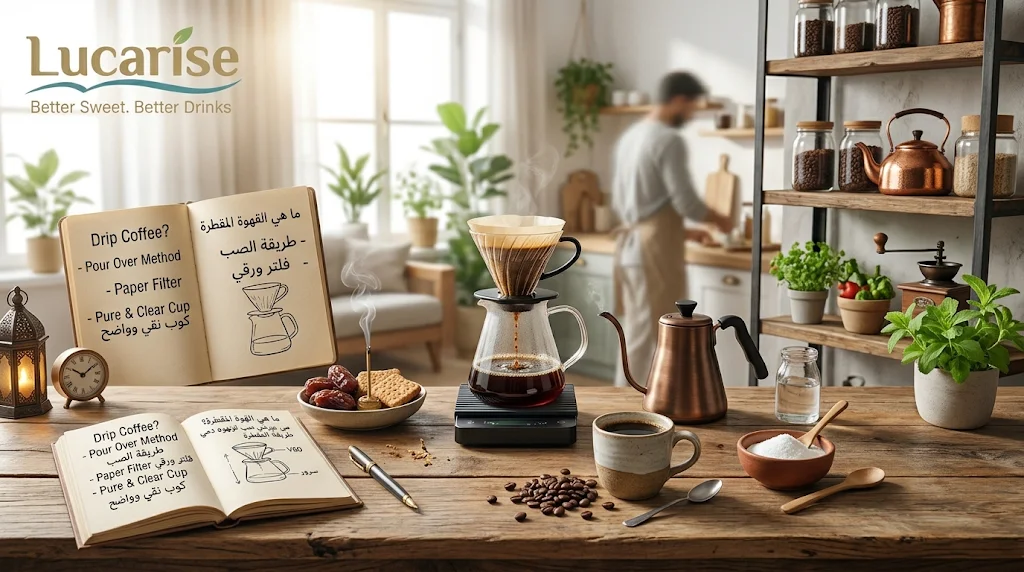
Quick answer: drip coffee, also called pour-over or filter coffee, is made by pouring hot water slowly over medium-fine ground coffee in a filter, so the coffee drips into the cup. A good starting point is 15 g of coffee for 250 ml of water (about 1:16), water at 90–96 °C and a total brew time of about 2.5–3.5 minutes. You can make it with a V60 or similar dripper, or with a ready drip bag that sits on your cup, with no machine at all.
Drip coffee has become one of the most popular ways to drink coffee in Saudi Arabia and the Gulf, in cafés and at home. This guide explains what it is, the right ratio, how to make it with a V60 step by step, how to use drip bags, why it can taste sour or bitter, how it compares with espresso and Arabic coffee, and which coffee to choose.
What is drip coffee?
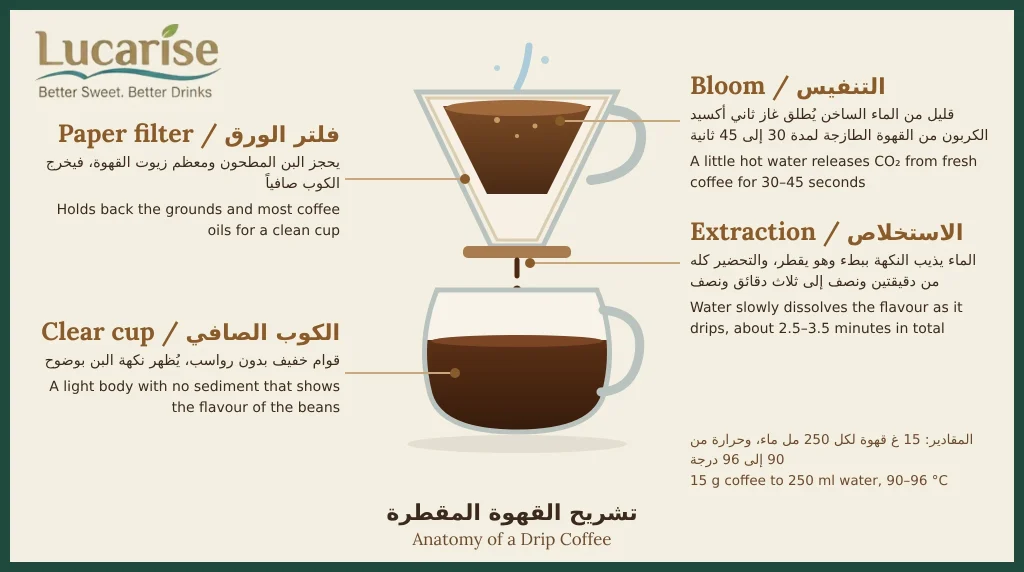
Drip coffee is any coffee brewed by letting hot water pass through ground coffee and a filter by gravity, with no pressure. Made by hand, it is called pour-over; the best-known drippers are the V60 and the Chemex. A filter coffee machine does the same job automatically. Drip bags are a single-cup version with the filter and coffee already inside. The result is a clean, light-bodied cup that shows the flavour of the beans more clearly than espresso.
Drip coffee ratio and measurements
| Guide | |
|---|---|
| One cup | about 15 g of coffee for 250 ml of water |
| Ratio | 1:15 to 1:17 (stronger to lighter) |
| Water temperature | about 90–96 °C |
| Grind | medium-fine, like coarse sand |
| Bloom | about 30–45 seconds with twice the coffee weight in water |
| Total brew time | about 2.5–3.5 minutes |
The Specialty Coffee Association recommends about 55 g of coffee per litre of water, at 92–96 °C[1]. Many people prefer it a little stronger, around 1:15. Scale it for any number of cups with our coffee to water ratio calculator.
How to make drip coffee with a V60
- Boil water and let it rest for about 30 seconds, to around 92–96 °C.
- Put a paper filter in the V60, rinse it with hot water to remove the paper taste and warm the dripper, then pour the rinse water away.
- Add 15 g of medium-fine ground coffee and shake gently to level it.
- Bloom: pour about 30 ml of water to wet all the coffee and wait 30–45 seconds while it bubbles and releases gas.
- Pour the rest of the water slowly in small circles, in two or three stages, until you reach 250 ml. Avoid pouring directly onto the filter paper.
- Let it drip through. The whole brew should take about 2.5–3.5 minutes. Swirl the cup and serve.
Why is my drip coffee sour or bitter?
| What you taste | Likely cause | What to change |
|---|---|---|
| Sour, thin, finishes in under 2 minutes | Grind too coarse or water too cool | Grind finer or use hotter water |
| Bitter, harsh, takes over 4 minutes | Grind too fine or too much coffee | Grind coarser or use a little less coffee |
| Weak and watery | Too little coffee | Use about 15 g per 250 ml |
| Flat, little aroma | Old coffee | Use freshly roasted coffee and close the pack tightly |
How to make coffee with drip bags
Drip bags are the easiest way to make filter coffee without any equipment, at home, in the office or when travelling:
- Open the bag, unfold the holders and hang it on the rim of your cup.
- Pour a little hot water (about 90–93 °C) to wet the coffee and wait about 20 seconds.
- Pour the rest slowly in two or three stages, letting it drip through each time.
- After 2–3 minutes, remove the bag and enjoy.
Lucarise UFO Drip Coffee uses 12 g of 100% Arabica ground coffee in each bag, for about 200 ml of water. It comes in a box of 5 single-serve bags and is packed in Sohar Free Zone, Oman.
Drip coffee vs espresso vs Arabic coffee
| Drip coffee | Espresso | Arabic coffee (gahwa) | |
|---|---|---|---|
| Method | Water drips through a filter | Water forced through at about 9 bar | Ground coffee boiled in water |
| Grind | Medium-fine | Fine | Medium |
| Cup size | About 200–250 ml | About 25–30 ml | Small finjan, about 30–60 ml |
| Taste | Clean, light, shows the beans | Thick, strong, with crema | Light roast with cardamom |
| Read more | — | Espresso guide | Arabic coffee guide |
How much caffeine is in drip coffee?
A 237 ml cup of brewed coffee has about 96 mg of caffeine[2], more than a single 30 ml espresso shot (about 63 mg), because the cup is much larger. For healthy adults, EFSA considers up to 400 mg of caffeine a day safe, and up to 200 mg a day during pregnancy and breastfeeding[3]. Check your total with our caffeine calculator.
Which coffee is best for drip?
- Roast: light to medium roasts are the most common for drip, because the filter brings out fruit, floral and sweet notes.
- Grind: medium-fine. Grind just before brewing if you can, or buy coffee ground for filter or pour-over.
- Origin: Ethiopian coffee is often fruity and floral, Colombian is balanced and sweet, and Brazilian is nutty and chocolatey.
- Freshness: keep coffee in a closed pack in a cool, dry place away from sunlight.
Lucarise coffee beans are 100% Arabica, roasted and packed in Oman: Ethiopia, Colombia and Brazil.
Prefer a thick, traditional cup? Try our guide to how to make Turkish coffee.
More ways to brew: see our specialty coffee guide, with grind, ratio, origins and every brewing method in one place.
Run a café, restaurant or shop?
Lucarise makes café drinks in business packs in our own factory in Oman: 1 kg café bags, 100-sachet hotel boxes and distributor cartons. Prices on request.
Drip coffee: frequently asked questions
What is drip coffee?
Coffee brewed by letting hot water drip through ground coffee and a filter by gravity, by hand (pour-over, V60) or with a filter machine.
How much coffee for one cup of drip coffee?
About 15 g of medium-fine ground coffee for 250 ml of water, a ratio of about 1:16.
What water temperature is best for drip coffee?
About 90–96 °C. Boil the water and let it rest for about 30 seconds.
Do I need a machine to make drip coffee?
No. A V60 or other dripper with a paper filter is enough, or use ready drip bags that sit on your cup.
Is drip coffee stronger than espresso?
Per sip, no; espresso is much stronger. Per cup, drip usually has more caffeine because the cup is bigger.
Why is my drip coffee sour?
It usually brewed too fast or with water that was too cool. Grind finer or use hotter water.
Sources
- Specialty Coffee Association (SCA). Golden Cup brewing standard: about 55 g of coffee per litre of water (±10%), water at 92–96 °C.
- Mayo Clinic. Caffeine content for coffee, tea, soda and more (brewed coffee, 237 ml: 96 mg).
- EFSA Panel on Dietetic Products (2015). Scientific opinion on the safety of caffeine. doi:10.2903/j.efsa.2015.4102


