
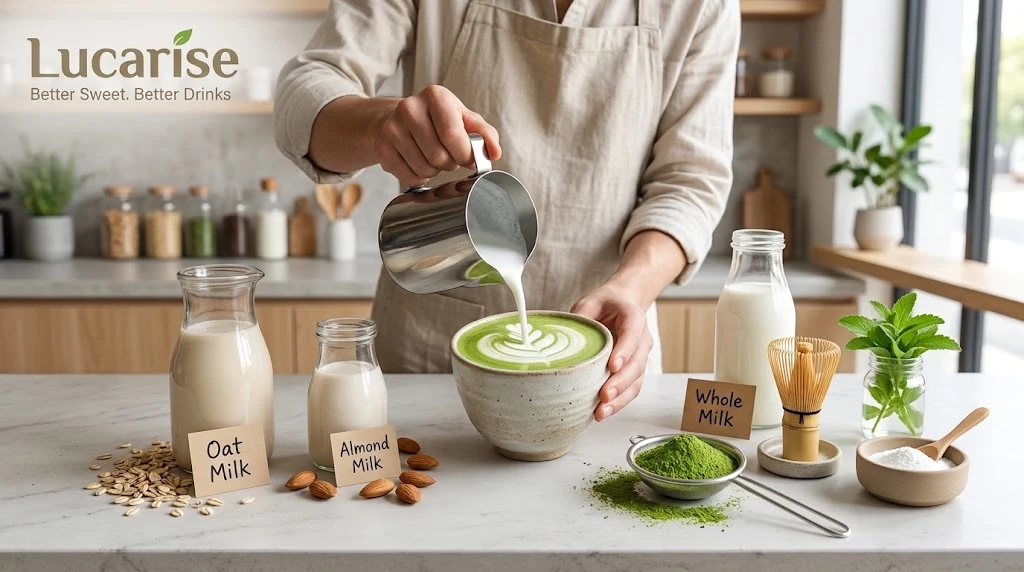
Quick answer: There is no single “best” milk for everyone. Whole milk gives the creamiest texture and the most stable foam and softens matcha’s bitterness. Oat milk (barista version) is the most popular plant option because it is slightly sweet and foams well. Almond milk is lighter and lower in calories but foams poorly, and soy milk foams well but has a stronger taste. Choose by the flavour you like, your diet, and whether you want your latte hot or iced.
Milk makes up more than three-quarters of a matcha latte, so it changes the taste and texture more than you might expect. This guide compares the most popular milks: taste, foam, natural sugar and when each one works best, plus tips for a smoother latte at home.
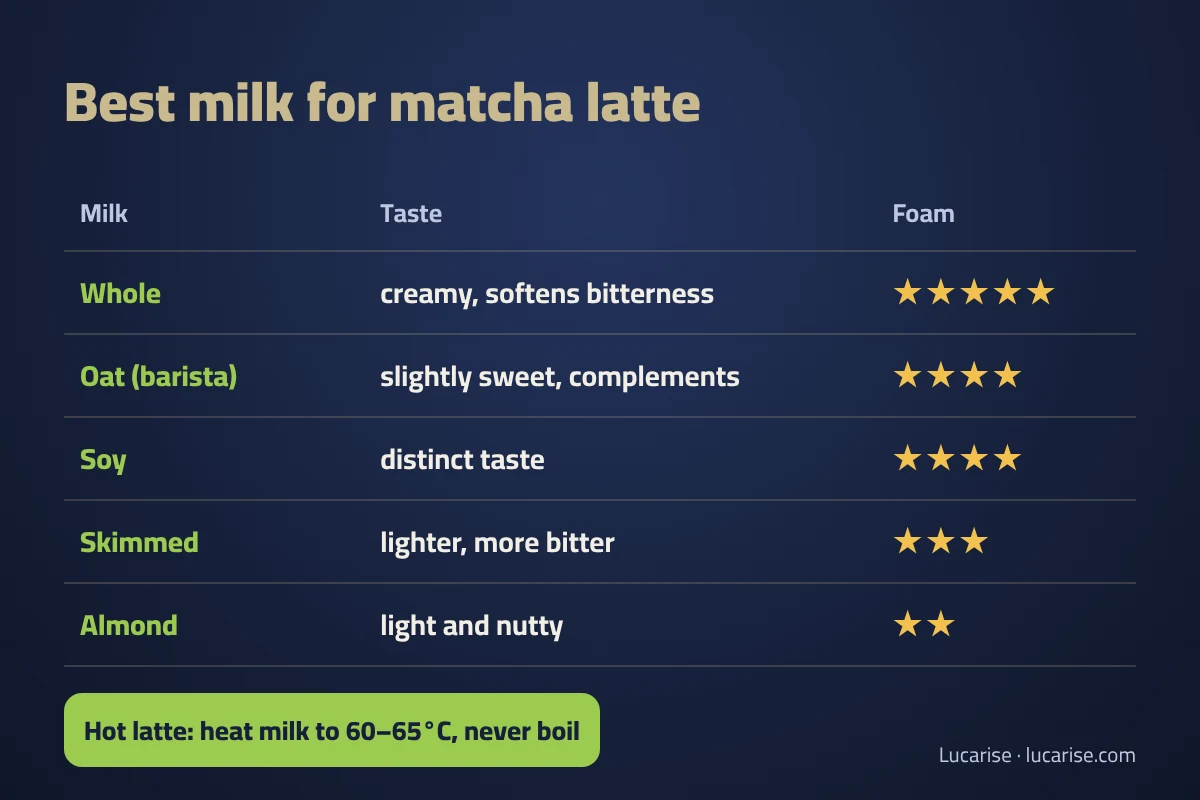
Best milk for matcha latte: quick comparison
| Milk | Taste with matcha | Foam | Best for |
|---|---|---|---|
| Whole milk | Creamy; softens bitterness and brings out umami | Excellent and stable | The classic hot latte |
| Low-fat or skimmed | Lighter; bitterness shows more | Lots of foam, but airy | Fewer calories |
| Oat (barista) | Slightly sweet and creamy; complements matcha | Very good | The most popular plant option, hot or iced |
| Almond | Light and nutty | Weak; can separate when hot | Iced matcha, fewer calories |
| Soy | Distinct taste that can mask matcha | Good (more protein) | Plant protein |
| Coconut | Tropical and strong | Medium | Iced matcha with fruit |
| Camel milk | Slightly salty, lighter than cow’s milk | Medium | A different Gulf twist |

Why does milk change the taste of matcha?
The fat and protein in milk coat matcha’s bitterness and astringency, so the taste becomes smoother. That is why a latte with whole milk seems sweeter than the same cup with skimmed milk, even though the sugar is about the same. Protein is what builds foam: cow’s milk has about 3.3 g of protein per 100 ml and soy milk is similar, while oat milk has about 1 g and unsweetened almond milk less than 1 g [1]. This is why “barista” plant milks contain added stabilisers and fats to help them foam.
Whole milk
The café classic. It gives a creamy body and a fine foam that holds on top of the cup, and it balances matcha’s bitterness, especially with latte or culinary grades. It contains natural milk sugar (lactose), about 5 g per 100 ml [1], but no added sugar. If dairy bothers you, lactose-free milk tastes almost the same.
Oat milk
The most popular plant milk for matcha lattes, because its gentle sweetness and cereal notes complement matcha rather than covering it. Choose a “barista” version for good foam. Watch out: oat milk labelled “no added sugar” can still contain natural sugars formed when the oats are broken down during processing, so read the nutrition table, not just the front of the pack.
Almond, soy and coconut milk
- Almond: usually lighter and lower in calories with a gentle flavour, but it can separate at high heat and foams poorly. Great in an iced matcha latte.
- Soy: more protein, so it foams well, but its taste is stronger and can mask a delicate matcha.
- Coconut: a strong tropical flavour; try it with iced matcha and mango or pineapple.
Does milk cancel the benefits of matcha?
The evidence is mixed. One small study found that adding milk blocked tea’s effect on blood-vessel function [2], while another found that milk did not change how the body absorbed polyphenols from tea [3]. The practical takeaway: if you enjoy matcha with milk, there is no need to worry, and if you want matcha on its own, try traditional matcha with water.
Tips for a smoother latte at home
- Whisk the matcha first with a little hot water (75–80°C) to dissolve the clumps, then add the milk.
- Heat the milk to about 60–65°C; boiling kills the foam and gives a cooked taste.
- For iced matcha, add the milk and ice first, then pour the whisked matcha on top.
- Start with 1–2 g of matcha per 200 ml of milk, and adjust to the strength you like.
- If you sweeten it, add the sweetener to the matcha before the milk so it dissolves well.
What about ready matcha latte mix?
Some ready mixes contain milk powder or creamer and need only hot water, while others are made with milk. Check the directions on the pack. Try Lucarise matcha latte mix with no added sugar, or matcha powder to choose your own milk. For the comparison, read matcha powder vs matcha latte mix, and for everything matcha, start with The Complete Matcha Guide.
☕ Running a café? Get our free Café Menu Kit: tested recipes from 1 kg packs, cups per pack, menu descriptions in English and Arabic, and a downloadable PDF.
New to matcha? Start with our complete matcha guide: what matcha is, its grades, and how to prepare it.
Best milk for matcha: FAQ
What is the best milk for a matcha latte?
Whole milk gives the creamiest texture and the most stable foam. Among plant milks, oat milk (barista version) is the most common choice because it is slightly sweet and foams well.
Is oat milk better than almond milk for matcha?
For a hot latte, usually yes, because it is creamier and foams better. Almond milk is lighter and lower in calories, and suits iced matcha better.
Can I make a matcha latte with skimmed milk?
Yes, and it makes plenty of foam, but the taste is lighter and the bitterness more noticeable. Use a smoother matcha or a little less powder.
Does milk reduce the benefits of matcha?
Studies disagree: one found milk blocked tea’s effect on blood vessels, another found it did not change polyphenol absorption. If you want matcha on its own, drink it with water.
Should the milk be hot or cold?
For a hot latte, heat the milk to 60–65°C without boiling. For an iced latte, use cold milk with ice and pour the whisked matcha over it.
Can I use camel milk?
Yes, it is a different Gulf option with a lighter, slightly salty taste. It foams less than cow’s milk, so froth it well or use it in an iced latte.
Sources
- USDA FoodData Central: nutrient data for milk and plant-based drinks. fdc.nal.usda.gov
- Lorenz M. et al. Addition of milk prevents vascular protective effects of tea. European Heart Journal, 2007. pubmed.ncbi.nlm.nih.gov
- Kyle J.A.M. et al. Effects of infusion time and addition of milk on content and absorption of polyphenols from black tea. Journal of Agricultural and Food Chemistry, 2007. doi:10.1021/jf070351y


