
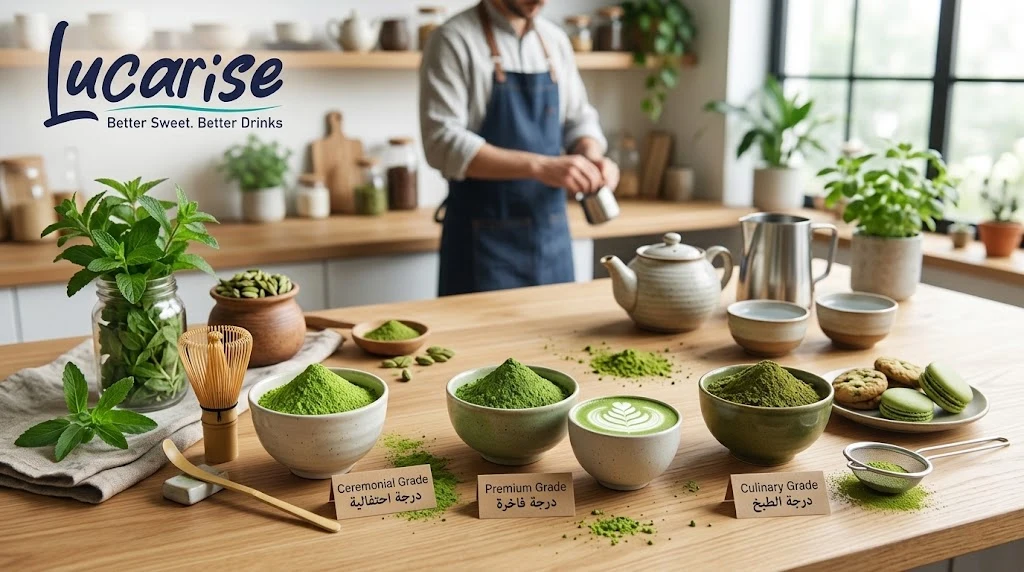
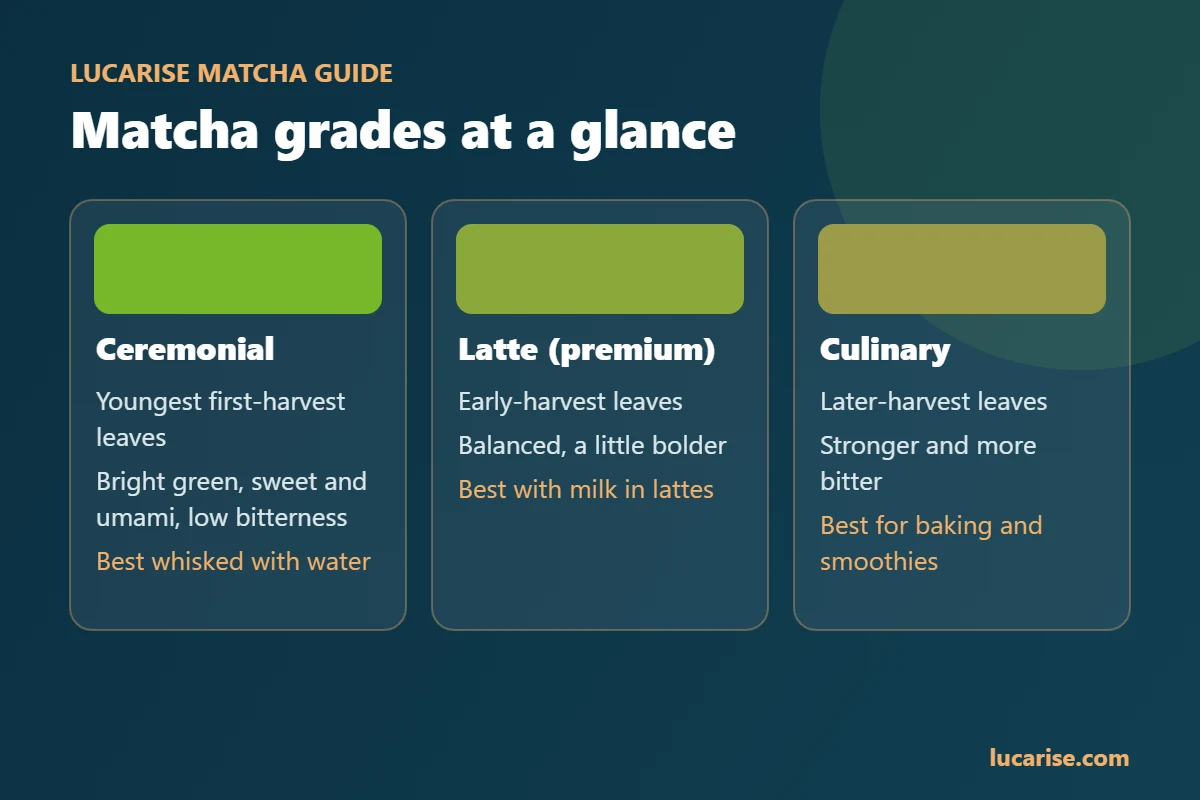
Quick answer: Matcha is usually sold in three grades. Ceremonial matcha is made from the youngest, first-harvest leaves: bright green, sweet and mellow, meant to be whisked with water. Latte (premium) grade is a little bolder and holds its own in milk. Culinary grade comes from later harvests: stronger, more bitter and best for baking and smoothies. “Ceremonial” is a trade term, not an official standard, so judge the powder by its colour, smell, texture and taste.
If you have shopped for matcha in Riyadh, Dubai or Muscat, you have seen the same powder sold at very different prices, labelled “ceremonial”, “premium”, “latte” or “culinary”. The labels matter, because the grade changes the taste of your cup much more than most people expect. This guide explains what each grade means, how they are made, how to check quality yourself and which grade fits the way you drink matcha.
What do matcha grades mean?
All matcha comes from the same plant, Camellia sinensis. The tea bushes are shaded for a few weeks before harvest, which pushes the leaves to make more chlorophyll and amino acids such as L-theanine. That is where matcha gets its bright colour and its savoury, sweet “umami” taste. The leaves are steamed, dried, de-veined and then ground into a fine powder.
What separates the grades is mainly which leaves are used and when they are picked. The first spring harvest gives the youngest, softest leaves with the most amino acids, so the tea tastes sweeter and smoother. Later harvests have older leaves with more catechins, which taste more bitter and astringent. Grinding also matters: slow stone-grinding keeps the powder fine and cool, while faster industrial grinding is cheaper but can warm the powder and dull the flavour.
There is no international rule that defines “ceremonial grade”. Each brand uses the words in its own way. That is why the checks later in this guide are more useful than the label alone.
Ceremonial, latte and culinary matcha compared
| Ceremonial | Latte (premium) | Culinary | |
|---|---|---|---|
| Leaves | Youngest, first harvest | Early harvests | Later harvests |
| Colour | Vivid, bright green | Green, slightly less bright | Duller, olive or yellow-green |
| Taste | Sweet, mellow umami, low bitterness | Balanced, a little bolder | Stronger, more bitter |
| Texture | Very fine, silky | Fine | Fine to slightly coarse |
| Best for | Whisked with water (usucha) | Hot or iced matcha lattes | Baking, desserts, smoothies |
| Price | Highest | Middle | Lowest |
Ceremonial grade
Ceremonial matcha is the one to drink on its own, whisked with hot water. Because the taste is gentle, it does not need milk or sweetener. A good ceremonial powder smells fresh and grassy-sweet and forms a fine, creamy foam when whisked. Using it in cakes is a waste: heat and sugar hide the very notes you paid for.
Latte or premium grade
Milk softens matcha, so a latte needs a powder with a little more character. Latte or premium grades are made for that job: they keep their green colour and matcha flavour after you add 150–200 ml of milk. If you mostly drink matcha lattes, this is usually the best value.
Culinary grade
Culinary matcha is stronger and more bitter on its own, but that is exactly what you want in baking, ice cream or smoothies, where sugar, fat and other ingredients balance it. It costs less and you can use more of it. Just do not judge matcha by a culinary powder whisked with water: it will taste harsh.
How to check matcha quality yourself
You do not need a lab. Five simple checks tell you most of what you need to know:
- Colour: high-quality matcha is a vivid green. Yellow, brown or dull olive powder is older, from later harvests or badly stored.
- Smell: fresh matcha smells sweet, grassy and slightly like seaweed. A flat, dusty or hay-like smell is a bad sign.
- Texture: rub a pinch between your fingers. It should feel silky, like eyeshadow, and leave a thin green film.
- Taste: whisk 1 g with 70 ml water at about 80 °C. Good matcha tastes smooth with a sweet finish; poor matcha is sharp and bitter.
- Label: look for “100% matcha” with no sugar, milk powder or fillers, plus the origin and a best-before date.
Origin is part of the story but not the whole story. Japan (Uji, Nishio and Kagoshima, for example) is famous for matcha, and China also produces a lot of matcha today. Judge each powder by the checks above rather than the country on the label alone. For a side-by-side comparison, read Japanese vs Chinese matcha. To spot fake matcha, see how to tell real matcha.
Note that labels such as “ceremonial grade” and “culinary grade” are not an official, regulated classification; they are terms popularised by sellers[1]. Judge matcha by its colour, fineness, taste and how openly the seller describes it, not by the label alone.
Does the grade change the caffeine?
A review of matcha studies reports about 19–44 mg of caffeine per gram of powder, depending on the tea[2].
A little. Published measurements put matcha at roughly 19–44 mg of caffeine per gram of powder, and younger, shaded leaves tend to sit at the higher end. A normal serving uses 1–2 g, so a cup has about 20–90 mg of caffeine whatever the grade. For comparison, a 240 ml cup of brewed coffee has around 95 mg. Read more in our matcha vs coffee guide.
Which grade should you buy?
- You drink matcha with water, the traditional way: choose ceremonial grade.
- You drink hot or iced matcha lattes most days: choose a latte or premium grade, or a good ceremonial if you like a softer taste.
- You bake, make ice cream or smoothies: choose culinary grade.
- You want matcha in seconds without whisking: try matcha capsules or a ready matcha latte mix with no added sugar.
Lucarise Ceremonial Matcha Powder is 100% pure matcha with nothing added, available in tins and 1 g single-serve sachets. Browse the full range in our pure matcha collection.
How to keep matcha fresh
Matcha loses colour and flavour when it meets air, light, heat and moisture. Keep it in an airtight, opaque container, away from the stove and sunlight. Once opened, store it in the fridge, let the tin reach room temperature before opening so no moisture forms inside, and use it within about one to two months for the best taste.
New to matcha? Start with our complete matcha guide, then learn how to prepare matcha the traditional way.
🍵 More ways to use it: see how to use matcha powder: 10 ideas from lattes and smoothies to cakes, cookies and tiramisu.
🛒 Looking for pure matcha? Browse Lucarise matcha powder: unsweetened ceremonial matcha in 1 g sachets, tins and capsules.
Serve matcha in your café?
Pure ceremonial matcha in 200 g tins and 5 kg bags, and unsweetened matcha latte mixes. See recipes, cups per pack and cost per cup, and ask for a sample for your baristas.
Matcha grades: frequently asked questions
Is ceremonial matcha better than culinary matcha?
Not better, just made for a different job. Ceremonial matcha tastes best on its own with water. Culinary matcha is stronger and works better in baking and smoothies, where it would be a waste to use an expensive ceremonial powder.
Can I use ceremonial matcha in a latte?
Yes. It makes a softer, sweeter latte. Some people prefer a latte or premium grade because its stronger flavour comes through the milk better, and it costs less.
Is “ceremonial grade” an official standard?
No. There is no international definition. It is a trade term that usually means first-harvest leaves and fine stone grinding, so check the colour, smell, texture and taste yourself.
Why is my matcha yellow or brown?
It is usually older matcha, made from later harvests, or stored badly with air, light or heat. Fresh, good-quality matcha is a vivid green.
How much matcha should I use per cup?
About 1–2 g (roughly one teaspoon) with 60–80 ml of water for traditional matcha, or the same amount topped up with 150–200 ml of milk for a latte.
Sources
- Ikkyu Tea. Ceremonial vs culinary matcha: why “ceremonial grade” isn’t a Japanese classification.
- Kochman J. et al. (2021). Health benefits and chemical composition of matcha green tea: a review. Molecules 26(1):85.


