
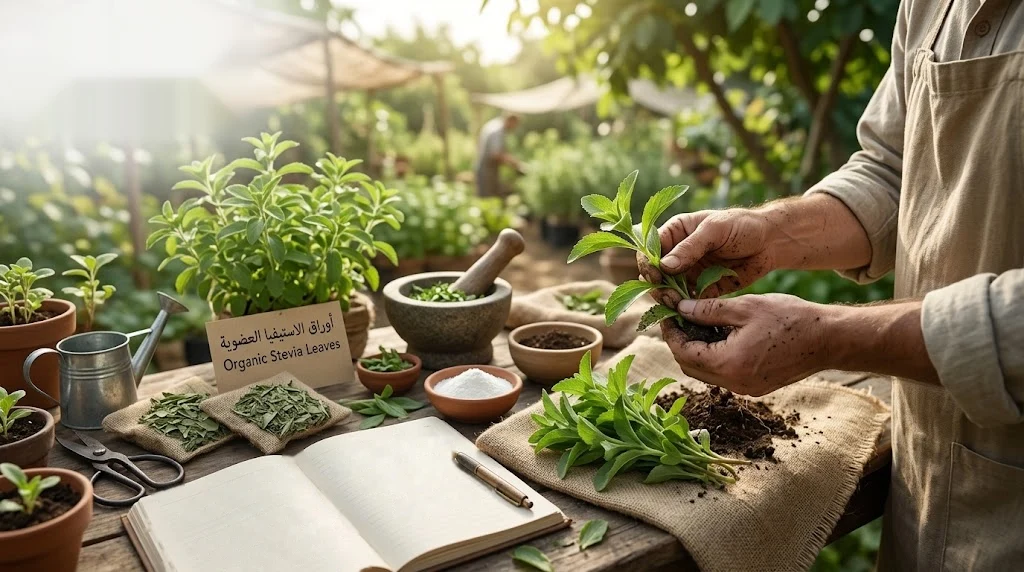
Quick answer: “organic stevia” means the stevia plant was grown without synthetic pesticides and fertilisers, and the product was made under organic rules and certified by an approved body. The sweet compounds themselves (steviol glycosides) are the same in organic and regular stevia, the acceptable daily intake is the same, and both have practically zero calories. The real difference is in how it is farmed and processed, not in sweetness or safety. Do not rely on the word “organic” alone: look for a clear certification logo.
The word “organic” on a pack of stevia suggests something purer and healthier, and it usually costs more. Is it worth it? This guide explains what “organic” really means, whether it changes taste or safety, why organic stevia Reb-M is so rare, and how to check that a product is truly organic.
What does “organic” mean for stevia?
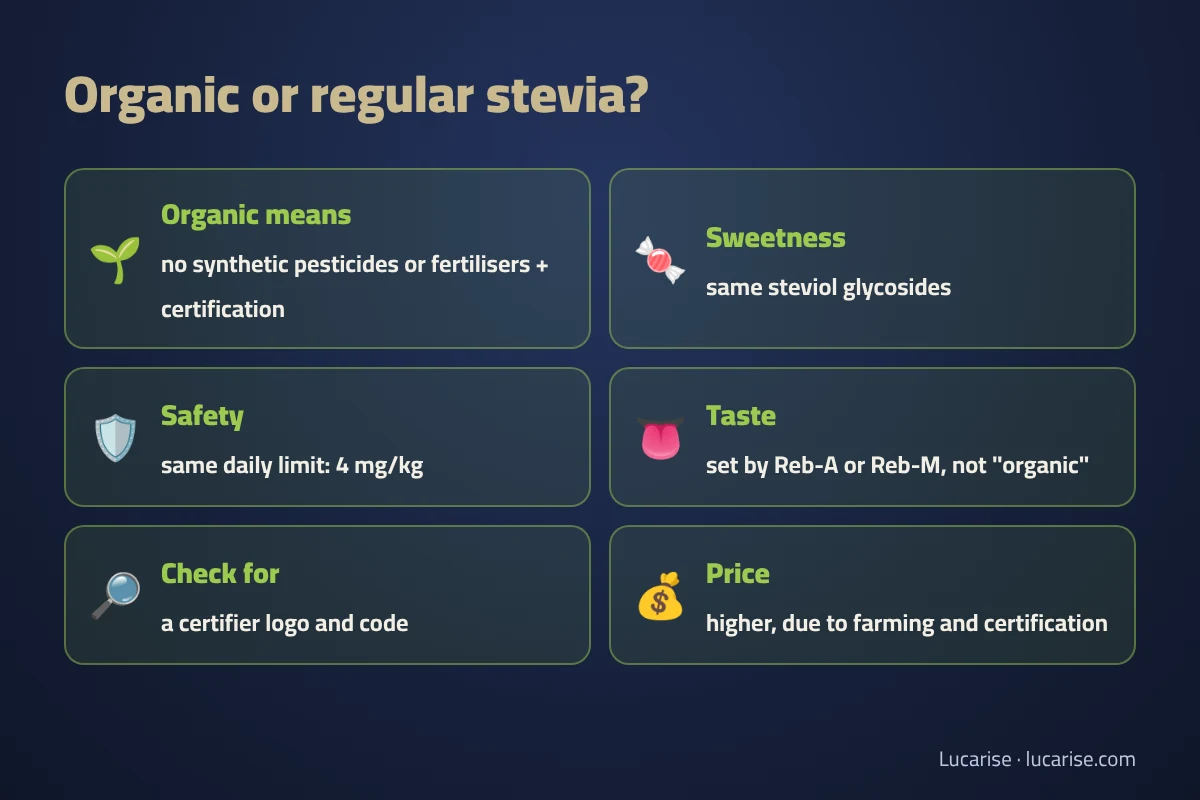
“Organic” is a legal description of how a product is made, not of its taste or chemistry. For stevia to carry an organic logo:
- The stevia plant is grown without synthetic pesticides and fertilisers, on land that follows organic farming rules.
- No GMOs are used, and no products made from or by GMOs, under EU rules [1].
- Extraction and purification use only processing aids that are allowed in organic production.
- An independent certification body inspects the farm and the factory, and its logo and code appear on the pack.
In the EU and under the US National Organic Program, at least 95% of the agricultural ingredients must be organic for a product to be labelled “organic”. “Made with organic ingredients” allows a lower share (70% under US rules) [2].
Is organic stevia healthier than regular stevia?
In terms of the sweetener itself, no. In both cases the sweetness comes from steviol glycosides, and regulators require a purity of at least 95% whether the product is organic or not. EFSA’s acceptable daily intake is the same too: 4 mg per kg of body weight (expressed as steviol) [3].
The real advantage of organic is about farming: a lower chance of pesticide residues, and a production method preferred by people who care about the environment. Nutritionally, a large systematic review found little strong evidence that organic foods are more nutritious [4]. With stevia in particular you use only a few milligrams per cup, so there is no meaningful nutritional difference.
For the full safety picture, read is stevia healthy?
Does organic stevia taste different?
Taste depends not on organic status but on the type of glycoside, its purity and what it is blended with. Common Reb-A stevia can leave a slight bitter aftertaste, while stevia Reb-M tastes closer to sugar. Green stevia leaf powder (organic or not) has a clear herbal taste and colour, so it does not suit every drink.
Why is organic stevia Reb-M so rare?
Reb-M occurs in the stevia leaf in tiny amounts, so most Reb-M on the market is produced by fermentation or by enzymatic conversion of stevia extract. EU organic rules prohibit products made by GMOs [1], and organic extraction needs organic leaves and organic processing aids, which raises costs. That is why most “organic stevia” products are Reb-A extract or leaf powder rather than Reb-M.
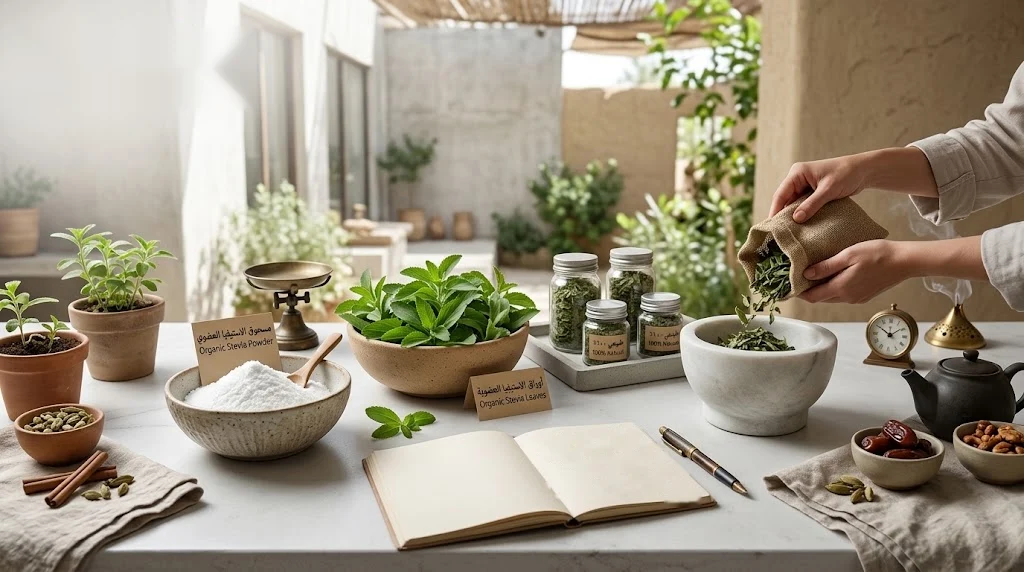
Types of stevia you will find on the shelf
| Type | Form | Taste | Note |
|---|---|---|---|
| Stevia leaf powder | green, ground leaves | herbal, can be bitter | sweetness not standardised; available organic |
| Reb-A extract | white powder or drops | sweet, sometimes slightly bitter | certified organic versions exist |
| Stevia with maltodextrin or dextrose | sugar-like sachets | sweet | the filler can raise blood sugar slightly |
| Stevia Reb-M with erythritol | sugar-like sachets | closest to sugar, no bitterness | zero calories, no blood-sugar rise; rarely organic |
To learn about the erythritol blended with stevia, read what is erythritol?
How to check that stevia is really organic
- A certification logo: such as the EU organic logo (the green leaf, with the control body code and place of farming), the USDA Organic seal, or the Saudi national organic products label issued by the Ministry of Environment, Water and Agriculture [5].
- “Natural” is not “organic”: words like “natural”, “plant-based” or “from stevia leaves” do not mean the product is certified organic.
- The ingredient list: see which ingredients are marked organic, and whether there are fillers such as maltodextrin or dextrose.
- Imported products: ask the seller for the organic certificate if the logo is not clear.
To tell genuine stevia from imitations, read how to spot real stevia.
Is organic stevia suitable for diabetes and keto?
Exactly like regular stevia: stevia itself does not raise blood sugar, organic or not. What matters is what it is blended with, because dextrose and maltodextrin are carbohydrates that can raise blood sugar slightly. Always read the label, and ask your doctor if you have a health condition. For details, read stevia for diabetics.
Organic or regular: how to choose
- If farming method matters to you: choose a product with a certified organic logo, and accept fewer taste options.
- If taste matters most: look for Reb-M on the label, as it is closest to sugar.
- If you want no blood-sugar rise: avoid products with dextrose or maltodextrin.
- Compare price per cup: not per pack, because sweetening strength varies between products.
Lucarise stevia sweetener
If you want a sugar-like taste without bitterness, Lucarise sweetener combines stevia Reb-M and erythritol in 1 g sachets, with no sugar and zero calories: Classic for coffee and tea, and Cardamom for karak and Arabic coffee. For everything stevia, see The Complete Stevia Guide.
🌿 Curious about the plant itself? Read stevia leaves: can you use them instead of sugar?
Organic is only one label claim. See types of stevia for the other things to check, such as Reb-M and the carrier.
Run a café, restaurant or shop?
Lucarise makes café drinks in business packs in our own factory in Oman: 1 kg café bags, 100-sachet hotel boxes and distributor cartons. Prices on request.
Organic stevia: FAQ
Is organic stevia better than regular stevia?
The sweetener and the acceptable daily intake are the same. Organic is better for people who care about farming methods and a lower chance of pesticide residues, but it is not sweeter and has no fewer calories.
Is organic stevia safer?
Regulators require at least 95% purity of steviol glycosides in all products, organic or not, and EFSA set the same acceptable daily intake of 4 mg per kg of body weight for all.
What is the difference between “organic” and “natural” stevia?
“Organic” is a legal term that needs certification by an approved body and a logo on the pack. “Natural” is a general marketing word that does not mean any certification.
Does organic stevia raise blood sugar?
Stevia itself does not raise blood sugar. If it is blended with dextrose or maltodextrin it can raise it slightly, so read the ingredient list.
Why is organic stevia more expensive?
It needs organically grown leaves, processing aids allowed in organic production, and inspection and certification by an independent body, all of which raise costs.
Are green stevia leaves always organic?
No. Dried or ground leaves are organic only if they carry organic certification. They also taste herbal and their sweetness is not standardised compared with purified extract.
Sources
- Regulation (EU) 2018/848 on organic production and labelling of organic products, Article 11 (prohibition on the use of GMOs). Official Journal of the European Union, 2018. eur-lex.europa.eu
- USDA Agricultural Marketing Service. Labeling organic products (National Organic Program). www.ams.usda.gov
- EFSA Panel on Food Additives and Nutrient Sources added to Food. Scientific opinion on the safety of steviol glycosides for the proposed uses as a food additive. EFSA Journal, 2010. doi:10.2903/j.efsa.2010.1537
- Smith-Spangler C. et al. Are organic foods safer or healthier than conventional alternatives? A systematic review. Annals of Internal Medicine, 2012. doi:10.7326/0003-4819-157-5-201209040-00007
- Saudipedia. Organic agriculture in Saudi Arabia (Saudi national organic products label). saudipedia.com


