
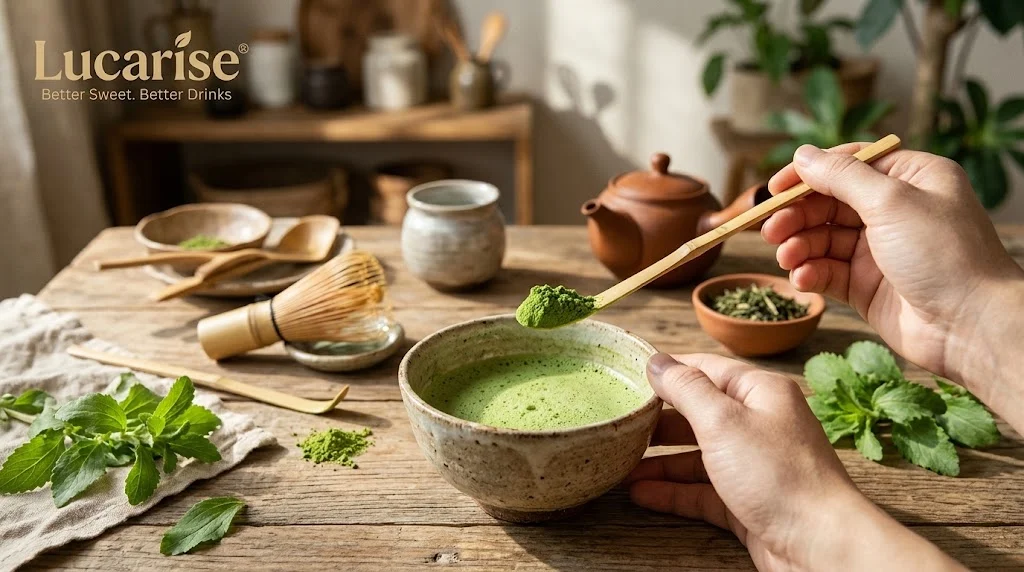
Quick answer: Real matcha is a powder made from shade-grown tea leaves ground very fine, and its only ingredient on the pack is “matcha”. The signs: bright green colour, a sweet grassy aroma, a texture as fine as eyeshadow, and a fine foam when whisked. Fake or poor matcha is often yellowish or olive, gritty, harshly bitter, or contains sugar, milk powder and added colours. Home tests are only indicators; the real proof is a lab analysis and the supplier’s certificates.
As matcha has spread across the Gulf, shelves have filled with green packs carrying the same name. Some are real matcha; others are ordinary green tea powder or sweetened mixes. This guide explains what makes matcha “real”, how to read the label, five simple tests you can do at home, and when you need a lab test.
What is real matcha?
Under the international standard ISO 20715:2023, matcha is tea made from leaves that are shaded before harvest, then steamed and dried without rolling, and ground into a fine powder [1]. Shading is the secret: it raises chlorophyll and L-theanine in the leaves, which give matcha its bright green colour and umami taste [2]. So powder made from ordinary green tea that was not shade-grown is not matcha, even if it is green and the pack says “matcha”.
What is “fake matcha”?
Fake matcha is rarely a powder with no tea in it. The three most common cases are:
- Ordinary green tea powder sold as matcha: cheaper, duller in colour and more bitter.
- A mix called “matcha” that contains sugar, milk powder or creamer, with only a small share of matcha.
- Old or poorly stored matcha: it was real, but it has oxidised, turned yellowish and lost its aroma.
A mix is not fake if it is clearly labelled as a mix. It becomes misleading when it is sold as “100% matcha”.
Read the label first
| What you see on the pack | What it means |
|---|---|
| Ingredients: matcha only (or “shade-grown powdered green tea”) | A good sign: pure matcha powder |
| “Green tea powder” | Often not matcha, just ground ordinary green tea |
| Sugar, milk powder, creamer, flavourings | A matcha latte mix, not pure matcha |
| Added colours (such as E141, or E102 with E133) | Real matcha does not need colouring |
| “Matcha flavour” | Tastes like matcha, but may contain little or no real matcha |
| Country of origin, best-before date and producer | A sign of transparency; if missing, be careful |
5 simple tests at home
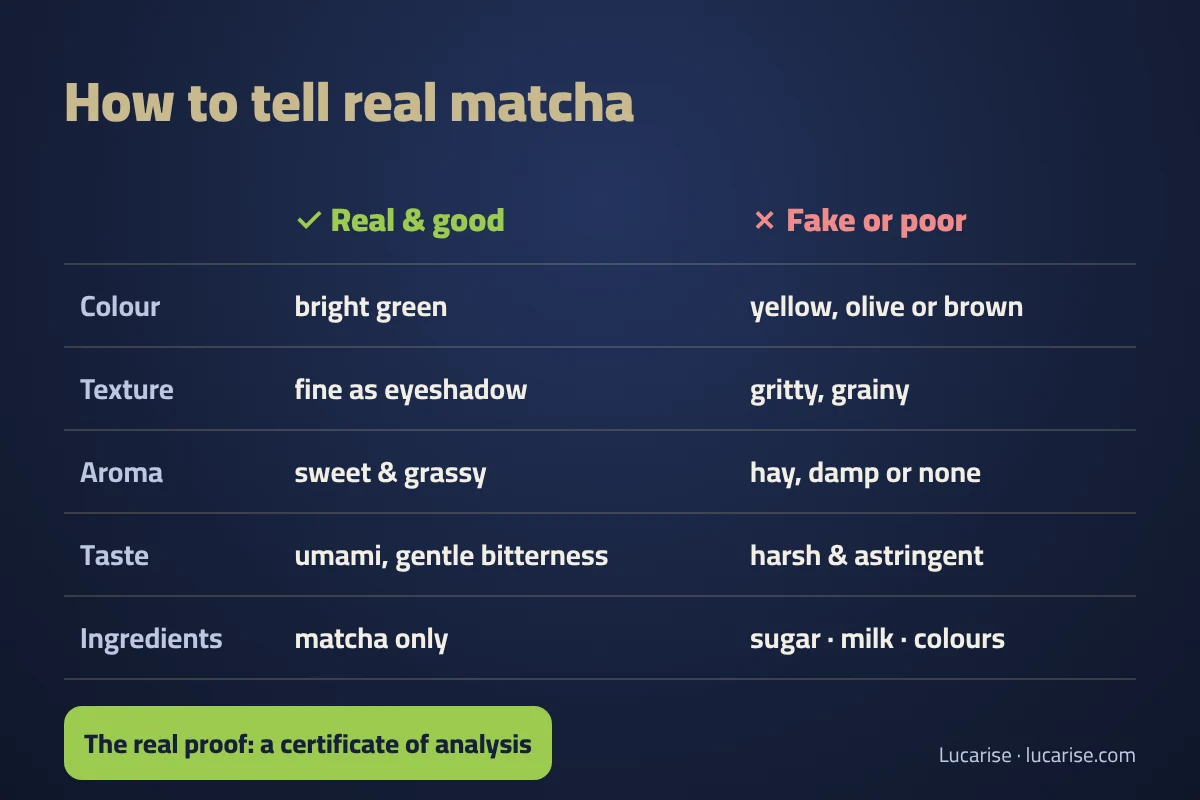
- Colour test: put a teaspoon on white paper in daylight. Good matcha is bright green; yellow, olive or brown suggests a lower grade or old powder.
- Smear test: smear a little powder across the paper with your finger. Good matcha leaves a smooth, even streak; coarse powder leaves grains and broken lines. Matcha is ground so fine that it clumps slightly from static electricity [4].
- Smell test: sweet, clean and grassy. A smell of hay or damp, or no smell at all, points to old powder.
- Whisk test: whisk 1 g with 70 ml of water at 75–80°C. Good matcha makes a fine foam with small bubbles, and the powder stays suspended in the water.
- Taste test: grassy, with sweetness, umami and gentle bitterness. Very harsh, astringent bitterness usually means ordinary green tea or a low grade.
Remember that these tests show quality more than authenticity: real culinary-grade matcha, for example, is duller and more bitter, and that is normal. For details, read matcha grades explained. If good matcha has turned dull at home, the cause may be storage: see how to store matcha.
Price: is cheap matcha always fake?
No, but price is a signal. Matcha needs shading, steaming and slow grinding, so high grades cannot sell at the price of ordinary green tea. If you find “premium matcha” at the price of plain tea powder, read the label carefully. On the other hand, a high price alone does not guarantee quality, as we explain in Japanese vs Chinese matcha.
When do you need a lab test?
If you buy wholesale for a café or shop, home tests are not enough. Ask the supplier for a certificate of analysis (COA) for each batch, covering pesticide residues, heavy metals and moisture, and if possible caffeine and L-theanine. Because you drink the whole leaf with matcha, this testing matters more than it does for steeped tea. Analyses of different commercial matcha found roughly 19–44 mg of caffeine per gram [3], so the difference between packs is large.
Real matcha or matcha latte mix?
| Pure matcha powder | Matcha latte mix | |
|---|---|---|
| Ingredients | Matcha only | Matcha with milk or creamer, sometimes sugar |
| Preparation | Needs whisking; sweeten as you like | Ready: add water or milk |
| Best use | Traditional matcha, lattes, baking | A quick cup at home or work |
| What to check | Colour, fineness, origin | Share of matcha and added sugar |
For the full comparison, read matcha powder vs matcha latte mix.
Lucarise matcha
We list the ingredients of every product clearly on the pack and on the product page. Try Lucarise matcha latte mix with no added sugar, or matcha powder to make your own. For everything matcha, start with The Complete Matcha Guide.
🛒 Looking for pure matcha? Browse Lucarise matcha powder: unsweetened ceremonial matcha in 1 g sachets, tins and capsules.
Run a café, restaurant or shop?
Lucarise makes café drinks in business packs in our own factory in Oman: 1 kg café bags, 100-sachet hotel boxes and distributor cartons. Prices on request.
Real matcha: FAQ
How can I tell if matcha is real?
Read the ingredients first: they should say “matcha” only. Then check the colour (bright green), texture (very fine), aroma (sweet and grassy) and the foam when whisked. For full certainty, ask the supplier for a certificate of analysis.
What colour is real matcha?
Bright green in higher grades, and a deeper or more olive green in culinary grades. Yellow or brown suggests old powder or ordinary green tea.
What is the difference between matcha and green tea powder?
Matcha comes from leaves shaded before harvest, steamed and dried without rolling, then ground very fine, so it is sweeter and richer in L-theanine. Green tea powder comes from ordinary unshaded leaves, so it is more bitter and duller in colour.
Is cheap matcha fake?
Not necessarily; it may be real culinary-grade matcha that suits baking and lattes. But if it is sold as “premium” at the price of plain tea powder, read the label and try the home tests.
Does real matcha dissolve in water?
Not completely. It stays suspended in the water because it is ground leaf, which is why you whisk it and drink it straight away. After a while it settles at the bottom, and that is normal.
Is matcha latte mix fake matcha?
No, as long as it is clearly labelled as a mix with its ingredients listed. It is misleading only when a mix with sugar and milk powder is sold as 100% matcha.
Sources
- ISO 20715:2023 Tea — Classification of tea types. International Organization for Standardization, 2023. www.iso.org
- Kochman J. et al. Health benefits and chemical composition of matcha green tea: a review. Molecules, 2021. doi:10.3390/molecules26010085
- Koláčková T. et al. Matcha tea: analysis of nutritional composition, phenolics and antioxidant activity. Plant Foods for Human Nutrition, 2020. doi:10.1007/s11130-019-00777-z
- Sawamura S. et al. Flowability properties of matcha varying with particle size and milling method. Nippon Shokuhin Kagaku Kogaku Kaishi, 2009. doi:10.3136/nskkk.56.103


