
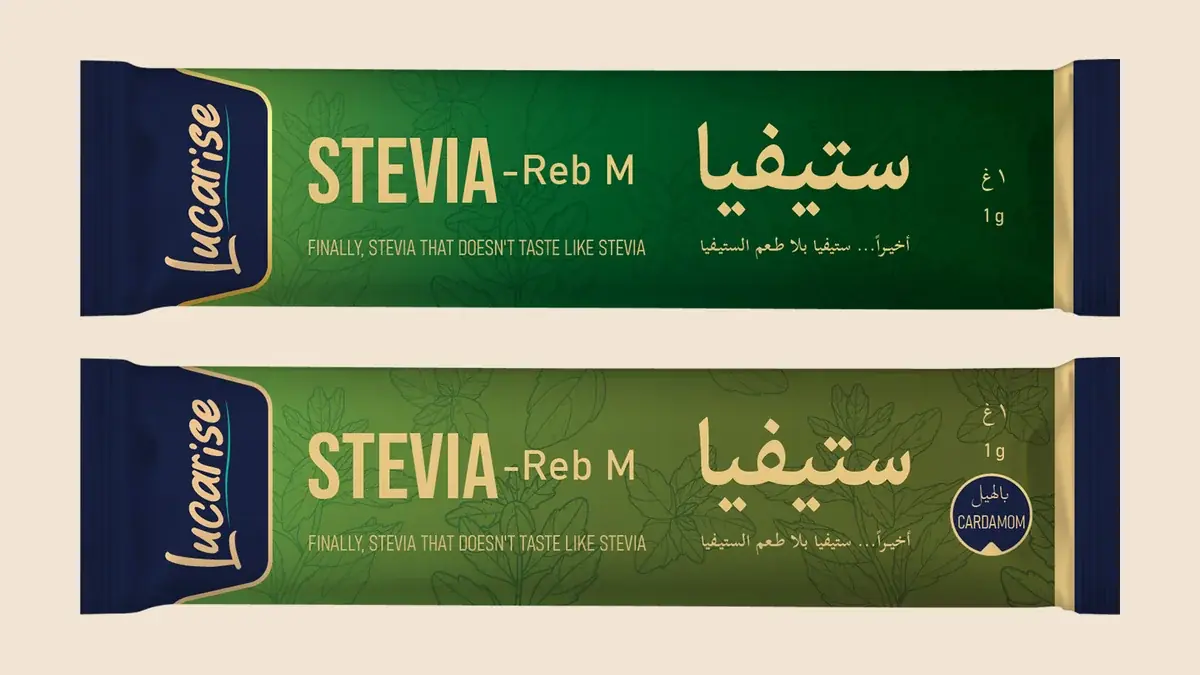
If you have ever tried a “stevia” sweetener and pushed the cup away because of a bitter, liquorice-like aftertaste, you are not alone – and you have almost certainly never tasted stevia Reb-M. In fact, Reb-M (short for rebaudioside M, and often written simply as “Reb M”) is one of the rarest and best-tasting sweet molecules found in the stevia leaf. It is roughly 200–350 times sweeter than sugar, contributes no calories, and in controlled sensory tests its bitterness was not significantly different from that of sugar itself.[1][2]
In this guide you will learn what stevia Reb-M is, why it tastes so different from ordinary stevia, how it is produced, what the world’s food-safety authorities have concluded about it, how it behaves in your body, and why we chose it to sweeten all sweetened Lucarise drinks and our tabletop sweetener sachets – the ones that carry the line “Finally, stevia that doesn’t taste like stevia.”
Key takeaways
- Stevia Reb-M (rebaudioside M) is a sweet compound that occurs naturally in the leaves of Stevia rebaudiana. It makes up only about 0.4–0.5% of the dried leaf, which is why the first generation of stevia sweeteners used other, more bitter glycosides instead.
- It is about 200–350 times sweeter than sugar with a clean, sugar-like taste; the bitterness and liquorice notes of classic stevia (rebaudioside A, stevioside) are largely absent.
- Reb-M provides zero calories and does not raise blood glucose or insulin.
- It is approved by JECFA (WHO/FAO), EFSA, the US FDA, the European Union (E 960a) and the GCC, with a lifetime Acceptable Daily Intake of 4 mg per kg of body weight (expressed as steviol).
- Lucarise uses leaf-extracted stevia Reb-M (≥95% purity) in all of its sweetened drinks and in its Classic and Cardamom sweetener sachets.
Stevia Reb-M, explained
What Reb-M is, and why we use it in our sweetened drinks.
What Is Reb M? (Stevia Reb-M Explained)
Stevia rebaudiana is a small shrub native to Paraguay, where its leaves have been used to sweeten mate and herbal infusions for centuries.[12] Above all, the sweetness comes from a family of molecules called steviol glycosides. Furthermore, every member of the family has the same core (steviol) decorated with a different number of sugar units – and that small structural difference decides how each one tastes.
The leaf contains dozens of steviol glycosides; however, a few dominate. Namely, stevioside (about 5–10% of the dried leaf) and rebaudioside A (about 2–4%) are the most abundant, and they were the basis of the first-generation stevia sweeteners that reached supermarket shelves around 2008. Rebaudioside M – Reb-M – is present at only about 0.4–0.5% of leaf dry weight.[3] Moreover, it was fully characterised only in the early 2010s, when it was briefly known as “rebaudioside X”.[1]
Chemically, Reb-M carries six glucose units on the steviol core, compared with four on rebaudioside A.[3] In short, those two extra sugars change how the molecule interacts with the taste receptors on your tongue – and that, as the next section explains, is the whole story of why Reb-M does not taste like “stevia”.
| Steviol glycoside | Share of dried leaf | Glucose units | Sweetness vs sugar | Taste profile |
|---|---|---|---|---|
| Stevioside | ~5–10% | 3 | ~200–300× | Noticeable bitterness and liquorice aftertaste |
| Rebaudioside A (Reb A) | ~2–4% | 4 | ~200–300× | Cleaner than stevioside, but still some bitter, lingering notes |
| Rebaudioside D (Reb D) | ~0.4–0.5% (together with Reb M) | 5 | ~200–300× | Clean, close to Reb-M |
| Rebaudioside M (Reb-M) | ~0.4–0.5% (together with Reb D) | 6 | ~200–350× | Clean and sugar-like; bitterness not significantly different from sugar |
Why Does Ordinary Stevia Have a Bitter Aftertaste?
In 2012, researchers at the Technical University of Munich and the German Institute of Human Nutrition tested nine steviol glycosides against all 25 human bitter-taste receptors. In particular, they found that steviol glycosides switch on two bitter receptors – hTAS2R4 and hTAS2R14 – at the same time as they activate the sweet receptor, so the brain registers “sweet” and “bitter” at once.[13]
The same study uncovered a simple rule: the more glucose units attached to the steviol core, the sweeter and the less bitter the molecule.[13] In other words, that rule explains the entire evolution of stevia sweeteners. For example, stevioside, with three glucose units, is the most bitter. Then, rebaudioside A, with four, is better and became the industry standard. Finally, rebaudioside M, with six, sits at the far end of the scale, with the sweetest and least bitter profile of the common glycosides.
What Does Stevia Reb-M Actually Taste Like?
Overall, sensory science is unusually consistent about Reb-M. When the molecule was first characterised, trained tasting panels reported significantly reduced bitterness, astringency and bitter lingering compared with rebaudioside A, together with a faster onset of sweetness – so the sweetness arrives when sugar’s would, rather than a beat later.[1]
Likewise, a 2020 study in the journal Foods compared sucrose, Reb A, Reb D and Reb M at matched sweetness levels with consumer panels. The bitterness of Reb D and Reb M was not significantly different from sucrose, while Reb A was clearly more bitter. However, the one remaining difference was a slightly longer-lasting sweetness than sugar – a gentle lingering sweetness rather than a bitter tail.[2]
In plain language: Reb-M tastes like sugar that stays a moment longer. That is why we could finally print “stevia that doesn’t taste like stevia” on a box and mean it.
Stevia Reb-M vs Sugar, Reb A and Erythritol
| Property | Table sugar (sucrose) | Stevia Reb A | Stevia Reb-M | Erythritol |
|---|---|---|---|---|
| Sweetness vs sugar | 1× | ~200–300× | ~200–350× | ~0.6–0.7× |
| Calories | 4 kcal/g | 0 | 0 | Practically zero (0–0.2 kcal/g) |
| Effect on blood glucose | Raises it | None | None | None |
| Bitter aftertaste | None | Noticeable | Not significantly different from sugar | None (mild cooling sensation) |
| Tooth-friendly | No – fermented by plaque bacteria | Yes | Yes | Yes |
| Origin | Sugar cane or beet | Stevia leaf | Stevia leaf | Fermentation of glucose; also found in fruits |
| Safety evaluations | – | JECFA, EFSA, FDA, EU, GCC | JECFA, EFSA, FDA, EU, GCC | JECFA, EFSA, FDA, EU (E 968) |
How Is Stevia Reb-M Made? The Three Production Routes
Because Reb-M is so scarce in the leaf, the industry has developed three ways to produce it, and food-safety authorities have evaluated each route separately:
- Leaf extraction and purification. Dried stevia leaves are steeped in hot water; the extract is clarified, passed through ion-exchange and adsorption resins and crystallised, and the Reb-M fraction is enriched to 95% purity or more. This is the traditional route, covered by the original FDA GRAS notices (for example GRN 473, 2013) and by the EU specification for “steviol glycosides from Stevia”, E 960a.[9][10]
- Enzymatic bioconversion. Instead, abundant rebaudioside A from the leaf is converted into Reb-M by glucosyltransferase enzymes that attach the two extra glucose units. The EU lists this material separately as E 960c(i).[10]
- Fermentation. Alternatively, engineered yeast (such as Yarrowia lipolytica) is fed simple sugars and produces Reb-M directly. The EU authorised fermentation-derived steviol glycosides as E 960b in 2025.[14]
Ultimately, all three routes yield the same molecule, and at its 102nd meeting in 2026 JECFA concluded that the newer production methods raise no additional safety concerns.[7] Therefore, the difference is mostly one of labelling and consumer preference: only leaf-extracted Reb-M can literally be described as extracted from the stevia plant.
What “Fermented Sugarcane Reb-M” Means on a Label
Some brands describe their sweetener as “Reb M from fermented sugarcane” or “fermented cane sugar Reb-M”. This is the fermentation route above: the yeast is fed sugar that comes from sugarcane, and it turns that sugar into Reb-M. The yeast uses up the sugar during fermentation, and the Reb-M is then separated and purified, so the finished sweetener is a high-purity steviol glycoside rather than sugar. It is assessed against the same acceptable daily intake as leaf-extracted steviol glycosides (0–4 mg per kg of body weight per day, expressed as steviol).[7]
| Production route | Wording you may see (varies by brand and country) | EU additive number |
|---|---|---|
| Leaf extraction | Stevia leaf extract, Reb M from stevia leaf | E 960a |
| Fermentation | Fermented Reb M, Reb M from fermented sugarcane | E 960b |
| Enzymatic bioconversion | Bioconverted Reb M, enzymatically produced Reb M | E 960c |
In other words, “fermented” describes how the Reb-M was made, not a different sweetener. If you specifically want Reb-M that comes from the stevia plant itself, look for “stevia leaf extract” or E 960a on the label.
The stevia Reb-M used in Lucarise products is extracted from stevia leaves and purified to a minimum of 95% rebaudioside M, according to our supplier’s specification. We chose the leaf route deliberately because, when we say “from the stevia leaf”, we want it to be literally true.
Is Stevia Reb-M Safe? What the Authorities Say
Indeed, steviol glycosides are among the most thoroughly reviewed sweeteners in the world:
- JECFA (WHO/FAO). The Joint FAO/WHO Expert Committee on Food Additives established an Acceptable Daily Intake (ADI) of 0–4 mg per kg of body weight per day, expressed as steviol, in 2008, based on a no-observed-effect level of 970 mg/kg bw/day in long-term studies and a 100-fold safety factor. At its 102nd meeting (2026) JECFA reconfirmed this ADI and reviewed the newer Reb-M production methods.[7]
- EFSA (European Union). The European Food Safety Authority reached the same ADI in 2010 and concluded that steviol glycosides are not carcinogenic, genotoxic or associated with any reproductive or developmental toxicity.[8] Later, in 2024, EFSA re-examined the evidence and kept the ADI at 4 mg/kg bw per day.[15]
- US FDA. High-purity steviol glycosides, including Reb-M, are Generally Recognized as Safe (GRAS). Moreover, the FDA issued its “no questions” letter for Reb-M (then called rebaudioside X) in December 2013 under GRAS Notice 473.[9]
- European Union. Reb-M is permitted as a component of E 960a (steviol glycosides from Stevia) and, depending on the production method, as E 960c(i) or E 960b.[10][14]
- GCC, including Oman. Steviol glycosides (INS 960) are permitted food additives under the Gulf standard GSO 2500, “Additives Permitted for Use in Food Stuffs”.[11]
What does the ADI mean in practice?
For a 70 kg adult, 4 mg/kg works out to 280 mg of steviol per day – equivalent to roughly 1.1 g of pure Reb-M (using the EU conversion factor of 0.25 for rebaudioside M).[10] Because Reb-M is about 250 times sweeter than sugar, that amount delivers the sweetness of roughly 70 teaspoons of sugar – every day, for a lifetime, with a 100-fold safety margin already built in. In comparison, sweetening a cup of tea takes only about 15–20 mg of Reb-M.
Stevia Reb-M, Calories and Blood Sugar
First of all, your body cannot digest steviol glycosides for energy. Instead, they pass through the stomach and small intestine unchanged; in the colon, gut bacteria strip off the glucose units (which the bacteria use, not you), leaving steviol. Next, steviol is absorbed, bound to glucuronic acid in the liver and excreted in the urine.[4][5] As a result, there are zero calories and no glucose entering the bloodstream.
Clinical studies also confirm this. In a crossover trial, participants who ate a stevia-sweetened preload before lunch had significantly lower post-meal glucose than after a sucrose preload, and lower insulin than after both sucrose and aspartame – without eating more at the next meal.[6] Similarly, a 2019 trial found that a stevia drink behaved like water on blood glucose, while reducing hunger and not increasing later energy intake.[16]
Additionally, the European Union authorises two health claims for foods and drinks in which sugar is replaced by intense sweeteners such as steviol glycosides: compared with sugar-containing products, they contribute to the maintenance of tooth mineralisation and induce a lower blood-glucose rise after consumption.[17]
A Balanced Word About Sweeteners and Weight
In May 2023 the World Health Organization issued a conditional recommendation against using non-sugar sweeteners – stevia included – as a tool for controlling body weight or reducing the risk of non-communicable diseases, because long-term observational studies have not shown a lasting weight benefit. The guideline explicitly does not apply to people with pre-existing diabetes, and it does not question the safety of approved sweeteners.[18]
Our position, therefore, is simple. Reb-M is a way to enjoy a sweet karak or cappuccino without sugar; it is not a weight-loss product, and any sweetener works best as part of an overall balanced diet.
Why We Blend Reb-M With Erythritol
To begin with, pure Reb-M is so potent that a sachet of it alone would hold a pinch too small to see. Tabletop sweeteners therefore need a carrier that gives volume, dissolves cleanly and rounds out the sweetness. For this reason, we use erythritol, a sugar alcohol that occurs naturally in fruits such as pears, melons and grapes and is produced commercially by fermenting glucose. In addition, it is about 70% as sweet as sugar, contributes practically no calories, does not raise blood sugar or insulin, and is tooth-friendly.[19]
Erythritol was re-evaluated by EFSA in 2023. Specifically, EFSA set an ADI of 0.5 g per kg of body weight per day – a precaution against laxative effects at high doses – and concluded that the available evidence does not show a connection between erythritol and an increased risk of cardiovascular disease, and that it is not genotoxic.[19] On the other hand, a 2023 observational study in Nature Medicine reported an association between high blood erythritol levels and cardiovascular events, and showed that a 30 g dose raised blood erythritol in eight volunteers; its authors called for long-term studies.[20]
For context, one Lucarise sachet weighs 1 g in total – about one-thirtieth of the dose used in that experiment – and the erythritol in it is there to carry the Reb-M, not to be eaten by the spoonful. Meanwhile, we follow this research closely and will update this page as the evidence evolves.
Lucarise and Stevia Reb-M
We are a beverage maker based in Oman, and we built our product line around a simple promise: café-style drinks with no added sugar that still taste like a treat. Every sweetened Lucarise drink – our karak teas, matcha lattes, cappuccinos and 2-in-1 coffee mix – is sweetened with stevia Reb-M rather than sugar or first-generation stevia.
In addition, for the cup you make yourself, we offer two tabletop sweeteners, each a 1 g single-serve sachet of stevia Reb-M blended with erythritol:
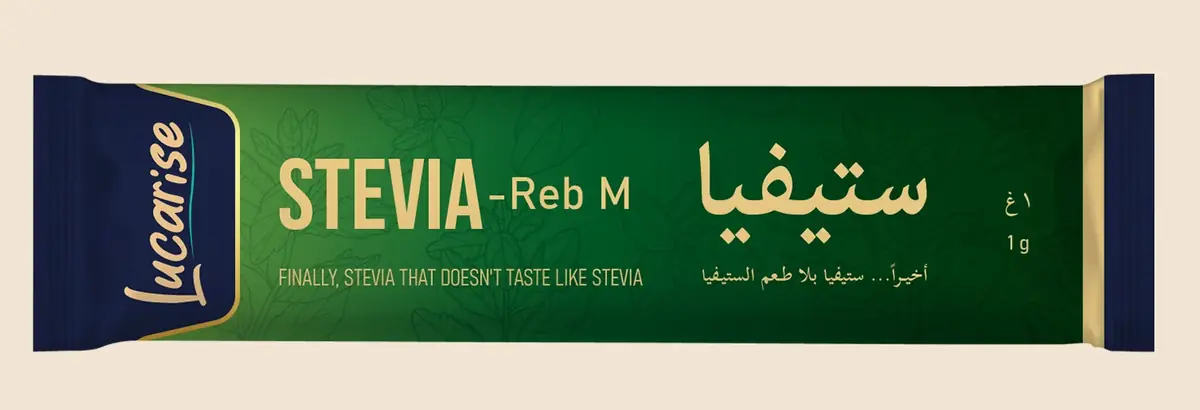
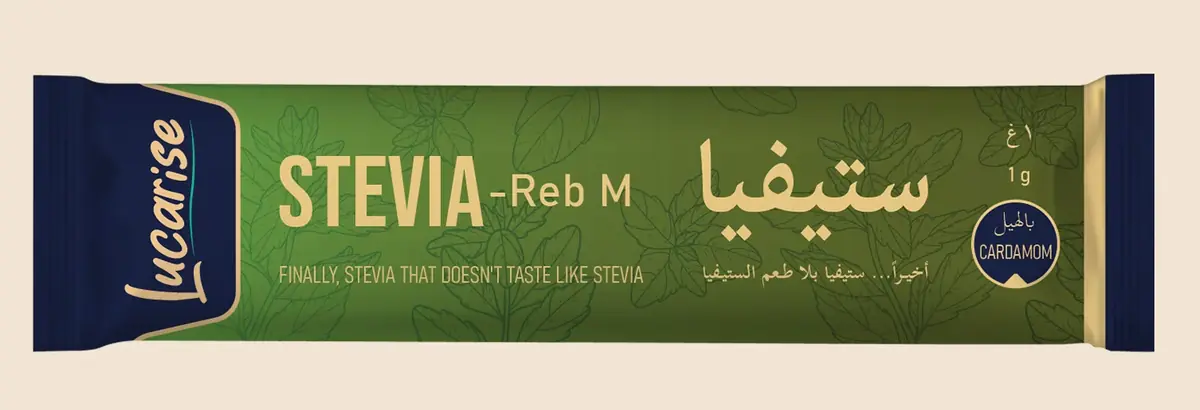
After all, the line on the box – “Finally, stevia that doesn’t taste like stevia” – is a promise, and this article is the science behind it. You can find both sachets in our natural sweeteners range, and you can taste Reb-M at work in our no-added-sugar karak and matcha lattes.
How to Use Stevia Reb-M Sachets
First, start with one sachet per cup of tea or coffee and then adjust to taste. Reb-M also dissolves in both hot and cold drinks, and steviol glycosides are stable at normal cooking and baking temperatures and across the acidity range of everyday foods, so the sachets also work in oatmeal, yoghurt, lemonade and baking. Because the sweetness lingers slightly longer than sugar’s, many people find they need a little less than they expect.
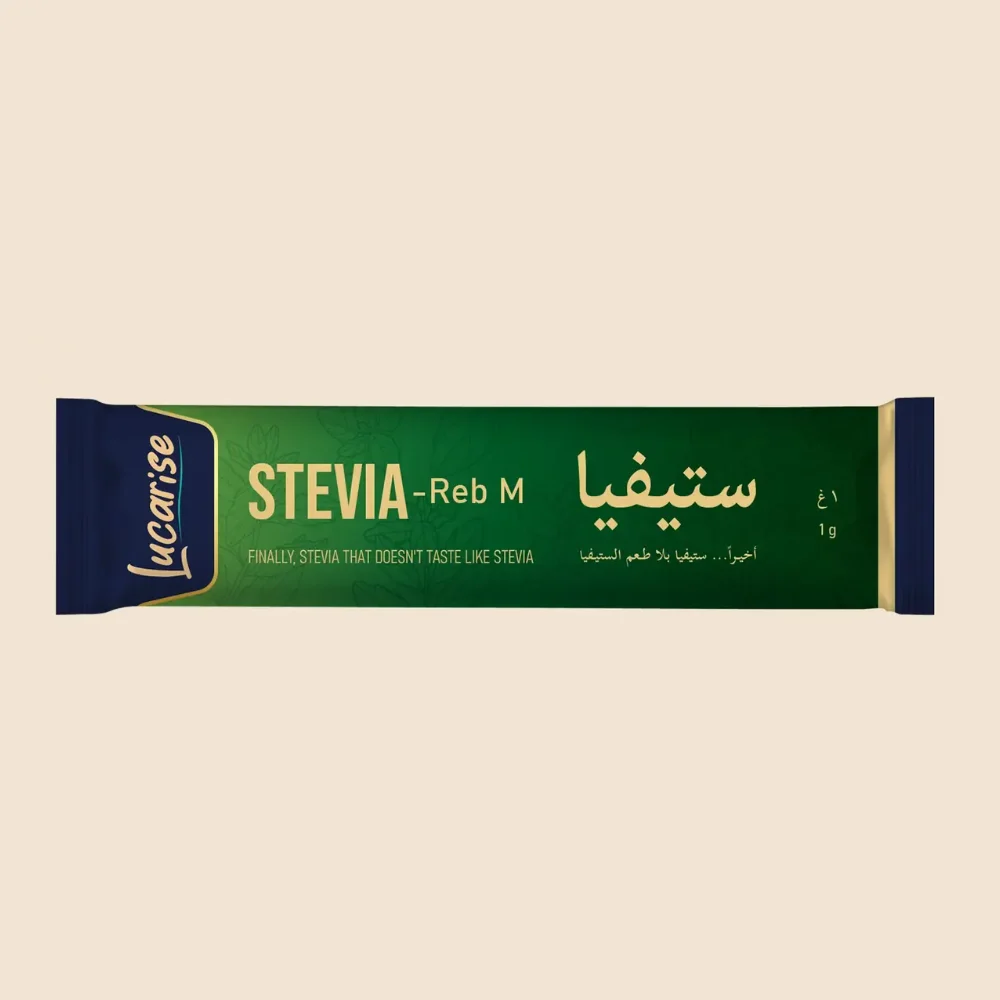
Finally, stevia that doesn’t taste like stevia
Two 1 g sachets, Classic and Cardamom, each blending stevia Reb-M with erythritol. One sachet per cup is a good start.
Where to Buy Stevia Reb-M in Oman and the GCC
Lucarise makes its stevia Reb-M sweeteners in the Sohar Free Zone, Oman, and delivers within Oman and to the other GCC countries: the UAE, Saudi Arabia, Qatar, Kuwait and Bahrain. Both tabletop versions come as 1 g single-serve sachets of Reb-M blended with erythritol:
- Stevia Reb-M Sweetener – Classic: clean, neutral sweetness for tea, coffee, yoghurt and baking.
- Stevia Reb-M Sweetener – Cardamom: the same sweetness with a hint of cardamom, made for karak and Arabic coffee.
If you would rather have the drink ready-made, every Lucarise karak tea, matcha latte and cappuccino has no added sugar: the topping flavours are sweetened with stevia Reb-M in the mix, and the classic flavours come with a separate stevia Reb-M sachet so you can sweeten them your way. For cafés, hotels, offices and distributors in the Gulf, wholesale prices and bulk packs are available through Lucarise for Business.
Swapping sugar for stevia in a recipe or drink? Use our stevia to sugar conversion calculator to work out how much you need.
Keep reading
Frequently Asked Questions About Stevia Reb-M
What is Reb M sweetener?
Reb M sweetener is made from rebaudioside M (Reb-M), one of the sweet compounds in the stevia leaf. It is roughly 200–350 times sweeter than sugar and contributes no calories, so only a tiny amount is needed. Tabletop sweeteners usually blend it with a carrier such as erythritol so that a serving is easy to measure; Lucarise sachets blend Reb-M with erythritol.
What is fermented Reb M?
Fermented Reb M is made by engineered yeast (such as Yarrowia lipolytica) that is fed simple sugars and produces Reb-M directly. The molecule is the same as leaf-extracted Reb-M, and the EU authorised fermentation-derived steviol glycosides as E 960b in 2025. The Reb-M in Lucarise products is extracted from stevia leaves, according to our supplier’s specification.
Does fermented sugarcane Reb-M contain sugar?
No. Sugar from sugarcane is only the food for the yeast. It is used up during fermentation, and the Reb-M is then purified, so the finished sweetener is a steviol glycoside that adds sweetness without the calories of sugar. See what fermented sugarcane Reb-M means on a label.
Is Reb M bad for you?
Reb-M is approved by JECFA (WHO/FAO), EFSA, the US FDA, the European Union and the GCC, with an Acceptable Daily Intake of 4 mg per kg of body weight (expressed as steviol). As with any sweetener, moderation is sensible, and if you have a medical condition, follow your doctor’s advice.
Is stevia Reb-M natural?
Rebaudioside M is a molecule that occurs naturally in the stevia leaf. Whether a particular product’s Reb-M counts as “natural” depends on how it was produced: leaf-extracted Reb-M comes directly from the plant, while bioconverted and fermented Reb-M are the identical molecule made with enzymes or yeast. Lucarise uses leaf-extracted Reb-M.
Is Reb-M the same thing as stevia?
“Stevia” on a label usually means a mixture of steviol glycosides dominated by rebaudioside A or stevioside. By contrast, Reb-M is one specific glycoside – the one with the cleanest taste. In short, all Reb-M is stevia, but most stevia is not Reb-M. For the wider picture, see our stevia sugar guide.
Does stevia Reb-M have an aftertaste?
In controlled sensory tests, the bitterness of Reb-M was not significantly different from sugar’s; the only measurable difference was a slightly longer-lasting sweetness.[2] In other words, people who dislike the aftertaste of classic stevia products are usually reacting to rebaudioside A or stevioside.
Is stevia Reb-M suitable for people with diabetes?
Steviol glycosides do not raise blood glucose or insulin, and the WHO’s 2023 advice against sweeteners for weight control explicitly excludes people with pre-existing diabetes.[6][18] Even so, if you manage diabetes, discuss any change in your diet with your doctor or dietitian. For a practical guide, read Stevia for diabetics: is it safe?
Is Reb-M suitable for children and during pregnancy?
The JECFA and EFSA ADI is set to protect the whole population, including children, and EFSA found no reproductive or developmental toxicity.[7][8] As with any food, moderation applies, and pregnant women should follow their physician’s advice.
Is stevia Reb-M keto-friendly?
Yes. Reb-M contains no digestible carbohydrate and does not affect blood glucose or insulin. Erythritol, the carrier in our sachets, is also widely used in ketogenic diets because it is not metabolised into glucose.
Is stevia Reb-M approved in Oman and the GCC?
Yes. Steviol glycosides (INS 960) are permitted food additives under the GCC standard GSO 2500,[11] and, in addition, Reb-M is approved by JECFA, EFSA and the US FDA.
Does Reb-M lose its sweetness when heated?
No. Steviol glycosides are stable at cooking and baking temperatures and across the acidity range of normal foods, which is why they are used in hot drinks, baked goods and soft drinks alike.
Related reading: comparing all your options? See our guide to natural sweeteners.
References
Sources 1–10
- Prakash I, Markosyan A, Bunders C. Development of Next Generation Stevia Sweetener: Rebaudioside M. Foods. 2014;3(1):162–175. doi:10.3390/foods3010162
- Tao R, Cho S. Consumer-Based Sensory Characterization of Steviol Glycosides (Rebaudioside A, D, and M). Foods. 2020;9(8):1026. doi:10.3390/foods9081026
- Olsson K, Carlsen S, Semmler A, Simón E, Mikkelsen MD, Møller BL. Microbial production of next-generation stevia sweeteners. Microbial Cell Factories. 2016;15:207. doi:10.1186/s12934-016-0609-1
- Magnuson BA, Carakostas MC, Moore NH, Poulos SP, Renwick AG. Biological fate of low-calorie sweeteners. Nutrition Reviews. 2016;74(11):670–689. doi:10.1093/nutrit/nuw032
- Samuel P, Ayoob KT, Magnuson BA, et al. Stevia Leaf to Stevia Sweetener: Exploring Its Science, Benefits, and Future Potential. The Journal of Nutrition. 2018;148(7):1186S–1205S. doi:10.1093/jn/nxy102
- Anton SD, Martin CK, Han H, et al. Effects of stevia, aspartame, and sucrose on food intake, satiety, and postprandial glucose and insulin levels. Appetite. 2010;55(1):37–43. doi:10.1016/j.appet.2010.03.009
- Joint FAO/WHO Expert Committee on Food Additives (JECFA). Steviol glycosides – evaluations of the 69th meeting (2008) and 102nd meeting (2026). JECFA database entry
- EFSA Panel on Food Additives and Nutrient Sources added to Food (ANS). Scientific Opinion on the safety of steviol glycosides for the proposed uses as a food additive. EFSA Journal. 2010;8(4):1537. doi:10.2903/j.efsa.2010.1537
- US Food and Drug Administration. GRAS Notice No. GRN 000473 – Rebaudioside X (rebaudioside M); FDA “no questions” letter, 17 December 2013. FDA GRAS Notice inventory
- Commission Regulation (EU) 2021/1156 of 13 July 2021 amending the rules on steviol glycosides (E 960a, E 960c) and setting specifications, including steviol conversion factors. EUR-Lex
Sources 11–20
- GCC Standardization Organization. GSO 2500:2015 – Additives Permitted for Use in Food Stuffs. GSO store
- Institute of Food Science & Technology (IFST). Stevia – a non-caloric sweetener of natural origin. Information Statement, 2023. ifst.org
- Hellfritsch C, Brockhoff A, Stähler F, Meyerhof W, Hofmann T. Human Psychometric and Taste Receptor Responses to Steviol Glycosides. Journal of Agricultural and Food Chemistry. 2012;60(27):6782–6793. doi:10.1021/jf301297n · TUM press release
- Commission Regulation (EU) 2025/652 of 2 April 2025 authorising steviol glycosides produced by fermentation (E 960b). EUR-Lex
- EFSA Panel on Food Additives and Flavourings (FAF). Scientific opinion on the extension of the authorisation of use of the food additive steviol glycosides (E 960a–d) and the modification of the acceptable daily intake (ADI) for steviol. EFSA Journal. 2024;22(11):e9045. doi:10.2903/j.efsa.2024.9045
- Farhat G, Berset V, Moore L. Effects of Stevia Extract on Postprandial Glucose Response, Satiety and Energy Intake: A Three-Arm Crossover Trial. Nutrients. 2019;11(12):3036. doi:10.3390/nu11123036
- Commission Regulation (EU) No 432/2012 establishing a list of permitted health claims – entries for sugar replacers (maintenance of tooth mineralisation; reduction of post-prandial glycaemic responses). EUR-Lex
- World Health Organization. WHO advises not to use non-sugar sweeteners for weight control in newly released guideline. 15 May 2023. who.int
- EFSA Panel on Food Additives and Flavourings (FAF). Re-evaluation of erythritol (E 968) as a food additive. EFSA Journal. 2023;21(12):e8430. doi:10.2903/j.efsa.2023.8430
- Witkowski M, Nemet I, Alamri H, et al. The artificial sweetener erythritol and cardiovascular event risk. Nature Medicine. 2023;29:710–718. doi:10.1038/s41591-023-02223-9
This article was written by the Lucarise product team at Food Legend Industries, Oman, and last reviewed in October 2026. It is provided for general information and does not replace advice from a doctor or dietitian.
Try Lucarise before you buy
Free samples are available for cafés, hotels, offices and distributors in Oman and the GCC.


