
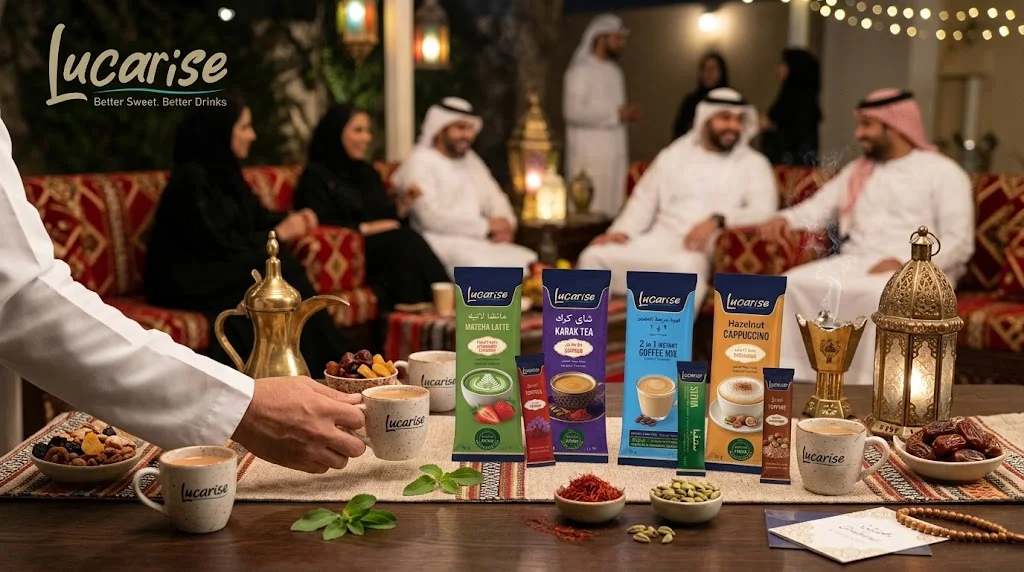
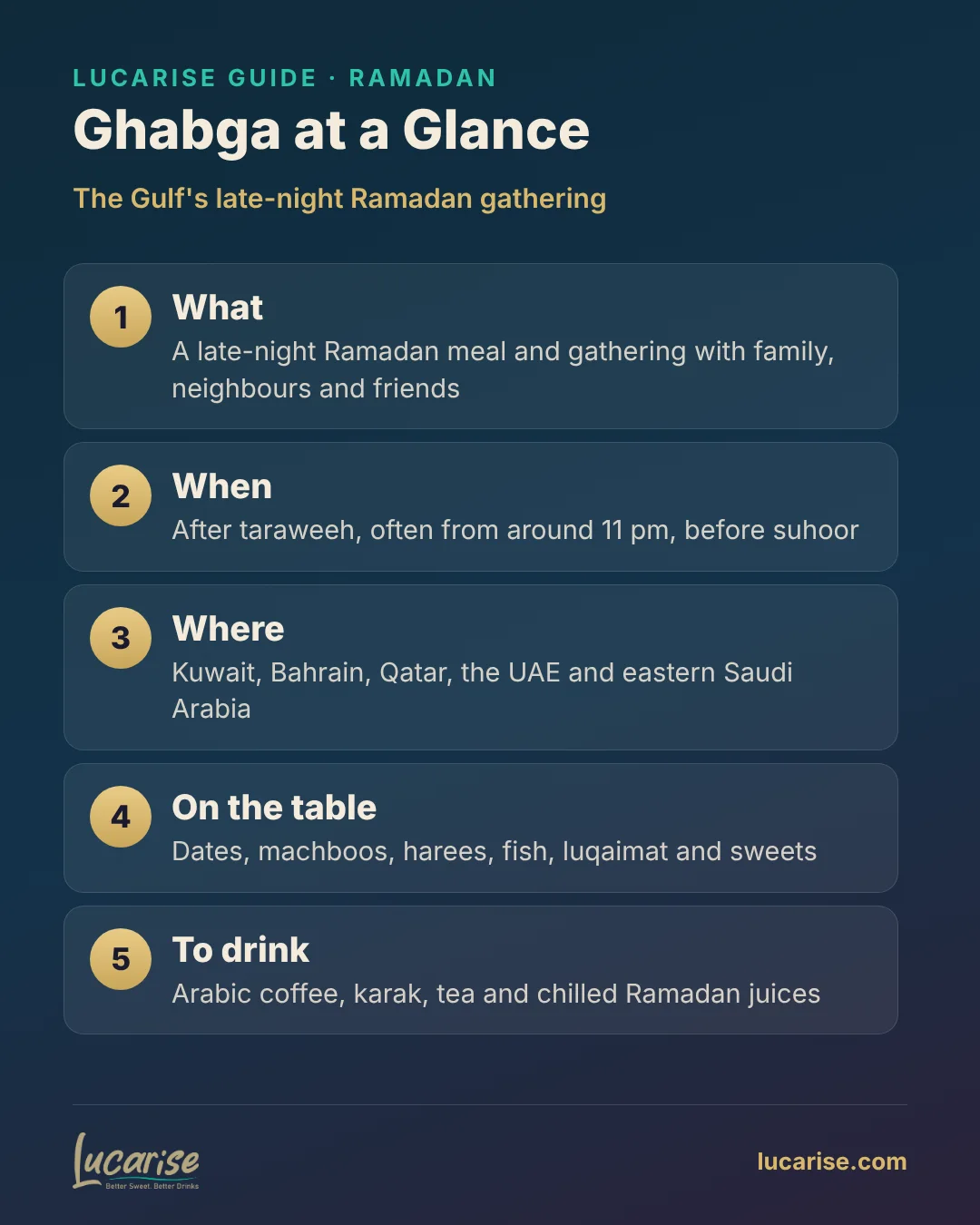
What is ghabga? Ghabga (غبقة, also written ghabqa) is a late-night Ramadan meal and gathering in the Gulf. Family, neighbours and friends meet after taraweeh prayers, often from around 11 pm, and share food, Arabic coffee and conversation before suhoor. The word comes from the Arabic ghabuq, a drink taken in the evening.
If you spend Ramadan in Kuwait, Bahrain, Qatar or the UAE, sooner or later someone will invite you to a ghabga. It is not iftar and it is not suhoor, but the relaxed evening in between, when the fast is over, the prayers are done and the dallah stays warm until late. This guide explains what the word means, where the tradition comes from, what is served, and how to host a ghabga at home.
What Does Ghabga Mean?
Ghabga comes from the classical Arabic ghabuq (غَبوق), a drink taken in the evening. Lisan al-Arab defines ghabq as drinking at the end of the day, the opposite of sabuh (صَبوح), the morning drink, and some scholars limit ghabuq to milk drunk at that time.1 In desert life it often meant camel milk drunk at night.6 Over time, the name moved from the evening drink to the late evening meal, and in Gulf dialect today ghabga means the late Ramadan dinner before suhoor.6,9
In English, ghabga is usually described as a late-night Ramadan meal or gathering. There is no exact translation, so Gulf media simply use the Arabic word.
Where Does the Ghabga Tradition Come From?
The word is most closely tied to Kuwait, where it has long described the Ramadan gatherings held between iftar and suhoor.2 Similar late-night visits already existed elsewhere in the Gulf, and today the name is used across Bahrain, Qatar, the UAE and eastern Saudi Arabia.2,7,9 In Qatar, the Ramadan ghabqa was added to the national inventory of intangible cultural heritage in 2015.4
Older generations see it as a way of keeping the neighbourhood close: the host invites the people of the fareej to his majlis after the night prayer, and the evening is spent talking about family news and the old days.5
When Is Ghabga Held?
- After taraweeh. The gathering starts after the night prayer, when families are home again.2,3
- Late in the evening. It often begins around 11 pm and runs towards midnight or later.7
- Before suhoor. It is a separate occasion from suhoor, the meal before dawn.2
- Not every night. A ghabga happens when someone invites, so it is not a daily meal.4
- Also in the last ten nights. In Qatar, some ghabgas are held after the late-night qiyam prayers of the last ten nights.5
Ghabga, Iftar and Suhoor: What Is the Difference?
| Meal | When | What it is like |
|---|---|---|
| Iftar | At sunset (maghrib) | Breaking the fast with water and dates, then the main family meal |
| Ghabga | After taraweeh, late evening | A social gathering with guests, lighter dishes, sweets, coffee and tea |
| Suhoor | Before dawn (fajr) | The last meal before the fast, usually at home |
What Is Served at a Ghabga?
There is no fixed menu. A traditional ghabga serves popular Gulf dishes, and the spread is usually lighter than iftar: dates, small savoury dishes and desserts.2,5 Common choices include:
- Dates, which open almost every Gulf gathering.
- Machboos, rice cooked with spiced chicken or lamb and dried lime (loomi).8
- Harees and jareesh, slow-cooked crushed wheat with meat.8
- Fish, a coastal favourite, such as farsh fish served with rice in the UAE.6
- Luqaimat, small fried dough balls with date syrup or sugar syrup.7,8
- Sweets and fruit to finish the evening.
Modern ghabgas mix these with grills, pastries and international dishes, and many hotels and Ramadan tents now host ghabga buffets.3,7
Drinks at a ghabga
Arabic coffee is poured all evening, together with karak, tea and chilled Ramadan juices.2,7 At Qatari ghabqas, guests help themselves from free-flowing pots of karak and kahwa.4 For the customs of pouring and drinking, see our guide to Arabic coffee etiquette in Ramadan.
How to Host a Ghabga at Home: Ideas
Plan the evening
- Guests: family, friends and neighbours, and sometimes colleagues.2
- Time: after taraweeh. Guests often arrive gradually and stay late, so there is no need for a strict start.2
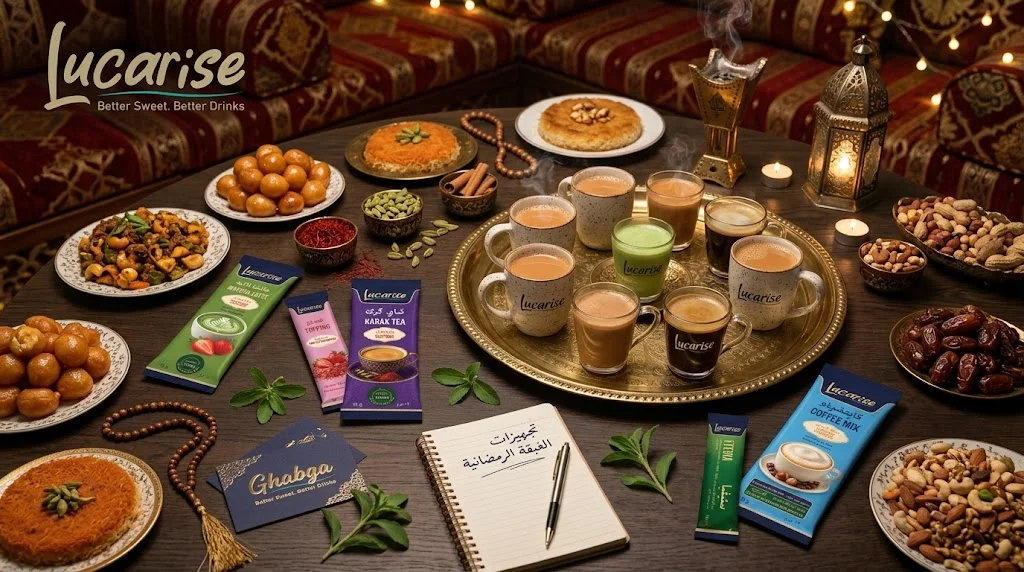
- Place: the majlis or the living room, with cushions, lanterns and simple Ramadan decorations.2
- Dress: in Emirati homes, many women and girls wear colourful mukhawar chosen for the evening.2
Menu ideas
Choose one main dish, such as machboos or harees, two or three small savoury dishes, dates and fruit, and one or two sweets such as luqaimat. Guests have already had a big iftar, so smaller portions and finger food work better than a second full dinner.
A drinks station
Set up a self-serve corner: a dallah of Arabic coffee with dates, a pot of karak, and a jug of cold karkade or laban. Plan about three small finjans of coffee per guest. For 10 guests that is around 30 finjans, roughly 3 litres of water and 180 g of Arabic coffee; for 20 guests, double it. Our Arabic coffee calculator and karak tea calculator work out the exact amounts.
Watch the sugar
Ramadan juices are where most of the sugar hides. In our data, one 240 ml glass of jallab carries about 34 g of free sugar (8 teaspoons) and Vimto about 30 g (7 teaspoons), and a cafeteria cup of karak about 20 g. Arabic coffee and unsweetened karkade have none. See all ten drinks in how much sugar is in Ramadan drinks.
Serve water, laban and unsweetened karkade next to the sweet drinks, and put stevia sachets beside the karak and tea. Instant karak sachets with no added sugar let each guest sweeten their own cup.
Hosting a ghabga at the office?
Many companies hold a ghabga for staff and clients during Ramadan. For office pantry drinks and Ramadan gift boxes, see Lucarise for offices and gifting.
Ghabga Etiquette for Guests
- Come after the invitation time. Guests usually arrive through the evening, so a little late is fine.2
- Take the coffee cup with your right hand, and gently shake it when you have had enough.
- A small gift such as dates, sweets or coffee is a kind gesture, but it is not expected.
- Leave in good time before suhoor, so your hosts can rest.
Mid-Ramadan brings another Gulf tradition for children: what is Gergean, when is it in 2027, and treat-bag ideas.
Explore more drinks from the region on our Gulf drinks map, with the signature drinks of Oman, Saudi Arabia, the UAE, Qatar, Kuwait and Bahrain.
Ghabga: Frequently Asked Questions
What is ghabga in English?
A late-night Ramadan meal or gathering, held after taraweeh prayers and before suhoor. There is no exact English word, so the Arabic name ghabga (or ghabqa) is used.
What does the word ghabga mean?
It comes from the Arabic ghabuq, a drink taken in the evening, often milk. It is the opposite of sabuh, the morning drink. In Gulf dialect today, ghabga means the late Ramadan dinner before suhoor.
Is ghabga the same as suhoor?
No. Suhoor is the last meal before dawn, eaten before the fast begins. Ghabga is a social gathering earlier in the night, usually with guests.
What time is ghabga?
After taraweeh prayers, often from around 11 pm until midnight or later.
Which countries celebrate ghabga?
It is most closely linked to Kuwait and is also common in Bahrain, Qatar, the UAE and eastern Saudi Arabia.
What is served at a ghabga?
Dates, Gulf dishes such as machboos, harees and fish, sweets such as luqaimat, and Arabic coffee, karak, tea and Ramadan juices.
Keep Reading
- Ramadan drinks: a guide for iftar and suhoor
- How much sugar is in Ramadan drinks?
- Arabic coffee etiquette in Ramadan
- Caffeine in Ramadan: when to drink coffee and tea
- Karak tea recipe
- Ramadan gift ideas: gift boxes for family, hosts and colleagues
References
- Lisan al-Arab (Ibn Manzur), entry غبق
- Gulf News: Embracing tradition: Ramadan ghabga in Emirati homes explained (March 2026)
- Qatar News Agency: Ramadan ghabga, an enduring tradition uniting Qatar’s community (March 2025)
- Doha News: Ramadan in Qatar: what is a ghabqa?
- الجزيرة نت: بين «الغبقة» وأهازيج «القرنقعوه»: كيف تحافظ قطر على طقوسها الرمضانية؟ (فبراير 2026)
- الإمارات اليوم: ماهي «الغبقة» الرمضانية؟ (يونيو 2017)
- Curly Tales: Ramadan: what is ghabga and where can you find one in the GCC? (March 2025)
- Kuwait Times: Taste of Kuwait in Ramadan (March 2025)
- اليوم: رمضان «الشرقية» غير (مايو 2018)


