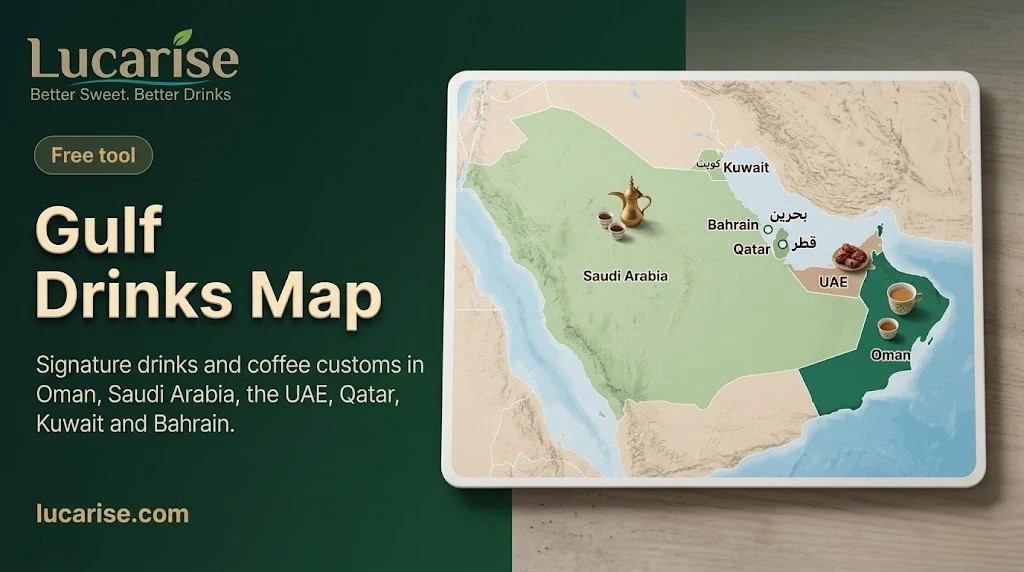
What do people drink across the Gulf? This Gulf drinks map answers that in one tap. First, choose a country. Then see its signature drinks, how people serve them and a simple way to try them at home. For example, you will find Omani qahwa with halwa, karak in Qatar and tea in a Kuwaiti diwaniya. In short, each country has its own way of welcoming a guest.

What the Gulf shares: coffee, dates and a warm welcome
Across the Gulf, offering coffee is the first act of hospitality. In fact, UNESCO inscribed “Arabic coffee, a symbol of generosity” on its list of intangible cultural heritage in 2015, nominated by the UAE, Saudi Arabia, Oman and Qatar, and the listing was extended in 2024. Traditionally, the host prepares the coffee in front of guests. First, the beans are lightly roasted. Then they are pounded in a mortar, boiled in a large pot and finally poured into small cups. Also, the host serves the most important or oldest guest first and fills each cup only part of the way. As a rule, it is polite to drink at least one cup and no more than three.1
Dates go hand in hand with coffee because Gulf coffee traditionally has no sugar. Meanwhile, karak tea, a sweet, spiced milk tea brought by South Asian communities, has become an everyday drink across the region.8
Gulf drinks at a glance
| Country | Signature drinks | Typical flavours |
|---|---|---|
| Oman | Omani qahwa, karak tea | Cardamom, saffron, rosewater; served with dates and halwa |
| Saudi Arabia | Saudi coffee, Khawlani coffee beans | Cardamom with saffron, cloves, mastic, cinnamon or ginger by region |
| UAE | Gahwa, karak chai | Cardamom; some homes add rose water |
| Qatar | Arabic coffee, karak, saffron tea | Cardamom, evaporated milk, saffron |
| Kuwait | Tea and Arabic coffee in the diwaniya | Cinnamon tea with breakfast, saffron and cardamom tea after lunch |
| Bahrain | Gahwa | Cardamom, cloves or saffron; never sweetened with sugar |
Bring Gulf hospitality home
Hosting soon? Then plan coffee and karak for your gathering with the Arabic coffee calculator and the karak tea calculator, read our guides to Arabic coffee, Saudi coffee and karak tea, or browse all our free tools. In addition, Lucarise makes Arabic coffee with cardamom and karak tea in Sohar, Oman.
☕ From Oman: Omani Coffee (Kahwa): How to Make It and How It Is Served.
Run a café, restaurant or shop?
Lucarise makes café drinks in business packs in our own factory in Oman: 1 kg café bags, 100-sachet hotel boxes and distributor cartons. Prices on request.
Gulf drinks: frequently asked questions
What is the traditional drink of the Gulf countries?
Arabic coffee, often called gahwa or qahwa. Usually it is lightly or medium roasted and boiled with cardamom, and sometimes also with saffron, cloves or rosewater. Then it is served in small cups with dates. In fact, UNESCO lists it as intangible cultural heritage.
How is Omani coffee different?
Omani qahwa usually has cardamom, saffron and rosewater, and it comes with dates, fruit and Omani halwa. Moreover, many families still roast and grind the beans themselves.
What is Khawlani coffee?
Khawlani coffee is grown on terraces in the mountains of south-western Saudi Arabia by the Khawlani tribes, who have cultivated it for more than 300 years. UNESCO added the knowledge and practices of growing it to its heritage list in 2022.
Is karak a Gulf drink?
Karak arrived with South Asian communities in the middle of the 20th century. Since then, it has become part of daily life across the Gulf, especially in the UAE and Qatar, where cafeterias and tea shops sell it by the cup.
Why do you shake the cup when drinking Arabic coffee?
Gently shaking the empty cup before handing it back tells the host you have had enough. On the other hand, handing it back without shaking means you would like more.
Sources
- UNESCO. Arabic coffee, a symbol of generosity (decision 10.COM 10.B.32, 2015). ich.unesco.org
- UNESCO. Arabic coffee, a symbol of generosity, extended nomination (decision 19.COM 7.B.55, 2024). ich.unesco.org
- UNESCO. Knowledge and practices related to cultivating Khawlani coffee beans (2022). ich.unesco.org
- UNESCO. The Diwaniya, a unifying cultural practice in Kuwait (2025). ich.unesco.org
- Oman Observer. Omani qahwa: the essence of Omani hospitality. omanobserver.om
- University of Illinois, Salaam. Khaleeji hospitality: coffee and dates. salaam.illinois.edu
- Department of Culture and Tourism Abu Dhabi. Gahwa, Arabic coffee. abudhabiculture.ae
- Michelin Guide. Tea in the UAE: meet karak chai (2023). guide.michelin.com
- Al Jazeera. How samovar tea is warming hearts in Qatar (2022). aljazeera.com
- Marhaba. Teas of the Arab world. marhaba.qa
- Wikipedia. Kuwaiti tea; Diwaniya. wikipedia.org
- Revista Cafeicultura. Coffee culture: what’s brewing in Bahrain. revistacafeicultura.com.br
- Gulf Daily News. Workshop focuses on serving Arabic coffee (2023). gdnonline.com


