
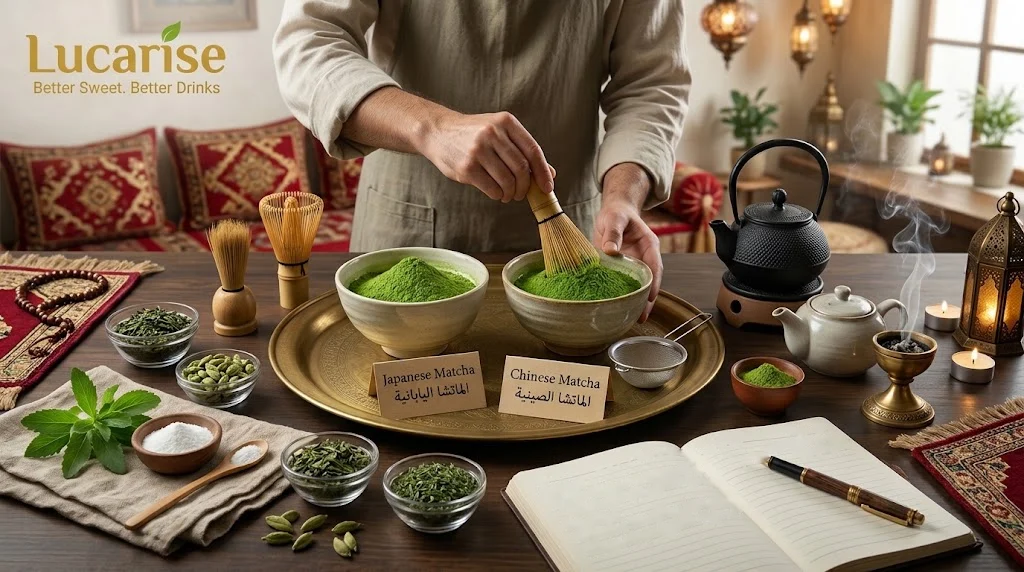
Quick answer: Japanese and Chinese matcha are made in almost the same way: shade-grown tea leaves that are steamed, dried and ground into a fine powder. The real differences are in origin, soil, tea cultivars, grinding method and price. Premium Japanese matcha (from Uji or Nishio, for example) suits matcha whisked with water, while good Chinese matcha is a practical choice for lattes and baking. What matters more than the country: colour, aroma, fineness and the ingredients list.
If you shop for matcha, you will notice some packs say “Japanese” and others “Chinese”, and the price gap can be large. So is Chinese matcha a “fake”? And is every Japanese matcha better? This guide compares them calmly: how each is made, where they really differ, and how to choose the right one for what you want to make.
What makes a powder “matcha”?
The international standard ISO 20715:2023 defines matcha as tea from the tea plant that is shaded before harvest, then steamed and dried without rolling (a stage called “tencha”), and ground into a fine powder [1]. The definition does not name a country, so matcha can be made in Japan, China or elsewhere as long as it follows these steps. Powder made from ordinary green tea that was not shade-grown is “green tea powder”, not matcha, even if it looks green.
Japanese matcha
Japan is the home of matcha as we know it today. Its best-known regions are Uji in Kyoto and Nishio in Aichi, along with Shizuoka and Kagoshima. Premium grades usually have a very bright green colour and a sweet, umami-rich taste with gentle bitterness, because growers choose specific tea cultivars and take great care over shading and the first harvest; shading raises chlorophyll and L-theanine in the leaves, which give the green colour and umami taste [3]. Higher grades are traditionally ground in slow stone mills that protect the flavour, which is one reason they cost more.
Chinese matcha
China is the world’s largest tea producer and has moved into matcha on a large scale in recent years. Guizhou province, for example, began experimenting with matcha in 2015 and now ranks first in China for matcha production and sales; the city of Tongren has a plant described as the world’s largest single matcha processing facility, with a capacity of 4,000 tonnes a year [2]. Chinese matcha is widely used in drinks, desserts and food manufacturing, and its quality ranges from excellent to ordinary, just like Japanese matcha.
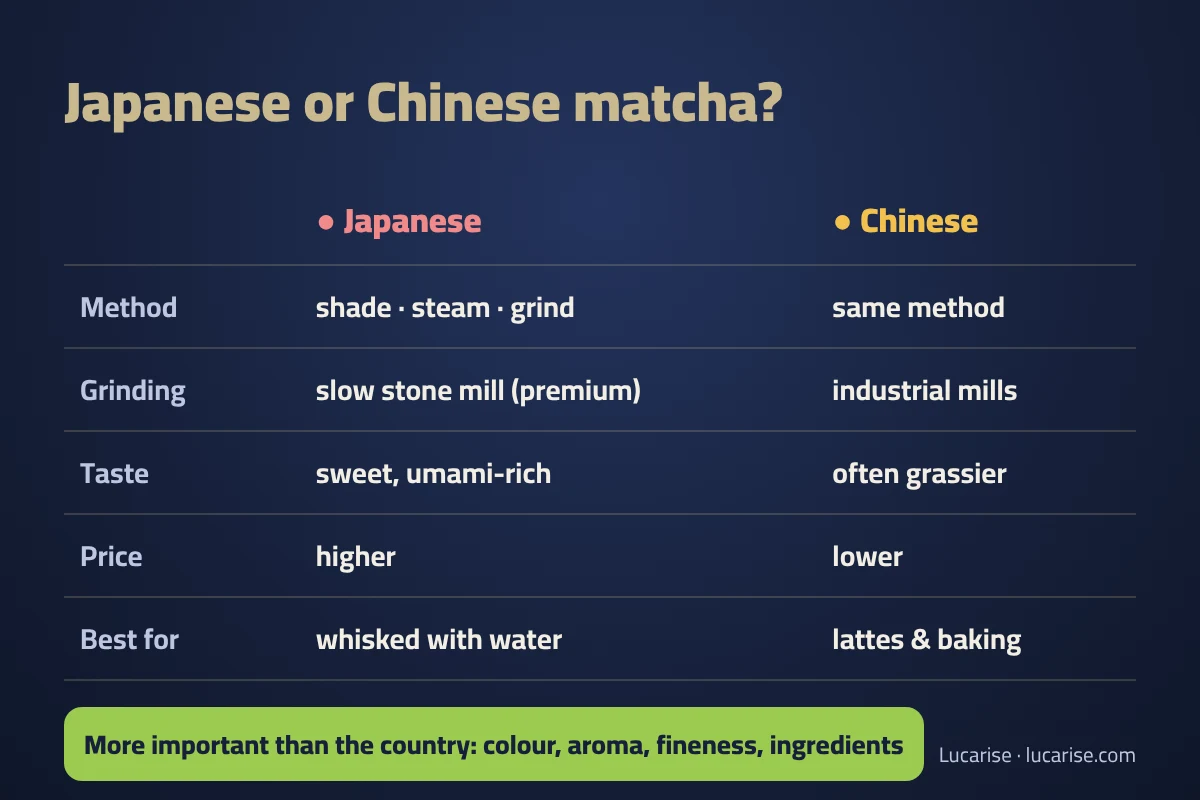
Japanese vs Chinese matcha: quick comparison
| Factor | Japanese matcha | Chinese matcha |
|---|---|---|
| How it is made | Shading, then steaming, drying and grinding | The same method at serious producers |
| Grinding | Premium grades often slow stone mills | Often modern industrial mills at large volumes |
| Taste | Premium: sweet and umami-rich, gentle bitterness | Varies a lot; can be grassier or more astringent |
| Colour | Bright green in higher grades | From bright green to olive, depending on grade |
| Price | Usually higher | Usually lower |
| Best use | Matcha whisked with water (usucha) and premium lattes | Lattes, iced drinks and baking |
These are general trends, not fixed rules: there is cheap, ordinary Japanese matcha and excellent Chinese matcha. So don’t judge a pack by the country name alone.
How to choose matcha, whatever the country
- Colour: bright green means shaded, fresh leaves. Yellow or brown suggests a lower grade or old powder.
- Aroma: sweet, clean and grassy, not like hay or damp.
- Fineness: a very fine, talc-like powder that whisks without grains.
- Ingredients: “100% matcha” only. If you see sugar, milk powder or flavourings, it is a matcha latte mix, not pure matcha.
- Origin and date: good brands state the country, ideally the region, and a best-before date.
- Testing: ask the supplier for pesticide and heavy-metal test certificates that meet your country’s rules, whether the matcha is Japanese or Chinese.
For full details on grades, read matcha grades explained. To spot fake matcha, see how to tell real matcha.
Which matcha suits you?
| What you want to make | Best choice | Why |
|---|---|---|
| Matcha whisked with water only | High-grade Japanese | With no milk, quality and bitterness show clearly |
| Everyday matcha latte | Good Japanese or Chinese | Milk softens the taste, so you don’t need the top grade |
| Iced matcha and fruit drinks | Chinese or latte-grade Japanese | Other flavours cover the fine differences |
| Cakes, cookies and desserts | Culinary grade (Japanese or Chinese) | Heat and sugar change the flavour, and it costs less |
If you are new to matcha, start with a matcha latte, then try traditional whisked matcha once you are used to the taste.
Is Chinese matcha safe?
Safety is not decided by the country name but by whether the producer follows food-safety standards. Any matcha, Japanese or Chinese, must meet the pesticide and heavy-metal limits of the country where it is sold. Because you drink the whole leaf with matcha, this testing matters more than it does for steeped tea. Buy from a brand that states the origin and can show you test certificates on request. Caffeine, too, varies by grade rather than by country: analyses found roughly 19–44 mg per gram across different commercial matcha [4].
Lucarise matcha
For a ready cup, try Lucarise matcha latte mix with no added sugar, or matcha powder to make your own. For everything matcha, start with The Complete Matcha Guide.
🛒 Looking for pure matcha? Browse Lucarise matcha powder: unsweetened ceremonial matcha in 1 g sachets, tins and capsules.
Run a café, restaurant or shop?
Lucarise makes café drinks in business packs in our own factory in Oman: 1 kg café bags, 100-sachet hotel boxes and distributor cartons. Prices on request.
Japanese vs Chinese matcha: FAQ
What is the difference between Japanese and Chinese matcha?
Both are made from shade-grown tea leaves that are steamed, dried and ground. The differences are origin, soil, cultivars, grinding method and price. Premium Japanese matcha is sweeter and more umami-rich, while Chinese matcha is usually cheaper and suits lattes and baking.
Is Chinese matcha good?
Yes, there is very good Chinese matcha, and quality varies from producer to producer. Judge it by colour, aroma, fineness, ingredients and test certificates, not by the country name alone.
Why is Japanese matcha more expensive?
Because of farming and labour costs in Japan, the choice of specific cultivars, the first harvest, and slow stone-milling for premium grades, plus the reputation of regions such as Uji and Nishio.
How can I tell if matcha is really Japanese?
Read the pack: it should state the country of origin (Japan), ideally the region and producer. “Japanese-style” does not mean it was made in Japan.
Which matcha is best for lattes?
A good latte-grade Japanese or Chinese matcha is enough, because milk softens the taste. Save the expensive grades for matcha whisked with water.
Is Chinese matcha safe?
Yes, if it meets the food-safety rules of your country. Any matcha, Japanese or Chinese, should be tested for pesticides and heavy metals, so buy from a brand that states the origin and provides test certificates.
Sources
- ISO 20715:2023 Tea — Classification of tea types. International Organization for Standardization, 2023. www.iso.org
- CGTN: Not made in Japan: the matcha truth behind Guizhou’s green gold, 2026. news.cgtn.com
- Kochman J. et al. Health benefits and chemical composition of matcha green tea: a review. Molecules, 2021. doi:10.3390/molecules26010085
- Koláčková T. et al. Matcha tea: analysis of nutritional composition, phenolics and antioxidant activity. Plant Foods for Human Nutrition, 2020. doi:10.1007/s11130-019-00777-z


