
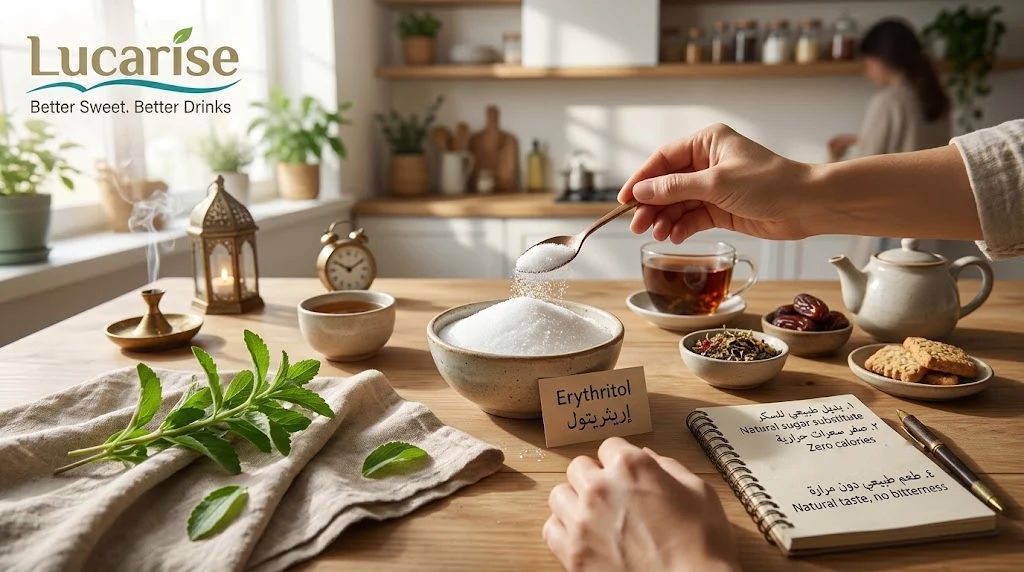
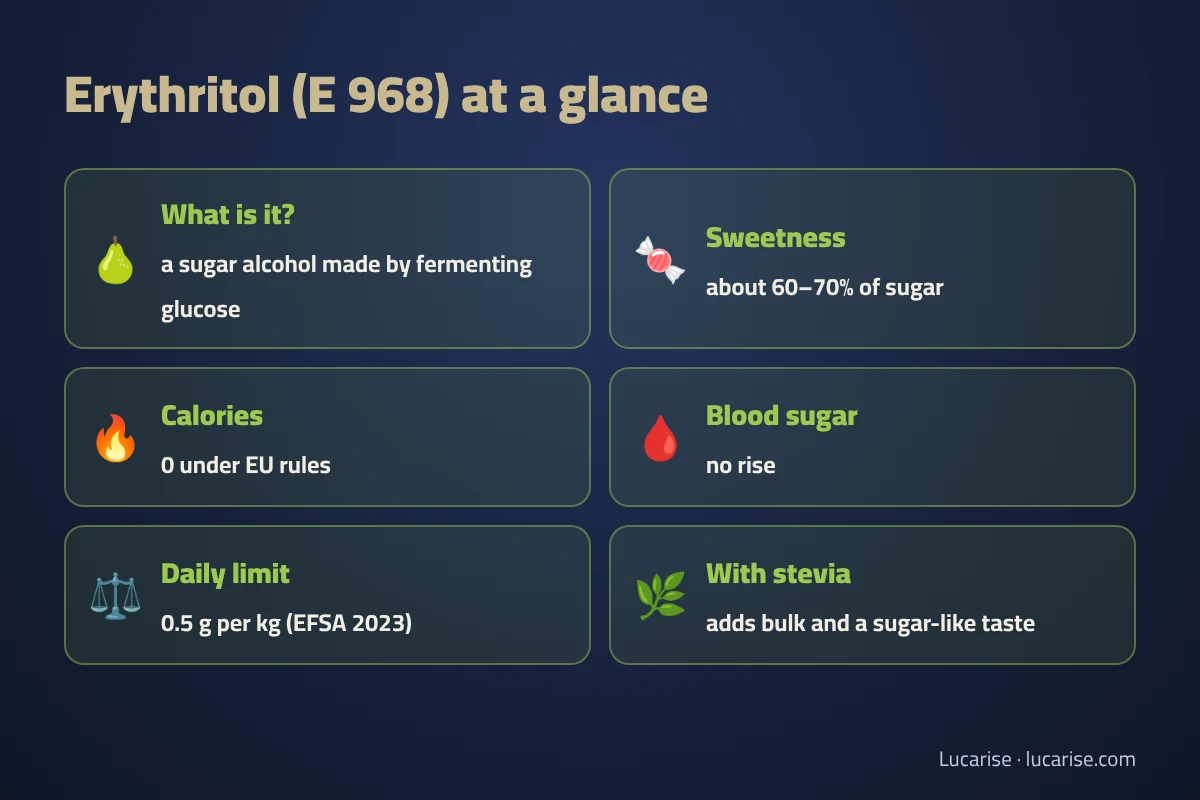
Quick answer: erythritol (E 968) is a sweetener from the “sugar alcohol” family. It occurs naturally in some fruits and fermented foods and is made commercially by fermenting glucose. It is about 60–70% as sweet as sugar, counts as zero calories under EU rules and does not raise blood sugar. It is often blended with stevia to add bulk and a more sugar-like taste. EFSA set an acceptable daily intake of 0.5 g per kg of body weight, because large amounts can cause diarrhoea.
Read the ingredients of almost any stevia sachet and you will usually find “erythritol” or E 968 listed before the stevia itself. So what is erythritol, why is it added, and is it safe? This guide explains it with numbers and sources, and looks honestly at the 2023 heart studies that made headlines.
What is erythritol?
Erythritol is a “sugar alcohol” (polyol), the same family as xylitol, sorbitol and maltitol. The name is a little misleading: it has nothing to do with drinking alcohol and simply describes the shape of the molecule. Erythritol occurs naturally in small amounts in fruits such as grapes, pears and melons and in fermented foods. Commercially it is made by fermenting glucose with yeasts, then purified and crystallised into a white powder that looks like sugar [1].
Erythritol vs sugar and stevia
| White sugar | Erythritol | Stevia Reb-M | Xylitol | |
|---|---|---|---|---|
| Sweetness | reference | about 60–70% | 200–350× sweeter | close to sugar |
| Calories | 4 kcal/g | 0 (EU rule) | almost none | 2.4 kcal/g |
| Blood sugar | raises it | no rise | no rise | small rise |
| Digestion | no issue | good in moderate amounts | no issue at normal use | can cause bloating sooner |
| Label code | — | E 968 | E 960 | E 967 |
In the EU, erythritol has counted as zero calories since 2008 [4], because the body gets almost no energy from it. To learn more about Reb-M, read what is stevia Reb-M?
Does erythritol raise blood sugar?
No. Most erythritol (about 90%) is absorbed in the small intestine and leaves the body unchanged in urine without being used for energy; the rest reaches the colon [1]. So it does not raise blood sugar or insulin, which is why it is common in keto and “sugar-free” products. Still, read the whole label, because some products blend it with ingredients that do raise blood sugar. For stevia and diabetes, read stevia for diabetics.
Is erythritol safe, and how much is too much?
EFSA re-evaluated erythritol in 2023 and set an acceptable daily intake of 0.5 g per kg of body weight. The main reason is its laxative effect: large amounts at once can cause diarrhoea [1]. For a 70 kg adult that is 35 g a day.
In practice, erythritol is easier on the stomach than most other sugar alcohols, because most of it is absorbed before reaching the colon. People who eat a lot of “sugar-free” desserts and drinks on the same day are the ones who might approach the limit.
What about the 2023 heart studies?
In 2023 the journal Nature Medicine published a study that found people with higher blood levels of erythritol were more likely to have a heart attack or stroke over 3 years; the participants were already at high risk. In the lab, erythritol increased platelet activity, and a drink containing 30 g of erythritol raised blood levels for more than two days [2].
But this study shows an association, not cause and effect: the body also makes erythritol itself, and higher levels may be a sign of existing metabolic problems. No controlled human trials have yet shown harm [3]. And 30 g at once equals about 30 sachets of a 1 g sweetener, far more than normal use in coffee and tea. The honest summary: regulators allow erythritol, research continues, and anyone with heart disease or a high clotting risk should ask their doctor.

Why is erythritol blended with stevia?
- Bulk: stevia is so sweet that a cup needs only a few milligrams. Erythritol adds volume so a 1 g sachet is easy to measure.
- Taste: it rounds out the sweetness and softens any bitter aftertaste.
- Texture: it looks like sugar and dissolves in hot and cold drinks.
- No calories: it adds no calories and does not raise blood sugar, so the blend stays sugar-free.
Note: in large amounts erythritol gives a light cooling feeling on the tongue, which is less noticeable in hot drinks.
How to find erythritol on the label
- It appears as “erythritol” or the code E 968.
- The first ingredient is the largest by weight; in stevia sachets erythritol is usually first.
- Avoid products that add dextrose or maltodextrin if you want a sweetener that does not raise blood sugar.
For more on labels, read how to spot real stevia and natural sweeteners explained.
Lucarise stevia sweetener
Lucarise sweetener combines stevia Reb-M and erythritol in 1 g sachets, with no sugar and zero calories: Classic for coffee and tea, and Cardamom for karak and Arabic coffee. Start with one sachet per cup. For everything stevia, see The Complete Stevia Guide.
⚖️ Comparing sweeteners? Read stevia vs sucralose vs aspartame: origin, safe daily limits, heat and taste side by side.
🍰 Using stevia in cakes or keto desserts? Read baking with stevia: what works and how much to use.
Run a café, restaurant or shop?
Lucarise makes café drinks in business packs in our own factory in Oman: 1 kg café bags, 100-sachet hotel boxes and distributor cartons. Prices on request.
Erythritol: FAQ
Is erythritol natural?
It occurs naturally in small amounts in some fruits and fermented foods, but commercial erythritol is made by fermenting glucose with yeasts and then purified. It is produced by fermentation from a natural source.
Is erythritol safe?
Regulators allow it, and in 2023 EFSA set an acceptable daily intake of 0.5 g per kg of body weight. The 2023 heart study showed an association, not cause and effect; anyone with heart disease should ask their doctor.
Does erythritol raise blood sugar?
No. Most of it is absorbed and leaves the body unchanged in urine without being used for energy, so it does not raise blood sugar or insulin.
Does erythritol cause bloating or diarrhoea?
Rarely at normal amounts, and it is easier on the stomach than other sugar alcohols. Large amounts at once can cause diarrhoea, which is why an acceptable daily intake was set.
Is erythritol keto-friendly?
Yes, it is usually counted as zero net carbs because it is not digested for energy and does not raise blood sugar. Check the label for added ingredients that do.
What is the difference between erythritol and xylitol?
Both are sugar alcohols, but xylitol is sweeter (close to sugar), has 2.4 kcal per gram, raises blood sugar slightly and upsets digestion sooner. Xylitol is also toxic to dogs, so keep it away from pets.
Sources
- EFSA Panel on Food Additives and Flavourings. Re-evaluation of erythritol (E 968) as a food additive. EFSA Journal, 2023. doi:10.2903/j.efsa.2023.8430
- Witkowski M. et al. The artificial sweetener erythritol and cardiovascular event risk. Nature Medicine, 2023. doi:10.1038/s41591-023-02223-9
- Pafili K., Roden M. The sugar-free paradox: cardiometabolic consequences of erythritol. Signal Transduction and Targeted Therapy, 2023. doi:10.1038/s41392-023-01504-6
- Commission Directive 2008/100/EC: energy conversion factor for erythritol (0 kcal/g). Official Journal of the European Union, 2008. eur-lex.europa.eu


