
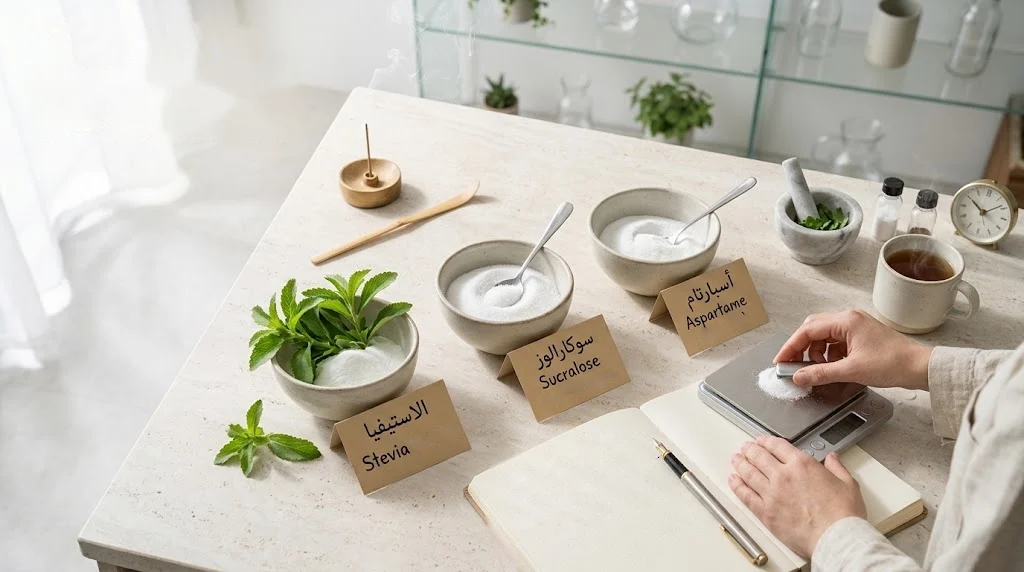
Quick answer: stevia, sucralose and aspartame are all approved, have practically no calories and do not add sugar when used within their safe daily limits. The real differences are origin (stevia comes from a plant, sucralose is made from sugar, aspartame from two amino acids), heat (stevia handles baking well, aspartame loses sweetness when heated, and sucralose is not recommended for home baking or frying at high temperatures) and taste. People with phenylketonuria (PKU) must avoid aspartame.
In the Gulf, “diet sugar” usually means the small sweetener sachets on café tables and supermarket shelves. Most of them are based on one of three sweeteners: stevia, sucralose or aspartame. This guide compares them side by side, using the latest assessments from WHO, EFSA and JECFA, so you can choose the one that fits how you use it.
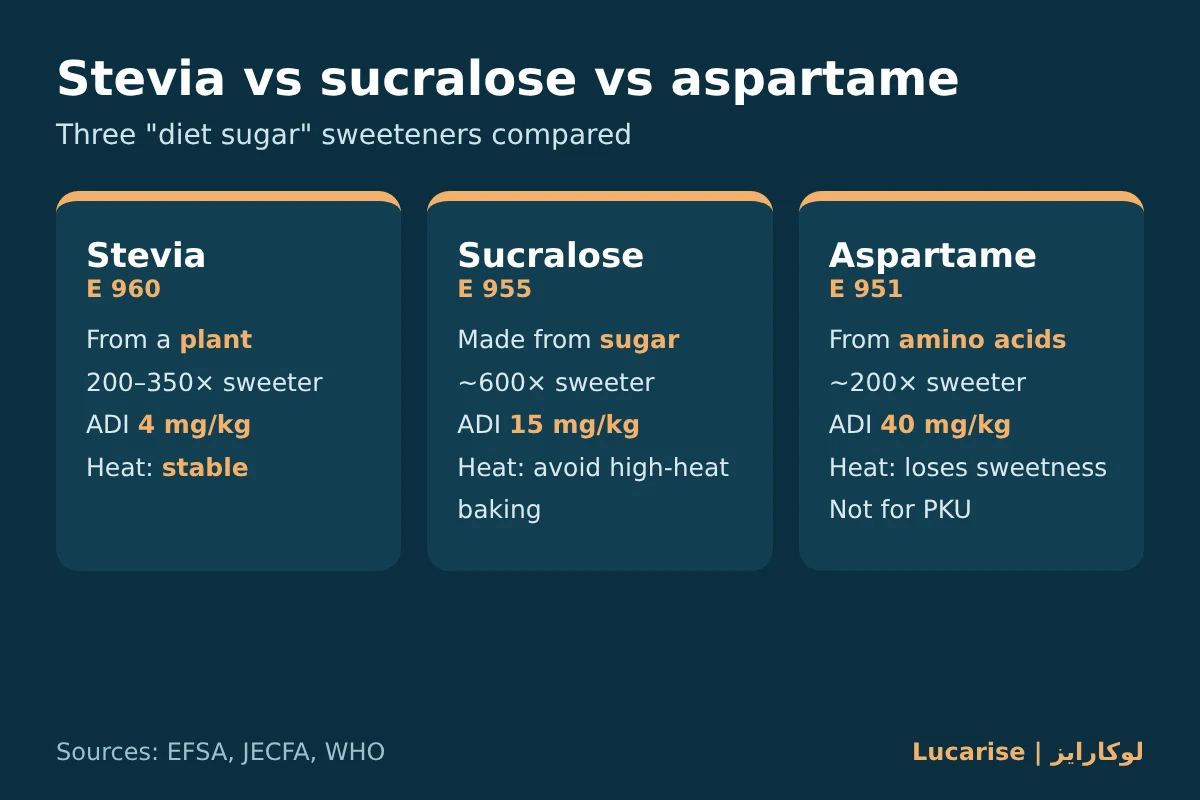
Stevia vs sucralose vs aspartame at a glance
| Stevia (steviol glycosides) | Sucralose | Aspartame | |
|---|---|---|---|
| E number | E 960 | E 955 | E 951 |
| Made from | Leaves of the stevia plant | Sugar, with 3 of its groups replaced by chlorine | Two amino acids (aspartic acid and phenylalanine) |
| Sweetness vs sugar | About 200–350 times | About 600 times | About 200 times |
| Calories in use | Zero | Zero | Practically zero (tiny amounts are used) |
| Acceptable daily intake (ADI) | 4 mg/kg body weight (as steviol)[6] | 15 mg/kg body weight[3] | 40 mg/kg body weight[2][5] |
| Heat | Stable; fine for baking | Avoid long high-heat home baking and frying[3][4] | Loses sweetness when heated |
| Taste | Older types (Reb-A) can be bitter; Reb-M tastes closer to sugar | Close to sugar | Clean, slightly lingering |
| Special warning | — | — | Not for people with PKU[5] |
What is in a “diet sugar” sachet?
A sachet holds about 1 g, but the sweetener itself is only a tiny part of it, because these sweeteners are hundreds of times sweeter than sugar. The rest is a carrier. Some brands use dextrose or maltodextrin, which add a few calories and some carbohydrate. Others use erythritol, which has practically no calories. Always read the ingredient list, not only the front of the pack.
Want the full picture on stevia alone? Read our stevia sugar guide: what it is, safety and the daily limit.
Stevia
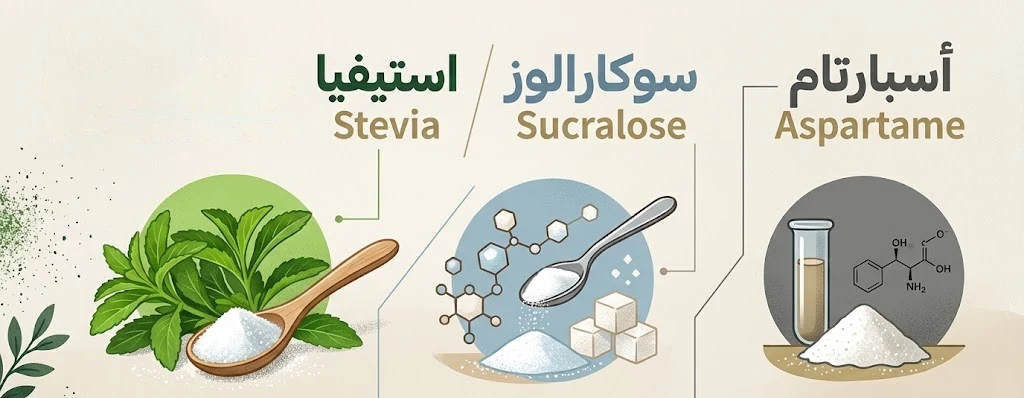
Stevia sweeteners are purified steviol glycosides from the leaves of the stevia plant. EFSA set an acceptable daily intake of 4 mg per kg of body weight, expressed as steviol[6]. Stevia stays stable when heated, so it works in hot drinks and baking. Older stevia (Reb-A) can leave a bitter, liquorice-like aftertaste; newer stevia Reb-M tastes much closer to sugar. More in our complete stevia guide.
Sucralose
Sucralose is made from ordinary sugar by replacing three of its groups with chlorine, which makes it about 600 times sweeter and stops the body from using it for energy. In February 2026, EFSA re-evaluated sucralose and kept its acceptable daily intake at 15 mg per kg of body weight; average intakes in Europe are below this level[3]. However, EFSA could not rule out that harmful chlorinated compounds form when sucralose is heated at high temperatures for a long time, as in home baking or frying[3]. Germany’s BfR had already advised in 2019 not to heat sucralose above 120 °C[4]. In tea and coffee it is fine; for baking, choose another sweetener.
Aspartame
Aspartame is made from two amino acids, aspartic acid and phenylalanine. In July 2023, the WHO cancer agency IARC classified it as “possibly carcinogenic to humans” (Group 2B), a category that reflects limited evidence. At the same time, the WHO and FAO expert committee JECFA reviewed the evidence and kept the acceptable daily intake at 40 mg per kg of body weight[2]. In practice, an adult weighing 70 kg would need to drink more than 9–14 cans of diet soft drink a day to exceed it[2]. Aspartame breaks down when heated, so it is not suitable for baking. Products with aspartame must carry a phenylalanine warning, because people with phenylketonuria (PKU) cannot break down phenylalanine[5].
Other diet sugars: erythritol, monk fruit and allulose
Besides these three, Gulf shops also sell other sweeteners as “diet sugar” or “sugar substitutes”, and they are often mixed with stevia in the same sachet.
Erythritol
A sugar alcohol found naturally in small amounts in some fruits. It is about 60–70% as sweet as sugar and adds almost no calories. It is used as a carrier in many stevia sachets because it gives bulk and a sugar-like taste. In large amounts it can cause bloating in some people. A 2023 observational study linked blood erythritol levels to heart events, but the U.S. FDA said these studies do not establish cause and effect and that it continues to monitor new information[7].
Monk fruit
An extract of a small fruit grown in China, also called luo han guo. It is about 100–250 times sweeter than sugar and adds almost no calories[7]. The FDA accepts it under its intended conditions of use and has not set an acceptable daily intake[7]. It is usually mixed with erythritol or allulose so it can be measured with a spoon.
Allulose
A rare sugar found in small amounts in foods such as figs and raisins. It is about 70% as sweet as sugar and very low in calories. The FDA has not objected to it being generally recognised as safe under its intended uses[7]. Unlike most sweeteners, it browns in baking like sugar.
Quick table: types of diet sugar
| Type | Sweetness vs sugar | Calories | Note |
|---|---|---|---|
| Stevia | About 200–400× | Zero | Heat stable; Reb M is less bitter |
| Sucralose | About 600× | Zero | Avoid in high-heat baking |
| Aspartame | About 200× | Almost zero | Not for baking; PKU warning |
| Erythritol | About 60–70% | Almost zero | Sugar-like bulk; may cause bloating in large amounts |
| Monk fruit | About 100–250× | Almost zero | Usually blended with erythritol or allulose |
| Allulose | About 70% | Very low | Browns in baking like sugar |
What is the best sugar substitute for tea and coffee?
There is no single best option for everyone. For everyday tea, karak and coffee, many people choose stevia Reb M blended with erythritol, because it dissolves easily and tastes close to sugar. For baking you need a sweetener with bulk, such as erythritol or allulose. If your goal is to cut sugar, also try using a little less in your cup each week. The WHO does not recommend relying on non-sugar sweeteners for weight control[1]. Check the sugar in your daily drinks with our sugar calculator, and if you have diabetes, read stevia for diabetics.
Which diet sugar is best for you?
| Use | Good choices |
|---|---|
| Tea, coffee, karak | All three work |
| Cold drinks | All three work |
| Baking and cooking | Stevia (or erythritol); not aspartame; avoid sucralose at high heat |
| People with PKU | Stevia or sucralose, never aspartame |
| If you want a plant-based option | Stevia |
If you have diabetes or another health condition, talk to your doctor or dietitian about which sweetener suits you. Our guide to stevia for diabetics covers what the research says about stevia and blood sugar.
Do diet sweeteners help with weight loss?
In 2023, the WHO advised against using non-sugar sweeteners as a way to control body weight. Its review found no long-term benefit for body fat in adults or children[1]. The guideline does not apply to people with diabetes and does not mean sweeteners are unsafe. The message is that the best long-term goal is to get used to less sweetness overall, not just to swap sugar for a sweetener.
How to read the label
- Look for the E number in the ingredients: E 960 (stevia), E 955 (sucralose), E 951 (aspartame).
- “Contains a source of phenylalanine” means the product contains aspartame.
- Check the carrier: dextrose and maltodextrin add calories and carbohydrate; erythritol does not.
- Many blends mix two sweeteners, for example stevia with erythritol, to improve taste.
Lucarise stevia sachets
Lucarise stevia sachets combine stevia Reb-M with erythritol, with no sugar and no calories, in classic and cardamom flavours. See our stevia sweeteners and convert any recipe with the stevia to sugar calculator.
Run a café, restaurant or shop?
Lucarise makes café drinks in business packs in our own factory in Oman: 1 kg café bags, 100-sachet hotel boxes and distributor cartons. Prices on request.
Frequently asked questions
Is diet sugar bad for you?
Stevia, sucralose and aspartame are approved by food safety authorities and are considered safe within their acceptable daily intake. A few sachets a day are far below these limits. The WHO does not recommend them for weight control.
Which diet sugar is best for coffee and tea?
All three work in hot drinks. Many people choose stevia because it comes from a plant; taste is a personal preference.
Can I bake with diet sugar?
Use stevia or erythritol for baking. Aspartame loses its sweetness when heated, and EFSA could not rule out harmful compounds when sucralose is baked or fried at high temperatures at home.
Does aspartame cause cancer?
In 2023 IARC classified aspartame as “possibly carcinogenic” based on limited evidence, while JECFA kept its acceptable daily intake at 40 mg per kg of body weight. A 70 kg adult would need more than 9–14 cans of diet soft drink a day to exceed it.
Does diet sugar raise blood sugar?
The sweeteners themselves contain no sugar. Some sachets use dextrose or maltodextrin as a carrier, which do contain carbohydrate, so check the label. People with diabetes should follow their doctor’s advice.
Is diet sugar keto-friendly?
Stevia and erythritol are commonly used on keto diets. Sachets with dextrose or maltodextrin add carbohydrate, so read the ingredients.
Sources
- World Health Organization (2023). Use of non-sugar sweeteners: WHO guideline. who.int
- WHO, IARC and JECFA (14 July 2023). Aspartame hazard and risk assessment results released. who.int
- EFSA FAF Panel (2026). Re-evaluation of sucralose (E 955) as a food additive. EFSA Journal. doi:10.2903/j.efsa.2026.9854
- German Federal Institute for Risk Assessment (BfR) (2019). Sucralose: heating above 120 °C can produce substances that are harmful to health. bfr.bund.de
- EFSA ANS Panel (2013). Scientific Opinion on the re-evaluation of aspartame (E 951) as a food additive. EFSA Journal 11(12): 3496. doi:10.2903/j.efsa.2013.3496
- EFSA ANS Panel (2010). Scientific Opinion on the safety of steviol glycosides for the proposed uses as a food additive. EFSA Journal 8(4): 1537. doi:10.2903/j.efsa.2010.1537
- U.S. Food and Drug Administration. Aspartame and Other Sweeteners in Food. fda.gov


