

Quick answer: Arabic coffee (gahwa or qahwa) is lightly roasted coffee boiled with cardamom, and often saffron, then served without sugar in small cups called finjan, usually with dates. In 2015 UNESCO inscribed “Arabic coffee, a symbol of generosity” on its list of the Intangible Cultural Heritage of Humanity, nominated by the UAE, Saudi Arabia, Oman and Qatar.
In the Gulf, gahwa is more than a drink. It is the first thing offered to a guest, the centre of every majlis and a fixed part of Ramadan evenings, weddings and family gatherings. This guide explains what it is, how to make it at home step by step, how it is traditionally served, how it differs from Turkish coffee, and what we really know about its benefits.
Arabic coffee, a symbol of generosity
Light roast, cardamom, small cups and dates: the Gulf way to welcome a guest.
What is Arabic coffee?
Gahwa is made from coffee beans that are roasted lightly, ground, and boiled in water with spices. Cardamom is the classic spice; saffron and cloves are also common. The result is a thin, golden, aromatic drink with a gentle bitterness, very different from espresso or Turkish coffee.
According to UNESCO, the traditional way is to prepare the coffee in front of guests: the beans are lightly roasted in a shallow pan, pounded in a mortar, boiled in a large pot, then moved to a smaller pot and poured into small cups. [1]
Saudi and Gulf styles: one drink, many versions
Every region has its own version. The taste depends mostly on how the beans are roasted and which spices are added, so a cup in Riyadh, Muscat or Abu Dhabi can taste quite different. [2] Many Saudi and Gulf households prefer a light, golden roast with plenty of cardamom, while others add saffron or cloves. For the regional styles of Saudi Arabia in detail, read our guide to Saudi coffee.
Ingredients you need
- Coffee: lightly roasted Arabica, ground.
- Water.
- Cardamom: ground or lightly crushed.
- Optional: a few threads of saffron, or a clove or two.
- No sugar: the sweetness comes from dates served on the side.
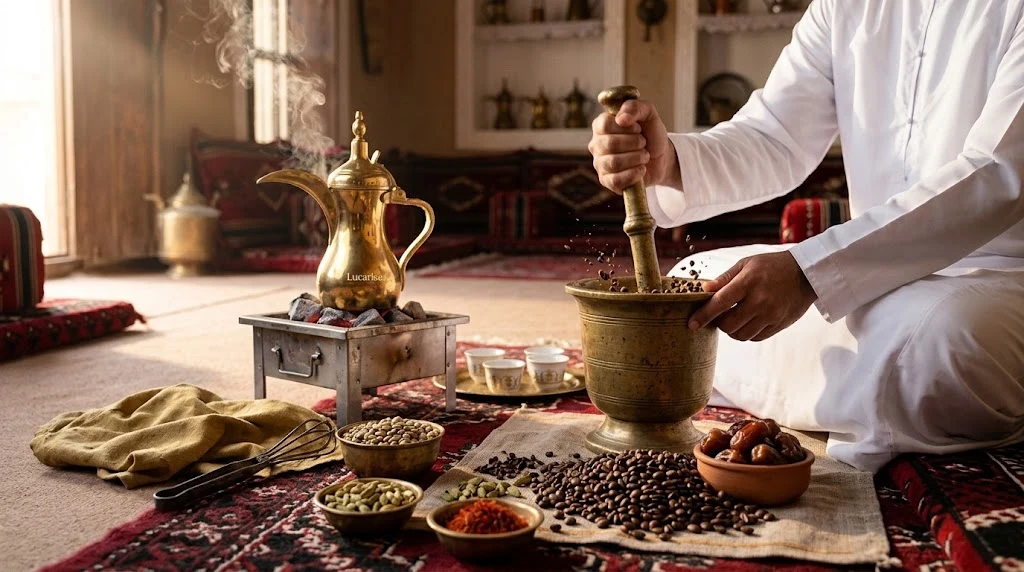
How to make Arabic coffee at home
This method is a good starting point. A useful ratio is about 30 g of ground coffee for 500 ml of water, which makes 5 to 6 small cups. Adjust it to taste.
- Bring the water to a boil in a pot.
- Add the coffee and let it boil gently for about 4 to 6 minutes without stirring. The longer it boils, the stronger the taste and colour. [2]
- If you use saffron, add it a few minutes before the end.
- Add the cardamom 2 to 3 minutes before you take the pot off the heat. [2]
- Remove from the heat, let the grounds settle for a minute, then strain into a dallah or thermos.
- Serve in small cups with dates.
| For | Water | Arabic coffee | Cardamom |
|---|---|---|---|
| 5–6 small cups | 500 ml | About 30 g | 1–2 teaspoons, to taste |
| 10–12 small cups | 1 litre | About 60 g | 2–3 teaspoons, to taste |
Tip: if your coffee blend already contains cardamom, as many ready blends do, you do not need to add more.
Instant Arabic coffee: can it replace the dallah?
Instant Arabic coffee (also sold as instant Saudi coffee) is a powder that dissolves straight into hot water: lightly roasted soluble coffee mixed with cardamom, and sometimes saffron or cloves. There is no boiling and no straining, so it suits offices, travel and hotel rooms. Its taste and aroma are usually lighter than ground coffee brewed in a dallah, because it is essentially dried instant coffee.
| Instant Arabic coffee | Ground Arabic coffee in a dallah | |
|---|---|---|
| Preparation | Dissolves in seconds in hot water | Simmers 4 to 6 minutes, then the grounds settle |
| Taste and aroma | Lighter | Richer, closer to traditional |
| Grounds | None | Strained before serving |
| Best for | A quick cup at work or on the go | The majlis, guests and occasions |
Read the ingredients when you buy: some instant Arabic coffees contain sugar or creamer. To make it, follow the amount on the pack, usually a teaspoon or one sachet per cup with water just off the boil.
A middle way: pre-portioned Arabic coffee sachets for the dallah
If you want the real taste without weighing and measuring, there are pre-portioned sachets of ground Arabic coffee for each pot. Lucarise Arabic Coffee with Saffron Topping, for example, is ground Arabic coffee with cardamom in a 30 g sachet plus a 1 g saffron topping, brewed with 500 ml of water for about 5 to 6 small cups. It is not instant, but it saves the measuring and gives you the same result every time.
Serving etiquette in the majlis
- The oldest or most important guest is served first. [1]
- Each cup holds only a small amount and is refilled as long as the guest wants more. [1]
- A guest is customarily expected to drink at least one cup and no more than three. [1]
- Dates or other sweets are served alongside to balance the bitterness.
Arabic coffee vs Turkish coffee
| Arabic coffee | Turkish coffee | |
|---|---|---|
| Roast | Light, golden | Dark |
| Spices | Cardamom, sometimes saffron or cloves | Usually none, sometimes cardamom |
| Serving | Strained into a dallah, poured into small cups | Served with the grounds in the cup |
| Sugar | Traditionally none; served with dates | Often sweetened while brewing |
| Taste | Light, aromatic, gently bitter | Strong and thick |
Benefits of Arabic coffee: what we really know
Gahwa is often described online with long lists of health benefits. Here is a more careful view; for the full research, read Arabic coffee benefits: what the research says.
- No added sugar: traditional gahwa is unsweetened, so a cup adds far less sugar than sweetened coffee drinks.
- Caffeine: like all coffee, it contains caffeine, which many people drink to feel more alert. Healthy adults should keep total caffeine to the level the FDA cites, up to 400 mg a day, and people who are pregnant or breastfeeding should ask their doctor. [3]
- Natural coffee compounds: coffee beans contain compounds such as chlorogenic acids. Research on coffee and health is ongoing, so treat it as a pleasure and a tradition, not a treatment.
Gulf-style Arabic coffee, roasted in Oman
100% Arabica, light roast, blended with cardamom and no sweetener. Choose the 250 g pouch, or the 30 g sachets with a 1 g saffron topping: each sachet with 500 ml of water makes about 5–6 cups.
Try Lucarise before you buy
Free samples are available for cafés, hotels, offices and distributors in Oman and the GCC.
Keep reading
Hosting guests? Find out how much coffee, water and cardamom you need with our Arabic coffee calculator.
Brewing at home? Get exact grams with our coffee to water ratio calculator.
Frequently asked questions
Why is gahwa so light in colour?
Because the beans are roasted lightly, much lighter than for Turkish coffee or espresso. The light roast, together with cardamom and sometimes saffron, gives gahwa its golden colour and gentle, slightly bitter taste.
Does Arabic coffee contain caffeine?
Yes. It is made from coffee beans, so it contains caffeine. The amount in each small cup depends on how much coffee you use and how long you boil it. The US FDA cites up to 400 mg of caffeine a day as an amount not generally associated with negative effects for healthy adults.
Is it drunk with sugar?
Traditionally, no. Gahwa is served without sugar, and the sweetness comes from the dates that are served with it.
How many cups should a guest drink?
Custom expects a guest to drink at least one cup and usually no more than three. The host serves a small amount in each cup and refills it until the guest signals that they have had enough.
What is the difference between Arabic coffee and Turkish coffee?
Arabic coffee uses lightly roasted beans and spices such as cardamom, and it is strained into a dallah before serving. Turkish coffee uses a darker roast ground very finely, and it is served with the grounds settled at the bottom of the cup.
Not sure which beans to buy? See our guide to Arabica vs Robusta.
Hosting in Ramadan? Read our guide to Arabic coffee etiquette in Ramadan: who to serve first, how much to pour and what shaking the cup means.
Sources
[1] UNESCO. Arabic coffee, a symbol of generosity, Decision 10.COM 10.B.32, 2015.
[2] Gulf News. A quick guide to making the perfect cup of Saudi gahwa at home.
[3] US FDA. Spilling the Beans: How Much Caffeine is Too Much?


