
Quick answer: to make Turkish coffee, put about 70 ml of cold water per small cup in a cezve (Turkish coffee pot), add one heaped teaspoon (about 6–7 g) of extra-fine ground coffee per cup, and sugar if you like. Stir once, then heat slowly on low heat without stirring again. When the foam rises to the rim (after about 3–4 minutes), take it off the heat and pour slowly into the cup, foam first. Let the grounds settle for a minute before drinking.
Turkish coffee is one of the oldest ways of making coffee and is loved across the Gulf, the Levant and Egypt. UNESCO added Turkish coffee culture and tradition to its list of the Intangible Cultural Heritage of Humanity in 2013[1]. This guide covers the right measurements, how to make it step by step with good foam, the sugar levels, common mistakes, how it differs from Arabic coffee and espresso, and how to choose the best Turkish coffee.
What is Turkish coffee?
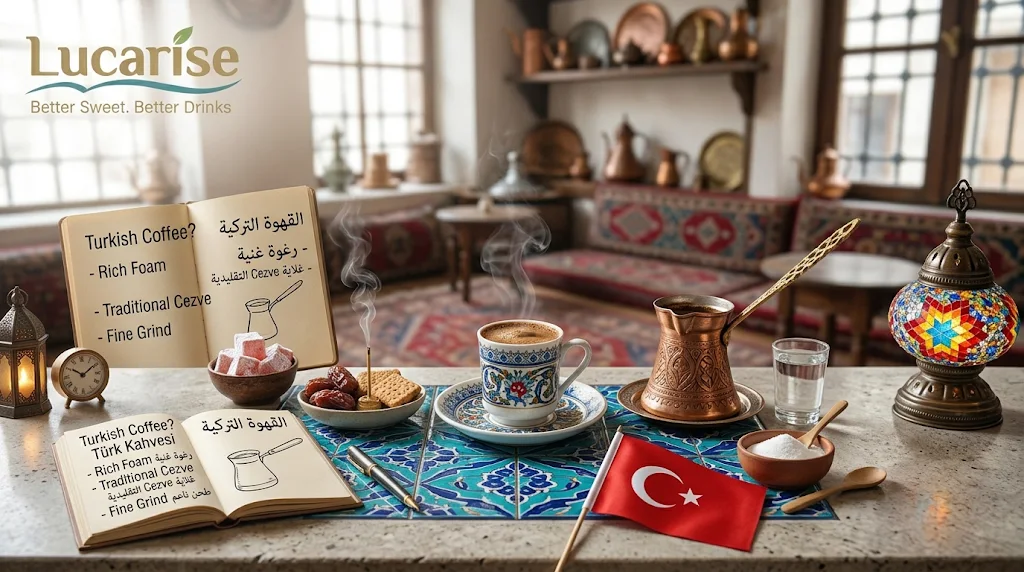
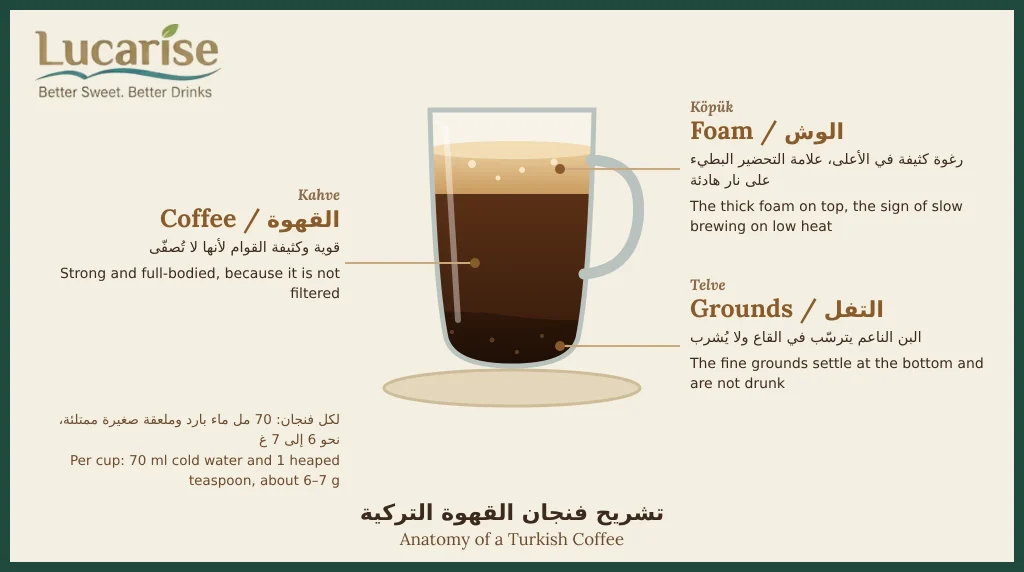
Turkish coffee is coffee ground to a very fine powder, almost like flour, and brewed slowly with cold water (and sugar if you like) in a small pot called a cezve, also known as an ibrik or rakwa. It is not filtered: the coffee is poured with its grounds into a small cup, and the grounds settle at the bottom. The result is a strong, thick cup with a layer of foam on top. It is traditionally served with a glass of water, and often with a piece of Turkish delight.
Turkish coffee measurements
| For one small cup | |
|---|---|
| Water | about 70 ml of cold water (one cup measured with the cup itself) |
| Coffee | 1 heaped teaspoon, about 6–7 g, ground extra fine |
| Sugar | 0 to 2 teaspoons, added before heating |
| Heat | low to medium-low |
| Time | about 3–4 minutes until the foam rises |
| Cardamom (optional) | a pinch of ground cardamom with the coffee |
For two cups, double everything and use a cezve big enough that the coffee fills it only about halfway, so the foam has room to rise.
How to make Turkish coffee step by step
- Measure cold water with the cup you will serve in and pour it into the cezve. Cold water gives the coffee more time to brew and makes better foam.
- Add one heaped teaspoon of Turkish coffee per cup, plus sugar if you want it. Sugar cannot be added later, because stirring breaks the foam.
- Stir well, only once, until no dry coffee is left on the surface.
- Put the cezve on low heat and do not stir again. Slow heating is the secret of good foam.
- After about 3–4 minutes, the coffee darkens and the foam starts to rise. Just before it boils over, take it off the heat.
- Spoon a little foam into each cup, then pour the coffee slowly from a low height so the foam stays on top.
- Wait about a minute for the grounds to settle, and do not drink the last sip with the grounds.
Sugar levels: how sweet do you want it?
| Name | Sugar per cup |
|---|---|
| Plain (sade) | no sugar |
| A little sweet (az şekerli) | about ½ teaspoon |
| Medium (orta) | about 1 teaspoon |
| Sweet (şekerli) | about 2 teaspoons |
Why does my Turkish coffee have no foam?
| Problem | Likely cause | What to change |
|---|---|---|
| No foam | Heat too high, or it boiled | Use low heat and take it off just before it boils |
| Foam disappears | Stirred during heating, or poured too fast | Stir only at the start and pour slowly |
| Gritty cup | Grind not fine enough, or no time to settle | Use extra-fine Turkish grind and wait a minute |
| Bitter or burnt | Boiled too long | Remove from the heat as soon as the foam rises |
| Weak and thin | Too little coffee | Use a heaped teaspoon (about 6–7 g) per 70 ml |
Turkish coffee vs Arabic coffee vs espresso
| Turkish coffee | Arabic coffee (gahwa) | Espresso | |
|---|---|---|---|
| Roast | Medium to dark | Light, golden | Medium-dark |
| Grind | Extra fine, like flour | Medium | Fine |
| Method | Heated slowly with cold water, not filtered | Boiled in a dallah, then left to settle | Water forced through at about 9 bar |
| Served | Small cup with foam and grounds | Small finjan, with cardamom and dates | About 25–30 ml with crema |
| Read more | — | Arabic coffee guide | Espresso guide |
Does Turkish coffee have a lot of caffeine?
Turkish coffee tastes strong because it is thick and unfiltered, but the cup is small, so the caffeine in one cup depends mostly on how much coffee you use. For healthy adults, EFSA considers up to 400 mg of caffeine a day safe, and up to 200 mg a day during pregnancy and breastfeeding[2]. Track your daily total with our caffeine calculator.
How to choose the best Turkish coffee
- Grind: it must be extra fine, like powder. Coffee ground for filter or espresso is too coarse and will not make foam.
- Roast: a medium roast gives a balanced cup; darker roasts taste stronger and more bitter.
- Beans: 100% Arabica gives a smoother, more aromatic cup.
- Freshness: ground coffee loses aroma quickly. Buy a size you will finish in a few weeks and keep the pack tightly closed.
- Flavour: plain, or with cardamom if you like the Gulf style.
Lucarise Turkish Ground Coffee is 100% Arabica, medium roasted and ground extra fine for the cezve. It comes in a 250 g pouch, or a 1 kg pouch for cafés and restaurants, and is roasted and packed in our own factory in Oman. It is ground coffee that you brew, not instant coffee.
Prefer a clean, light cup? Try our guide to drip coffee with a V60 or drip bags.
More ways to brew: see our specialty coffee guide, with grind, ratio, origins and every brewing method in one place.
Run a café, restaurant or shop?
Lucarise makes café drinks in business packs in our own factory in Oman: 1 kg café bags, 100-sachet hotel boxes and distributor cartons. Prices on request.
Turkish coffee: frequently asked questions
How do you make Turkish coffee?
Put about 70 ml of cold water and one heaped teaspoon of extra-fine coffee per cup in a cezve, add sugar if you like, stir once and heat slowly. When the foam rises, take it off the heat and pour slowly.
How much coffee for one cup of Turkish coffee?
One heaped teaspoon, about 6–7 g, for about 70 ml of water.
How do I get more foam on Turkish coffee?
Use cold water, extra-fine coffee and low heat, stir only at the start, and take it off the heat just before it boils.
Can I make Turkish coffee without a cezve?
Yes, a very small saucepan works. Choose the smallest pot you have so the foam can form.
Can I use Turkish coffee in a French press or filter machine?
Not well. It is ground too fine for those methods; they need a coarser grind.
Is Turkish coffee the same as Arabic coffee?
No. Turkish coffee is darker, ground finer and served with its foam and grounds. Arabic coffee is a light roast with cardamom, brewed in a dallah.
Sources
- UNESCO. Turkish coffee culture and tradition, inscribed in 2013 on the Representative List of the Intangible Cultural Heritage of Humanity.
- EFSA Panel on Dietetic Products (2015). Scientific opinion on the safety of caffeine. doi:10.2903/j.efsa.2015.4102


