
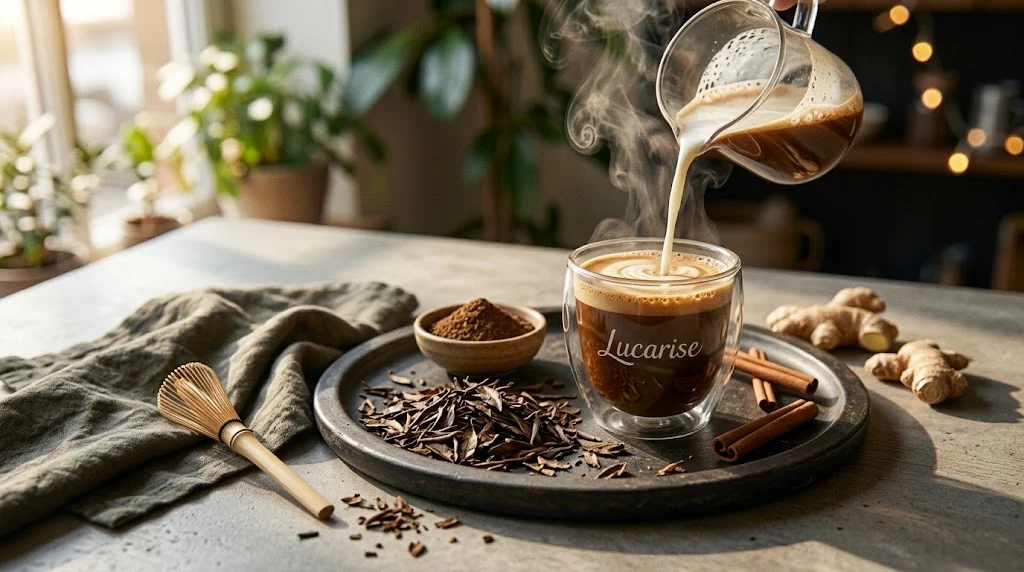
What is hojicha? Hojicha is a Japanese green tea whose leaves and stems are roasted at high heat instead of steamed. Roasting turns it red-brown and gives it a toasty, nutty taste with very little bitterness. A brewed cup has about 20 mg of caffeine per 100 ml, roughly a third of matcha’s concentration, but it is not caffeine-free. You can drink it brewed, or as a powder whisked into milk as a hojicha latte.
After matcha took over café menus in Riyadh, Dubai and Muscat, a new name has started to appear next to it: hojicha. It is also a Japanese green tea from the same tea plant, but it differs from matcha in almost every way: colour, taste, how it is made and how much caffeine it has. In this guide we explain what hojicha is, how it tastes, how it compares with matcha, how much caffeine it contains, and how to make it brewed or as a hojicha latte at home.
How hojicha is made
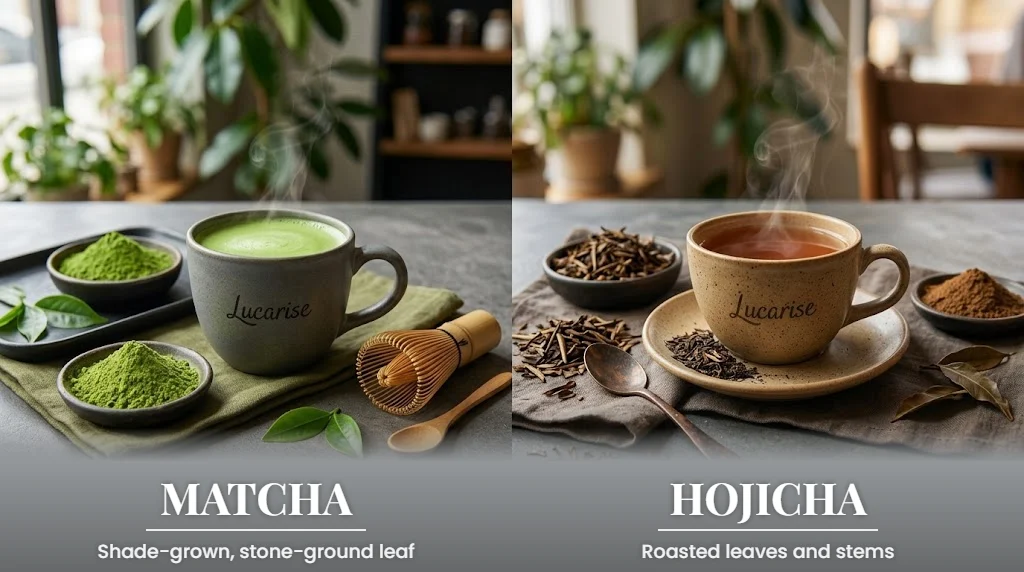
Most Japanese green teas, such as sencha and matcha, are steamed right after picking to keep their green colour. Hojicha usually starts as bancha, a later-harvest tea with larger leaves, or as stem tea (kukicha). The leaves and stems are then roasted at high heat, roughly 150 to 200 °C. The method is said to have started in Kyoto in the 1920s.
Roasting changes the tea’s chemistry. In a Japanese study on roasted stem tea, catechins and amino acids fell quickly as the roasting temperature rose, while pyrazines, the compounds behind the toasty aroma, increased [1]. That is why hojicha is less bitter and astringent than regular green tea, with an aroma closer to caramel and roasted nuts.
What does hojicha taste like?
- Toasty and nutty: many people compare it to roasted nuts or toasted grains.
- Low bitterness: roasting reduces the catechins that cause astringency.
- Naturally mellow sweetness: with a caramel-like note and no added sugar.
- No grassy taste: unlike matcha and sencha, it has none of the green, grassy flavour, which is why many people who did not enjoy matcha like it.
Does hojicha have caffeine?
Yes, but less than matcha. Brewed hojicha has about 20 mg of caffeine per 100 ml, similar to sencha and far less than gyokuro [3]. A small cup of matcha made with 1.5 g of powder in 70 ml of water has about 48 mg [4], or roughly 60 to 70 mg per 100 ml.
People often say roasting “burns off” the caffeine, and it may remove some, but much of the difference comes from the leaves themselves: hojicha is usually made from bancha, mature leaves and stems that already contain less caffeine than the young leaves used for matcha and gyokuro [3]. Keep in mind that with hojicha powder, used for lattes, you drink the whole leaf, so a hojicha latte can contain more caffeine than a cup of brewed hojicha.
That makes it a good choice for the afternoon or evening if you want something lighter than coffee or matcha. It is not caffeine-free, though, so if you are pregnant or breastfeeding, count it within the 200 mg a day limit advised by the European Food Safety Authority [5]. To compare it with other drinks, see our caffeine chart.
Hojicha vs matcha: the differences
| Hojicha | Matcha | |
|---|---|---|
| How it is made | Leaves and stems are roasted | Shaded, steamed, then the whole leaf is stone-ground |
| Leaves | Usually mature leaves and stems | Young leaves from the first harvest |
| Colour | Red-brown | Bright green |
| Taste | Toasty, nutty, low bitterness | Grassy and umami, slightly bitter |
| Caffeine | About 20 mg per 100 ml (brewed) | About 60 to 70 mg per 100 ml |
| Catechins | Lower because of roasting | Very high |
| Best time | Afternoon, evening or after meals | Morning and early afternoon |
In short: choose matcha if you want energy, focus and a clear green flavour, and choose hojicha if you prefer a warm, toasty cup with less caffeine. For more on matcha’s health effects, read matcha benefits.
Does hojicha have health benefits?
Research on hojicha itself is very limited, so no specific health benefits can be claimed for it. What we know is that it still contains polyphenols, and a recent lab study found that its infusion kept part of its antioxidant activity after simulated digestion [2]. These are lab results, not human trials. Its practical advantage is clear, though: a warm, low-bitterness drink that tastes good without sugar and has less caffeine than coffee or matcha.
How to brew hojicha tea
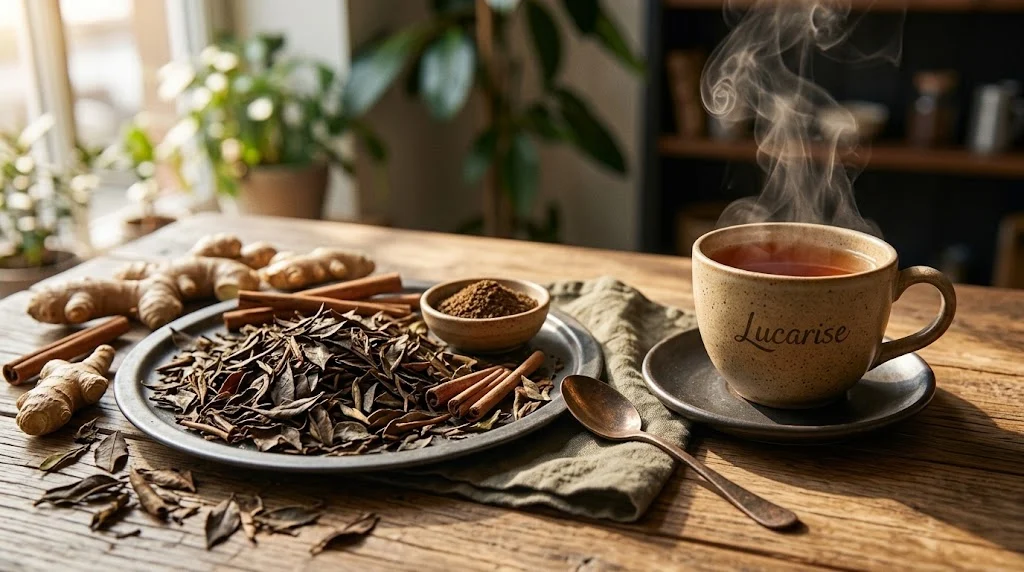
- Put about 3 to 4 g of hojicha leaves (roughly one tablespoon) in a teapot.
- Add 200 ml of very hot water, close to boiling (90 to 95 °C). Unlike matcha, hojicha does not turn bitter easily with hot water.
- Steep for 30 seconds to 1 minute, then pour out every drop. You can steep the same leaves a second time.
How to make a hojicha latte at home
The hojicha latte is the most popular way to drink hojicha in cafés, and it needs hojicha powder rather than leaves. Ingredients for one cup:
- Hojicha powder: about 2 g (one teaspoon).
- Hot water: 30 to 40 ml.
- Milk: 150 to 200 ml, hot or cold.
- Optional: a sweetener such as stevia, and a small pinch of ground cardamom for a Gulf twist.
- Sift the powder into a cup, add the hot water and whisk with a whisk or small spoon until smooth, with no lumps.
- If you want sweetener or cardamom, add them now to the hot mixture.
- Heat the milk without boiling it, froth it if you like, and pour it over the mixture.
- For an iced version: fill a glass with ice and cold milk, then pour the hojicha mixture over it and stir.
How to choose a good hojicha powder
- Read the ingredients: pure powder has one ingredient, hojicha. A “hojicha latte mix” may contain sugar and creamer, so check the difference.
- Colour and aroma: an even red-brown colour and a clear roasted aroma. A faint smell usually means old powder.
- Storage: keep it sealed away from heat and humidity, and use it within a few weeks of opening so it keeps its aroma.
Love Japanese tea? Try our cardamom matcha latte
If you enjoy hojicha, you may also like Lucarise Cardamom Matcha Latte: real matcha with cardamom in a creamy latte that is ready in seconds, with no added sugar in the mix and a separate stevia sachet with every serving so you choose the sweetness yourself.
Keep reading
Hojicha: frequently asked questions
What is hojicha?
A Japanese green tea whose leaves and stems are roasted instead of steamed, giving it a red-brown colour and a toasty, nutty, low-bitterness taste.
Does hojicha have caffeine?
Yes, about 20 mg per 100 ml when brewed. That is much less than matcha, but it is not caffeine-free, and a hojicha latte made from powder can contain more.
What is the difference between hojicha and matcha?
Matcha is shaded leaf that is steamed and ground whole, so it is green, grassy and higher in caffeine. Hojicha is roasted leaves and stems, so it is brown, toasty and lower in caffeine.
What does hojicha taste like?
Toasty and nutty with a caramel-like note, low in bitterness, and without the grassy taste of matcha.
Can I drink hojicha before bed?
It has less caffeine than coffee or matcha, which is why many people drink it in the evening. It is not caffeine-free, though, so if you are sensitive to caffeine, have it in the afternoon or make a lighter cup.
How do I make a hojicha latte?
Whisk about 2 g of hojicha powder with 30 to 40 ml of hot water, then add 150 to 200 ml of hot milk, or pour it over ice and cold milk for an iced version.
Is hojicha safe during pregnancy?
It contains caffeine, so count it within the limit the European Food Safety Authority advises during pregnancy and breastfeeding: 200 mg a day from all sources. Check with your doctor if unsure.
Sources
- Sasaki et al. The Effects of Roasting Conditions on the Physical Appearance Traits and Aroma and Taste Components of Roasted Stem Tea. Food Science and Technology Research, 2020. doi.org
- Qin and Ketnawa. Exploring the Bioaccessibility of Roasted Japanese Green Tea: Impact of Simulated Gastrointestinal Digestion. Foods, 2025. doi.org
- Yamamotoyama (Japanese tea company founded in 1690). Does hojicha have less caffeine? yamamotoyama.co.jp
- Food Safety Commission of Japan. Fact sheet on caffeine in foods. www.fsc.go.jp
- European Food Safety Authority (EFSA). Caffeine. www.efsa.europa.eu


