
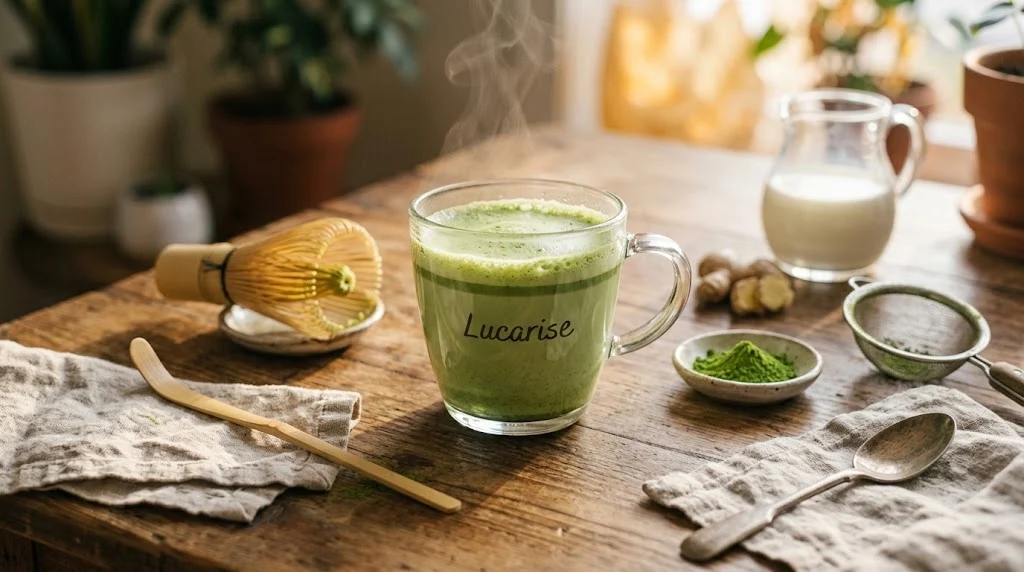
Quick answer: The best-supported benefit of matcha in humans is sharper attention for a short time, thanks to caffeine working together with L-theanine. Matcha is also very rich in antioxidants (catechins), and green tea research in general links it to small drops in LDL cholesterol and fasting blood sugar. Claims about “fat burning”, skin and hair are not backed by strong evidence. To get the most from it, drink one or two cups a day, between meals and without added sugar.
Search for “matcha benefits” and you will find long lists: fat burning, detox, glowing skin, a stronger immune system. Some of these come from real studies, many are borrowed from research on concentrated extracts or animals, and some have no evidence at all. In this guide we separate what the research actually supports from marketing, and answer the most common questions: matcha benefits for women, matcha with milk, drinking it on an empty stomach and how many cups a day are fine. If you are new to the drink, start with our guide: What is matcha?
Matcha benefits: what the science says
Focus, calm caffeine, antioxidants, heart health and blood sugar, and what the research does not show.
Why matcha is different from regular green tea
Matcha is green tea that is shaded for the last weeks before harvest, then ground whole into a fine powder. When you drink matcha you drink the leaf itself, not just an infusion as with a green tea bag. So one cup delivers more of the tea’s compounds, mainly:
- Catechins, especially EGCG, antioxidants from the polyphenol family.
- L-theanine, an amino acid found almost only in tea, which builds up in shade-grown leaves.
- Caffeine, about 19 to 44 mg per gram of matcha powder depending on the grade [1]. A latte made with 1 to 2 g usually has roughly 20 to 90 mg.

Matcha benefits: what the research supports
Most available research looks at green tea in general or its extracts. Studies on matcha itself are few and small, so for each benefit we also tell you how strong the evidence is.
1. Better attention for a short time
This benefit has the most direct evidence for matcha. In a 2017 study, 23 people had 4 g of matcha or a placebo. An hour later, matcha improved their scores on attention and reaction-speed tasks, while effects on memory were slight and mood did not change [2]. This fits with other trials in which L-theanine plus caffeine improved attention and task switching more than caffeine alone [3].
2. Calmer alertness than coffee for many people
Many people describe matcha as giving them “calm” alertness without the jitters. A Japanese study partly supports this: anxiety was lower in 39 participants who drank a theanine-rich matcha than in the comparison group [4]. But the researchers found the effect only when the ratio of caffeine to theanine was low, and many commercial matcha grades do not meet that ratio. So the result depends on the matcha, and it varies from person to person.
3. A rich source of antioxidants
Because you consume the whole leaf, matcha is one of the richest drinks in catechins. These compounds show strong antioxidant activity in the lab, but a 2021 review of matcha research stressed that most evidence comes from lab or animal studies and that larger human trials are needed before firm health claims can be made [1].
4. Cholesterol and blood pressure: a small effect
A Cochrane review of 11 trials of green and black tea lasting 3 to 6 months found that tea probably lowers LDL (“bad”) cholesterol and may lower blood pressure slightly, by about 2 to 3 mmHg [5]. These studies did not measure heart attacks or strokes and did not test matcha specifically, so this is a promising benefit, not a treatment.
5. Blood sugar: a small drop in fasting glucose
An analysis of 27 trials with more than 2,000 people found that green tea lowered fasting blood glucose by only about 1.4 mg/dL, with no clear effect on HbA1c or insulin [6]. That is a very small difference, and matcha is not a substitute for treatment or diet. If you have diabetes, talk to your doctor before making changes, and watch out for café matcha lattes, which can be high in sugar.
6. A lighter swap for sugary drinks
This may be the most practical benefit day to day. A cup of matcha with no added sugar instead of a soft drink or a sweetened coffee cuts the free sugar in your day, which is what the World Health Organization recommends [11]. The idea that matcha “burns fat”, however, is not supported: a Cochrane review found that green tea preparations led to a small weight loss that was not clinically important [7].
| Benefit | Strength of evidence | What it means for you |
|---|---|---|
| Focus and attention | Moderate (small human trials) | A short-term lift after a cup |
| Calm alertness | Limited, depends on the matcha | May suit people who get jittery on coffee |
| Antioxidants | Strong in the lab, limited in humans | Matcha is rich in catechins |
| Cholesterol and blood pressure | Moderate to low (tea in general) | A small effect over time |
| Fasting blood sugar | Moderate, very small effect | Not a treatment |
| Fat burning and weight loss | Weak | Do not rely on it to lose weight |
| Skin and hair | Not enough evidence for drinking it | Mostly a marketing claim |
Matcha benefits for women: what to know
There are no proven benefits of matcha that are specific to women; the benefits above apply to everyone. Claims about periods, PCOS or belly fat are not based on good studies. But three points matter for women in particular:
- Iron: tea polyphenols reduce the absorption of iron from plant foods. In a classic study, black tea drunk with a meal cut this iron absorption by 79 to 94% [8]. Matcha is also rich in polyphenols, so it is better to drink it between meals rather than with them, especially if you are low in iron.
- Pregnancy and breastfeeding: the European Food Safety Authority advises no more than 200 mg of caffeine a day from all sources during pregnancy and breastfeeding [9]. A matcha latte has roughly 20 to 90 mg, so count it along with coffee and tea, and check with your doctor.
- Concentrated supplements: the same authority considers catechins from tea drinks generally safe, but warned that EGCG doses of 800 mg a day or more from supplements may be linked to early signs of liver damage [10]. A cup of matcha is not a supplement, but avoid “matcha slimming pills” and concentrated green tea extracts.
Matcha with milk: does milk reduce the benefits?
A matcha latte is the most popular way to drink matcha in the Gulf, and milk adds protein and calcium and softens the taste. The biggest difference between a healthy cup and an unhealthy one is not the milk but the sugar: many café matcha lattes are sweetened with syrup. Choose milk with no added sugar, and sweeten with stevia or leave it unsweetened. You will find exact measurements in our guide on how to make a matcha latte, or a lighter version in sugar-free matcha latte.
How many cups of matcha a day?
For most healthy adults, one or two cups a day is a sensible amount. The European Food Safety Authority considers up to 400 mg of caffeine a day from all sources safe for healthy adults [9], so two cups of matcha still leave room for a coffee or tea. If you are sensitive to caffeine, or have trouble sleeping or palpitations, have less. For side effects in detail, read matcha side effects, and to compare caffeine with other drinks see our caffeine chart.
Best time to drink matcha: empty stomach or before bed?
- Morning or early afternoon: the best time to make use of the focus it gives.
- On an empty stomach: there is no proven extra benefit, and it can upset some people’s stomachs. If it does, have it an hour after breakfast.
- Before bed: not a good idea, because it contains caffeine and may affect your sleep if you drink it in the evening.
- Between meals: better than with food if you care about iron absorption.
Cardamom matcha latte, no added sugar
Lucarise Cardamom Matcha Latte blends real matcha with cardamom into a creamy latte that is ready in seconds with hot water or milk. The latte mix has no added sugar, and each 14 g sachet comes with a separate stevia sachet so you choose the sweetness yourself. If you prefer your matcha pure, try our 1 g ceremonial matcha sachets.
Keep reading
Matcha benefits: frequently asked questions
Is matcha good for you?
Yes, in moderation. It is rich in antioxidants, improves attention for a short time, and green tea research links it to a small drop in LDL cholesterol. Its benefits are modest, and its biggest advantage is replacing sugary drinks.
Does matcha burn fat or help you lose weight?
There is no strong evidence for that. A Cochrane review found that green tea preparations led to a small weight loss that was not clinically important. Any benefit for weight comes from swapping sweetened drinks for it.
What are the benefits of matcha for women?
No benefits specific to women have been proven. The general benefits apply, but drink it between meals because of iron, and keep caffeine under 200 mg a day during pregnancy and breastfeeding.
Can I drink matcha every day?
Yes, for most healthy adults, at one or two cups a day, keeping total caffeine from all sources under 400 mg.
Does matcha with milk lose its benefits?
A matcha latte is a good way to drink matcha, and the biggest difference in the cup is sugar, not milk. Choose milk with no added sugar and sweeten with stevia or leave it unsweetened.
Is matcha good for skin and hair?
There is not enough evidence that drinking matcha improves skin or hair. Most of what you read about this is marketing or comes from lab studies.
Is matcha better than coffee?
Not necessarily better, but different: it usually has less caffeine than a cup of filter coffee, plus L-theanine, which makes the alertness feel calmer for many people.
This article is for general information only and does not replace advice from your doctor, especially if you are pregnant, have a chronic condition or take medication.
Sources
- Kochman et al. Health Benefits and Chemical Composition of Matcha Green Tea: A Review. Molecules, 2021. doi.org
- Dietz et al. An intervention study on the effect of matcha tea, in drink and snack bar formats, on mood and cognitive performance. Food Research International, 2017. doi.org
- Owen et al. The combined effects of L-theanine and caffeine on cognitive performance and mood. Nutritional Neuroscience, 2008. doi.org
- Unno et al. Stress-Reducing Function of Matcha Green Tea in Animal Experiments and Clinical Trials. Nutrients, 2018. doi.org
- Hartley et al. Green and black tea for the primary prevention of cardiovascular disease. Cochrane Database of Systematic Reviews, 2013. doi.org
- Xu et al. Effects of green tea consumption on glycemic control: a systematic review and meta-analysis of randomized controlled trials. Nutrition & Metabolism, 2020. doi.org
- Jurgens et al. Green tea for weight loss and weight maintenance in overweight or obese adults. Cochrane Database of Systematic Reviews, 2012. doi.org
- Hurrell et al. Inhibition of non-haem iron absorption in man by polyphenolic-containing beverages. British Journal of Nutrition, 1999. doi.org
- European Food Safety Authority (EFSA). Caffeine. www.efsa.europa.eu
- European Food Safety Authority (EFSA). Scientific opinion on the safety of green tea catechins, 2018. www.efsa.europa.eu
- World Health Organization. WHO calls on countries to reduce sugars intake among adults and children, 2015. www.who.int


