
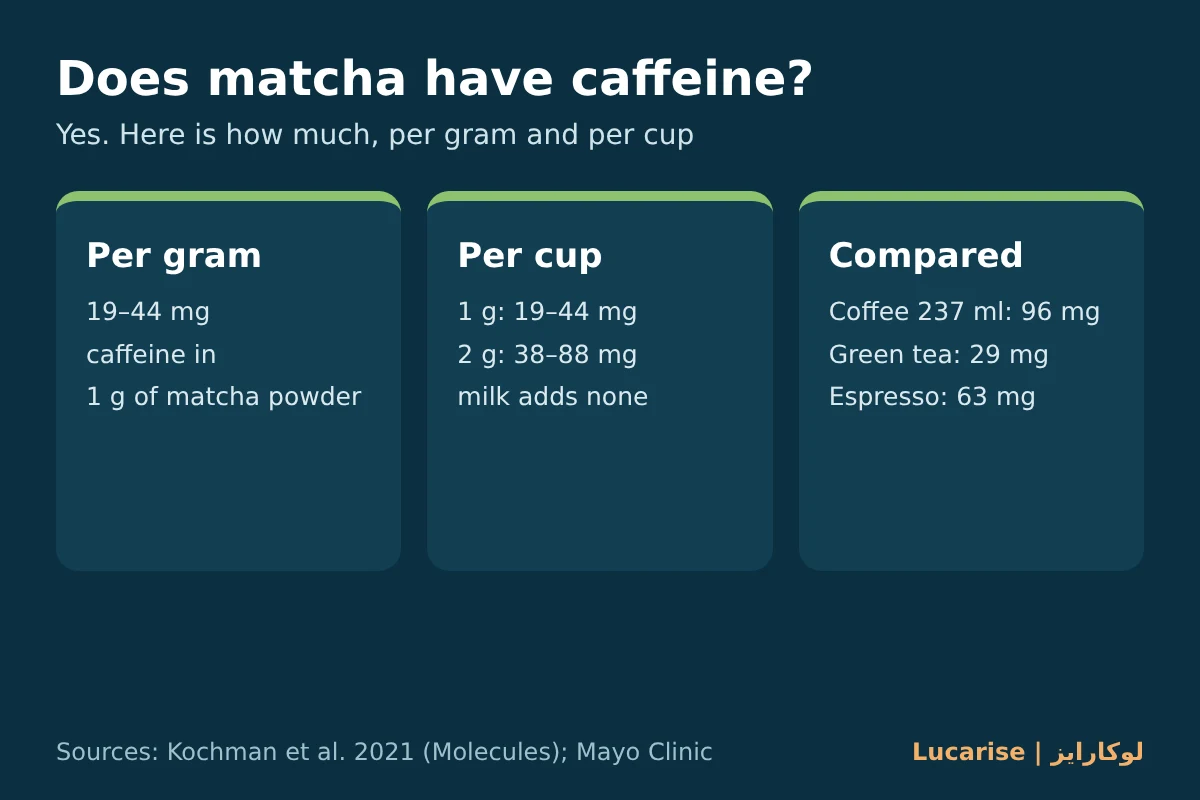
Quick answer: yes, matcha has caffeine. Matcha powder contains roughly 19–44 mg of caffeine per gram[2], so a cup made with 1 g has about 19–44 mg and a stronger cup with 2 g has about 38–88 mg. That is usually less than a 237 ml cup of brewed coffee (about 96 mg) and more than a cup of steeped green tea (about 29 mg)[1].
This article is part of the Lucarise complete matcha guide. Matcha is green tea, and all true tea contains caffeine. Below you will find how much caffeine is in matcha per gram and per cup, how it compares with coffee, karak and other teas, whether a matcha latte has caffeine, and when to have your last cup of the day.
Does matcha have caffeine?
Yes. Matcha is made from shade-grown green tea leaves that are ground into a fine powder. Caffeine is found naturally in the tea leaf, so every matcha contains it. There is no naturally caffeine-free matcha.
Matcha usually gives more caffeine per cup than ordinary green tea. With steeped green tea you throw the leaves away and drink only what dissolves into the water. With matcha you whisk the powder into the water and drink the whole leaf.
How much caffeine is in matcha?
A review of matcha research reports 18.9–44.4 mg of caffeine per gram of matcha powder[2]. The amount varies with the harvest, the age of the leaves, the tea variety and the grade. A higher grade is not automatically stronger, so treat these numbers as ranges.
| Matcha you use | Typical drink | Caffeine (approx.) |
|---|---|---|
| 1 g (about ½ teaspoon) | A light cup of matcha or a 1 g sachet | about 19–44 mg |
| 2 g (about 1 teaspoon) | A stronger cup, or a matcha latte with 2 g | about 38–88 mg |
| 3 g | A very strong cup | about 57–132 mg |
To find your own number, enter the grams you use in our matcha calculator.
Matcha vs coffee, karak and tea: caffeine per cup
| Drink | Serving | Caffeine (approx.) |
|---|---|---|
| Brewed coffee | 237 ml cup | 96 mg [1] |
| Matcha | 2 g powder | 38–88 mg [2] |
| Espresso | 30 ml shot | 63 mg [1] |
| Instant coffee | 237 ml cup | 62 mg [1] |
| Karak tea | 150 ml cup | about 40–80 mg (estimate for strong black tea) |
| Black tea | 237 ml cup | 48 mg [1] |
| Green tea, steeped | 237 ml cup | 29 mg [1] |
So a normal cup of matcha usually has less caffeine than a mug of filter coffee, but a strong 2 g cup can come close to it. For a fuller comparison of taste, energy and sugar, read matcha vs coffee, and see all drinks side by side in our caffeine chart.
Does a matcha latte have caffeine?
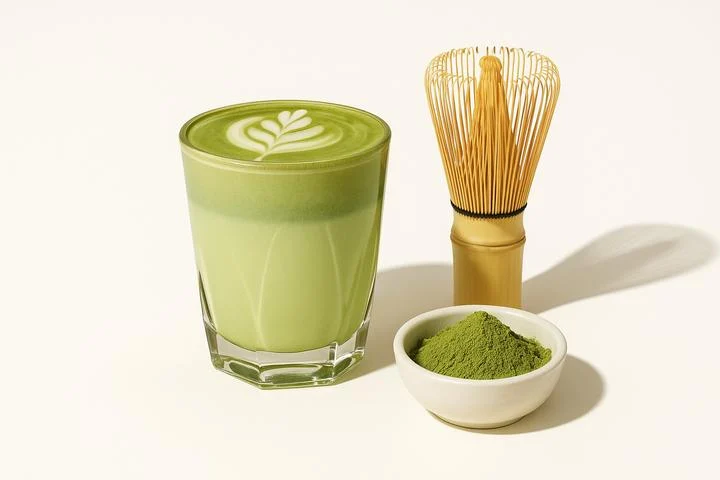
Yes. The caffeine in a matcha latte comes only from the matcha. Milk adds no caffeine. A latte made with 1–2 g of matcha has about the same caffeine as a cup of matcha made with the same amount, whether it is hot or iced. Café lattes sometimes use more powder, so a large cup can contain more.
What a café latte often adds is sugar. Read how much sugar is in café matcha lattes before you order a large flavoured one.
Matcha also contains L-theanine
Besides caffeine, matcha contains L-theanine, an amino acid found in tea leaves. The same review reports about 44.65 mg of L-theanine per gram of matcha powder[2]. Researchers are studying how L-theanine and caffeine work together, which is one reason people say matcha feels different from coffee. We explain what is known in matcha vs coffee.
How much matcha a day, if you count caffeine?
For healthy adults, EFSA considers up to 400 mg of caffeine a day safe, and up to 200 mg in a single dose. During pregnancy and breastfeeding, the limit is 200 mg a day[3]. Using the range above, 400 mg is about 4–10 cups made with 2 g each, but remember to count coffee, tea, karak and soft drinks too.
Add up your whole day with our caffeine calculator. If you are pregnant, take medication or are sensitive to caffeine, ask your doctor what is right for you.
Can you drink matcha at night?
Matcha in the evening can keep some people awake, just like coffee or tea. A simple rule is to have your last cup about 6 hours before bed. See the best time to drink matcha, or check how long caffeine stays in your body with the caffeine half-life calculator.
For a caffeine-free evening drink, try hibiscus tea, rooibos tea or date seed coffee. All three are naturally caffeine-free.
Lucarise matcha
Lucarise pure matcha comes in 1 g sachets, 2 g capsules and tins, so you always know how many grams you use. A 1 g sachet gives roughly 19–44 mg of caffeine, and a 2 g capsule about twice that. Our matcha latte sachets are sweetened with stevia, with no added sugar.
Run a café, restaurant or shop?
Lucarise makes café drinks in business packs in our own factory in Oman: 1 kg café bags, 100-sachet hotel boxes and distributor cartons. Prices on request.
Matcha caffeine: frequently asked questions
Does matcha have caffeine?
Yes. Matcha is green tea, and caffeine occurs naturally in the tea leaf. Matcha powder contains roughly 19–44 mg of caffeine per gram.
How much caffeine is in a cup of matcha?
A cup made with 1 g of matcha has about 19–44 mg of caffeine. A stronger cup with 2 g has about 38–88 mg.
Does matcha have more caffeine than coffee?
Usually not per cup. A 237 ml cup of brewed coffee has about 96 mg, while a 2 g cup of matcha has about 38–88 mg. A strong matcha can come close to a cup of coffee.
Does matcha have more caffeine than green tea?
Yes, usually. A 237 ml cup of steeped green tea has about 29 mg, because you drink only what dissolves from the leaves. With matcha you drink the whole leaf.
Does a matcha latte have caffeine?
Yes. The caffeine comes from the matcha powder. Milk adds none, so a latte with 1–2 g of matcha has about 19–88 mg.
Is there caffeine-free matcha?
No. All matcha is made from tea leaves and contains caffeine naturally. For a caffeine-free drink, choose hibiscus, rooibos or date seed coffee.
Can I drink matcha before bed?
It can affect sleep, like other caffeinated drinks. Have your last cup about 6 hours before bed.
Sources
- Mayo Clinic. Caffeine content for coffee, tea, soda and more.
- Kochman J, Jakubczyk K, Antoniewicz J, et al. (2021). Health benefits and chemical composition of matcha green tea: a review. Molecules 26(1):85. Reports 18.9–44.4 mg of caffeine per gram of matcha.
- EFSA Panel on Dietetic Products (2015). Scientific opinion on the safety of caffeine. doi:10.2903/j.efsa.2015.4102


