

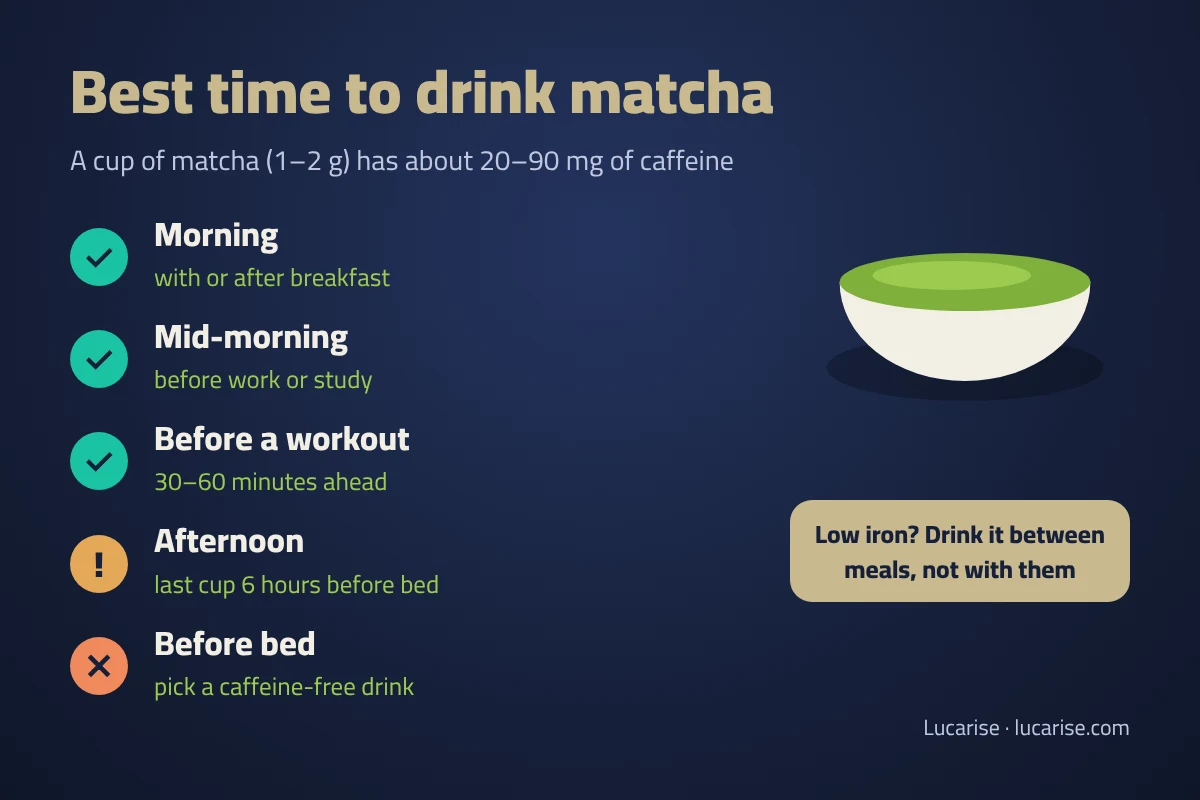
Quick answer: for most people the best time to drink matcha is in the morning or mid-morning, with or shortly after breakfast, or 30–60 minutes before a workout. Have your last cup about 6 hours before bed, and if your iron is low, drink it between meals rather than with them. A typical cup (1–2 g of powder) has about 20–90 mg of caffeine.
There is no single magic hour that suits everyone. Matcha is stone-ground green tea that you drink whole, so you get its caffeine together with an amino acid called L-theanine. The best time to drink it comes down to three questions: when do you need to focus, when do you sleep, and are you eating with it? This guide plans your day with matcha step by step, based on published research rather than marketing.
How much caffeine is in a cup of matcha?
Laboratory analyses of commercial matcha found roughly 19–44 mg of caffeine per gram of powder [1]. A usual cup uses 1–2 g, so about 20–90 mg, depending on the matcha and how much you use. For comparison, a cup of filter coffee has about 90 mg. Matcha also contains L-theanine and catechins (green tea polyphenols) [8], which is why timing matters for sleep and for iron absorption, as you will see below.
For the full comparison, read Matcha vs Coffee.
The best times to drink matcha during the day
| Time | Why it works | Practical tip |
|---|---|---|
| Morning, with or after breakfast | Calm energy to start the day; easier for people whose stomach dislikes tea before food | Whisk 1–2 g, or make a latte with milk for a gentler cup |
| Mid-morning (before work or study) | Caffeine plus L-theanine may slightly improve attention [2][3] | One cup is enough for most people |
| 30–60 minutes before a workout | A light caffeine lift before you move | The dose is far below the amounts studied in sports research [4] |
| Early afternoon | A lighter swap for a second coffee | Make it your last cup, about 6 hours before bed [5] |
| Between meals | Does not reduce iron absorption from your food [6] | Wait about an hour after eating |
| Evening and before bed | Not ideal: caffeine can delay and shorten sleep [5] | Choose a caffeine-free drink, such as a date latte or herbal tea |
Morning: with breakfast or on an empty stomach?
Morning is the most popular time for matcha: it gives you caffeine at the start of the day and leaves plenty of time before bed. There is no rule against drinking it on an empty stomach, but some people feel stomach discomfort when they drink green tea before eating. If that is you, have it with or shortly after breakfast, or make a matcha latte with milk.
Just remember that matcha drunk with an iron-rich meal (beans, spinach, fortified cereals) can reduce how much of that iron you absorb. If that matters to you, see the iron section below.

Before work or study: caffeine plus L-theanine
In a study with volunteers, 50 mg of caffeine with 100 mg of L-theanine improved accuracy on an attention-switching task and reduced tiredness compared with a placebo [2]. In another study on matcha itself, some attention and reaction-speed tests improved slightly [3]. The effect is real but small, so do not expect miracles. The best practical use: one cup mid-morning before a task that needs focus, rather than several cups in a row.
Before a workout: when and how much?
The International Society of Sports Nutrition says caffeine improves exercise performance at 3–6 mg per kilogram of body weight, usually taken about 60 minutes before exercise [4]. For a 70 kg person that is 210–420 mg, far more than a cup of matcha (20–90 mg). So matcha 30–60 minutes before training is a pleasant, light lift, but it is not a sports supplement. Drink water with it, and skip the sugar if fitness is your goal.
When to avoid matcha
Within about 6 hours of bedtime
In a trial published in 2013, people took 400 mg of caffeine right at bedtime, 3 hours before, or 6 hours before. Even at 6 hours, they lost more than an hour of sleep [5]. A cup of matcha has much less than 400 mg, but sensitivity to caffeine varies from person to person. The practical rule: have your last cup about 6 hours before bed. If you sleep at 11 pm, finish your last cup before 5 pm. So can matcha keep you up at night? Yes, if you drink it late.
With meals, if your iron is low
Polyphenol-rich drinks, including tea, reduce the absorption of non-haem iron (the iron in plants and grains) from the meal they are drunk with [6]. Matcha is rich in these compounds because you drink the whole leaf [8]. This does not matter for most people, but it does for people with low iron, vegetarians and pregnant women. The fix is simple: drink matcha between meals, about an hour after eating. If you have anaemia, ask your doctor.
During pregnancy and breastfeeding
The European Food Safety Authority considers up to 200 mg of caffeine a day safe for the unborn child during pregnancy and breastfeeding [7]. Count every source together: coffee, tea, karak, cola and energy drinks. One or two light cups of matcha usually keep you under that limit. See also matcha side effects and when to cut back.
Matcha in Ramadan: after iftar or at suhoor?
In Ramadan the whole schedule changes. The best time is usually one to two hours after iftar, early in the evening, not right before bed. At suhoor, only drink it if you will stay awake afterwards, for work or study for example. If you go back to sleep after suhoor, the caffeine may make your sleep lighter and shorter. And watch the sugar in Ramadan drinks: how much sugar is in Ramadan drinks?
How many cups of matcha a day?
For healthy adults, the European Food Safety Authority considers up to 400 mg of caffeine a day from all sources safe, and up to 200 mg in a single serving [7]. Since a cup of matcha has 20–90 mg, two or three cups a day is a moderate amount for most people, and even 4 strong cups (about 360 mg) stay under the limit if you have no other caffeine. Spread them over the morning and early afternoon, not the evening.
Lucarise matcha
For a quick cup in the morning or before a workout, try Lucarise matcha latte mix in single-serve sachets with no added sugar, or matcha powder to make it the traditional way (how to prepare matcha). For everything matcha, start with The Complete Matcha Guide.
🛒 Looking for pure matcha? Browse Lucarise matcha powder: unsweetened ceremonial matcha in 1 g sachets, tins and capsules.
Drinking matcha to lose weight? Read Matcha for Weight Loss: What the Research Says.
Run a café, restaurant or shop?
Lucarise makes café drinks in business packs in our own factory in Oman: 1 kg café bags, 100-sachet hotel boxes and distributor cartons. Prices on request.
Best time to drink matcha: FAQ
What is the best time to drink matcha?
For most people, morning or mid-morning, with or shortly after breakfast, or 30–60 minutes before a workout. Have your last cup about 6 hours before bed.
Can matcha keep you awake at night?
Yes, if you drink it late, because a cup has 20–90 mg of caffeine. In one study, caffeine taken 6 hours before bed cut sleep by more than an hour, so have your last cup about 6 hours before bedtime.
Can I drink matcha on an empty stomach?
Most people can, but some feel stomach discomfort. If that happens, drink it with or after breakfast, or make it a latte with milk.
Does matcha affect iron absorption?
Yes, if you drink it with a meal. Tea polyphenols reduce the absorption of non-haem iron from food. If your iron is low, drink matcha between meals, about an hour after eating.
How many cups of matcha can I drink a day?
Two or three cups is a moderate amount for most adults. The safe caffeine limit from all sources is 400 mg a day for adults and 200 mg for pregnant or breastfeeding women.
Is matcha good before a workout?
It can give a light lift if you drink it 30–60 minutes before exercise, but its caffeine is far below the doses that improved performance in studies (3–6 mg per kg).
Sources
- Koláčková T. et al. Matcha tea: analysis of nutritional composition, phenolics and antioxidant activity. Plant Foods for Human Nutrition, 2020. doi:10.1007/s11130-019-00777-z
- Owen G.N. et al. The combined effects of L-theanine and caffeine on cognitive performance and mood. Nutritional Neuroscience, 2008. doi:10.1179/147683008X301513
- Dietz C. et al. An intervention study on the effect of matcha tea, in drink and snack bar formats, on mood and cognitive performance. Food Research International, 2017. doi:10.1016/j.foodres.2017.05.002
- Guest N.S. et al. International Society of Sports Nutrition position stand: caffeine and exercise performance. JISSN, 2021. doi:10.1186/s12970-020-00383-4
- Drake C. et al. Caffeine effects on sleep taken 0, 3, or 6 hours before going to bed. Journal of Clinical Sleep Medicine, 2013. doi:10.5664/jcsm.3170
- Hurrell R.F. et al. Inhibition of non-haem iron absorption in man by polyphenolic-containing beverages. British Journal of Nutrition, 1999. doi:10.1017/S0007114599000537
- EFSA Panel on Dietetic Products, Nutrition and Allergies. Scientific opinion on the safety of caffeine. EFSA Journal, 2015. doi:10.2903/j.efsa.2015.4102
- Kochman J. et al. Health benefits and chemical composition of matcha green tea: a review. Molecules, 2021. doi:10.3390/molecules26010085


