

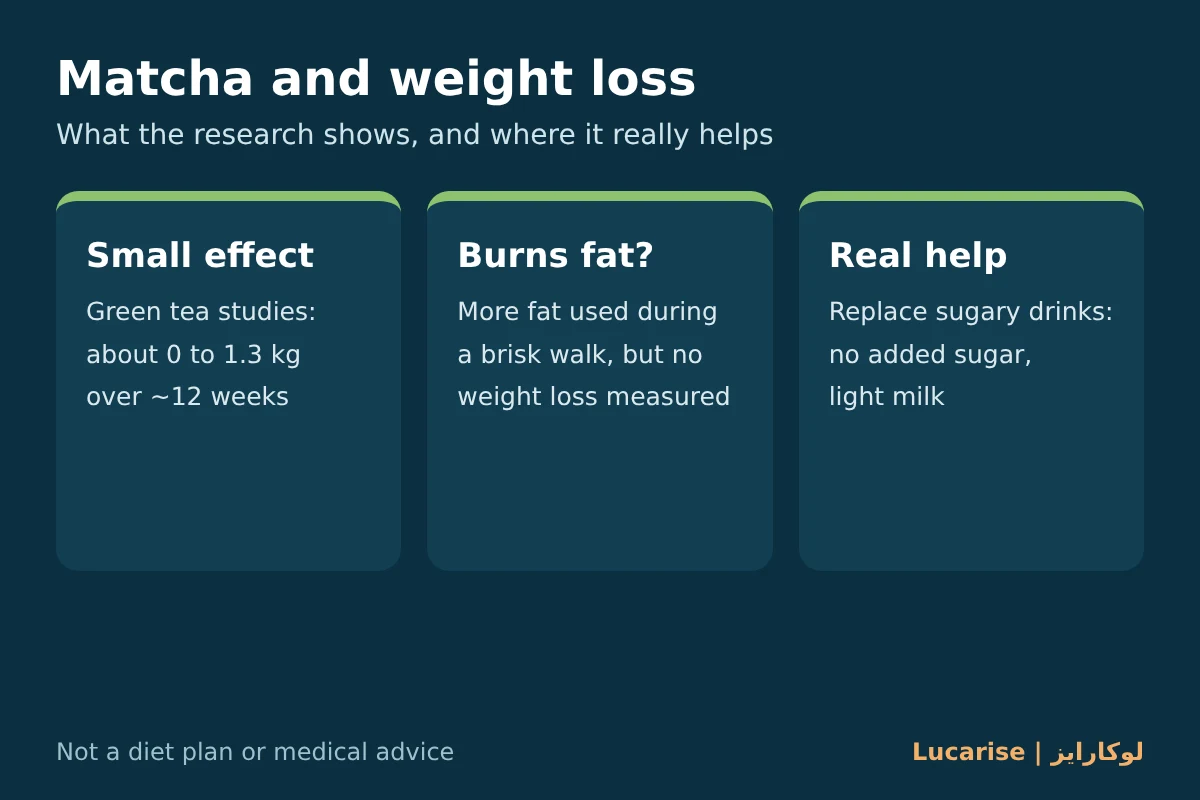
Quick answer: matcha on its own will not make you lose weight. Research on green tea and its extracts shows a very small effect: in a Cochrane review the difference in studies outside Japan was not significant (about 0.04 kg)[1], and another analysis found an average of about 1.3 kg over roughly 12 weeks[2]. Its real value on a diet is as a low-calorie drink that can replace sugary ones, as long as you drink it without added sugar.
“Matcha for weight loss” and “does matcha burn fat” are common searches, and social media is full of promises of quick results. This article sets out what the studies actually show, where matcha can help as part of a diet, and when it quietly turns into a high-calorie drink. It is part of the Complete Matcha Guide and is general information, not a diet plan or medical advice.
Does Matcha Help You Lose Weight? What the Research Says
Most studies used green tea or concentrated catechin extract, not cups of matcha itself. Matcha is ground green tea that you drink whole, so the findings are relevant, but they are not direct matcha weight-loss trials:
| Study | What it measured | Result | What it means for you |
|---|---|---|---|
| Cochrane review, 2012[1] | 15 weight-loss studies, 1,945 participants, 12–13 weeks | Outside Japan: about 0.04 kg, not significant. In Japan: 0.2 to 3.5 kg, results too varied to pool | A small effect that is unlikely to be clinically important |
| Hursel meta-analysis, 2009[2] | 11 studies of green tea catechins | About 1.3 kg on average; smaller in people who already had a lot of caffeine (0.27 kg vs 1.6 kg) | A small effect, and smaller if you already drink plenty of coffee |
| Willems matcha study, 2018[3] | 13 women: 3 matcha drinks (1 g each) the day before and 1 drink 2 hours before a 30-minute brisk walk | Fat use during the walk rose from 0.31 to 0.35 g per minute | The body burned more fat during the walk, but the study did not measure weight loss |
Bottom line: there is no strong evidence that matcha causes meaningful weight loss. The authors of the walking study themselves warned against overstating their result[3].
Why Do People Say Matcha “Burns Fat”?
Matcha contains caffeine (about 19–44 mg per gram[4]) and catechins, mainly EGCG. Researchers study this pair because it may slightly raise energy use and fat use during exercise. But the effects in trials are small, and most used concentrated capsules at doses above a normal cup of matcha. No drink burns fat from one specific area, such as the belly.
Where Matcha Actually Helps on a Diet: Calories and Sugar
Matcha made with water has very few calories. What you add to it decides the total. The figures below are rough estimates for one cup:
| Cup | Approximate calories |
|---|---|
| Matcha with water (1–2 g) | Very few |
| Matcha latte with 200 ml skimmed milk | About 70 |
| Matcha latte with 200 ml whole milk | About 125 |
| Each teaspoon of sugar (4 g) you add | About 16 more |
| Café matcha latte with syrup and cream | Can be over 200 |
The World Health Organization recommends keeping free sugars below 10% of daily energy, ideally below 5%, which is about 25 g (6 teaspoons)[7]. So the best thing matcha can do for your diet is replace a sweetened juice or a caramel iced coffee. See also: How much sugar is in a café matcha latte? and sugar-free matcha latte.

Best Time to Drink Matcha for Weight Loss
There is no magic time that makes matcha work for weight loss. These times make sense:
- 1–2 hours before a walk or workout: the timing used in the walking study[3].
- Morning or mid-morning: instead of a sweet drink.
- Not before bed: have your last cup about 6 hours before sleep, because poor sleep makes it harder to control eating.
- Between meals: if your iron levels are low.
More detail in Best Time to Drink Matcha.
How Many Cups of Matcha a Day?
EFSA considers up to 400 mg of caffeine a day from all sources safe for healthy adults, and up to 200 mg during pregnancy and breastfeeding[6]. A 1–2 g cup of matcha has about 20–90 mg, so one or two cups a day is a moderate amount. Drinking more will not increase weight loss, but it can cause poor sleep and jitters.
Be Careful With “Slimming” Capsules and Teas
Concentrated green tea extract in diet supplements is not the same as a cup of matcha. EFSA found that EGCG doses from supplements of 800 mg or more a day were linked to raised liver enzymes[5]. Avoid any product that promises rapid weight loss. More in Matcha Side Effects.
How to Use Matcha as Part of Your Diet
- Use it to replace a sweet drink, not on top of one.
- Drink it without added sugar, or sweeten it with stevia.
- Use skimmed milk or unsweetened plant milk if you count calories.
- Have it before a walk or workout instead of an energy drink.
- Do not rely on it alone: food, sleep and movement do the real work. For a personal plan, speak to a dietitian.
For what else matcha offers, read Matcha Benefits, or compare it with coffee in Matcha vs Coffee.
Lucarise Matcha
For a quick cup with no added sugar, try the Lucarise matcha latte mix in single sachets, or matcha powder to prepare with water.
🛒 Looking for pure matcha? Browse Lucarise matcha powder: unsweetened matcha in 1 g sachets, tins and capsules.
Run a café, restaurant or shop?
Lucarise makes café drinks in business packs in our own factory in Oman: 1 kg café bags, 100-sachet hotel boxes and distributor cartons. Prices on request.
Matcha for Weight Loss: FAQ
Does matcha reduce belly fat?
No. No drink burns fat from one specific area, and research on green tea shows only a small effect on weight overall. Food, movement and sleep together decide belly fat.
Does matcha burn fat?
Caffeine and catechins may slightly increase fat use during exercise, as in a brisk-walking study. That does not mean noticeable weight loss, and the effect in weight studies is small.
How many cups of matcha a day for weight loss?
No amount causes weight loss. One or two cups a day (1–2 g each) is moderate; drinking more adds caffeine, not weight loss.
Is a matcha latte good for a diet?
Yes, if it has no added sugar and uses skimmed or unsweetened plant milk, at about 70 calories. A café matcha latte with syrup can be over 200 calories.
Does drinking matcha on an empty stomach help weight loss?
There is no evidence that it works better on an empty stomach. It can upset some people’s stomachs, so after breakfast is fine.
Is matcha better than coffee for weight loss?
Both contain caffeine and are very low in calories without additions. The real difference is the sugar, milk and cream you add to the cup.
Sources
- Jurgens T.M. et al. Green tea for weight loss and weight maintenance in overweight or obese adults. Cochrane Database of Systematic Reviews, 2012. doi:10.1002/14651858.CD008650.pub2
- Hursel R., Viechtbauer W., Westerterp-Plantenga M.S. The effects of green tea on weight loss and weight maintenance: a meta-analysis. International Journal of Obesity, 2009. doi:10.1038/ijo.2009.135
- Willems M.E.T. et al. Matcha green tea drinks enhance fat oxidation during brisk walking in females. International Journal of Sport Nutrition and Exercise Metabolism, 2018. doi:10.1123/ijsnem.2017-0237
- Koláčková T. et al. Matcha tea: analysis of nutritional composition, phenolics and antioxidant activity. Plant Foods for Human Nutrition, 2020. doi:10.1007/s11130-019-00777-z
- EFSA Panel on Food Additives and Nutrient Sources. Scientific opinion on the safety of green tea catechins. EFSA Journal, 2018. doi:10.2903/j.efsa.2018.5239
- EFSA Panel on Dietetic Products, Nutrition and Allergies. Scientific opinion on the safety of caffeine. EFSA Journal, 2015. doi:10.2903/j.efsa.2015.4102
- World Health Organization. Guideline: sugars intake for adults and children, 2015.


